The Godfather, based on a novel by Mario Puzo and directed by Francis Ford Coppola, was a landmark film in Hollywood’s history. For those not familiar with The Godfather, it is about turf wars between the migrant Italian Mafia families in the US that made New York their base. A scene in the movie shows the funeral of Vito Corleone, the head of the Corleone family. The scene is set in the cemetery where the Corleone family members gather for the burial of the don. His younger son, Michael, is seen sitting on a chair and the family counsel, Tom Hagen, is standing behind him. When members of other Mafia families reach the cemetery to pay their last respects to the departed soul, Hagen whispers to Michael details about each entrant, and he nods in acknowledgement.
The Godfather, which bagged three Oscars and seven other nominations, continues to be one of the best commercial movies made in Hollywood at a time modern gimmicks like digital movie-making technology and digital effects were unheard of. What suddenly brought the film back to mind are some real-life scenes one saw on Tuesday as Jayaraman Jayalalithaa lay in state at the Rajaji Hall in Chennai.
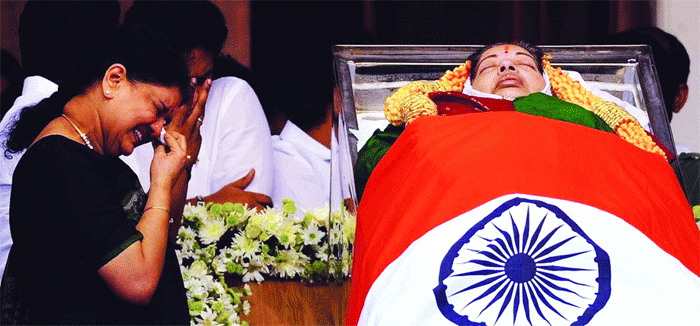
Amma’s confidante, Sasikala Natarajan, stood near her body looking like an arrogant Mafia boss. She was staring at all those who came to pay their last respects to Jayalalithaa. One of the male members of the family was seen whispering to Sasikala the details of the visitors and she nodded at some as a sign of acknowledgement. She was seen sobbing when Prime Minister Narendra Modi turned towards her and expressed his condolences.
The funeral sent out the signal that Sasikala and her close family members have taken over the AIADMK and the State administration. While a grief-stricken Chief Minister O Panneerselvam and his council of ministers preferred to sit on the steps of the Victorian building, members of the Mannargudi Mafia — as Sasikala and her family members are known in Tamil Nadu, as they hail from the town of Mannargudi in Tiruvarur district — sat in a line on chairs and were seen giving the CM scornful looks.
Natarajan, described as Sasikala’s non-resident husband (as Jayalalithaa had declared him persona non grata in Veda Nilayam, her palatial house in Poes Garden), had managed to sneak into the corridors of power when the former CM was admitted to the Apollo Hospital on September 22. l Ganesan, the BJP MP, was seen introducing Natarajan, a known sympathiser of lTTE, to the Prime Minister. It remains a mystery how Natarajan, a security risk, managed to infiltrate into the inner circle, outsmarting the CM and his Cabinet colleagues.
The AIADMK, which Jayalalithaa headed, is not a cadre-based party. It was an off-shoot of the DMK, formed by former Chief Minister MG Ramachandran when he was ousted from the DMK by party president Muthuvel Karunanidhi in 1972. The reasonIJ MGR had questioned Karunanidhi about how the party funds were being spent. Karunanidhi, whose passion for films, heroines, and power knew no bounds, had wanted to anoint Muthu, his son by first wife Padmavathy, as his successor and was grooming him for the important job. The only stumbling block in the elevation of Muthu was MGR, known all over Tamil Nadu for his charisma and pro-poor image. But Karunanidhi’s dreams were shattered as Muthu went haywire, imploding himself both in politics and cinema.
MGR formed the AIADMK upon his ouster from the parent party and the rest is history. People wanted a change as most of them knew that for Karunanidhi, the family was more important than the party. Remember, he had three “official” wives in Chennai itself.
Karunanidhi never imagined that MGR would unseat him from power as it was difficult to form a political party and sustain it with life and energy. But he had underestimated MGR, who was equally or more “competent” than Karunanidhi in wooing women. A former actress confided to this writer about how Makkal Thilakam (star of the people, as MGR was addressed by fans) once told her not to pursue a career in acting. “I was asked
to be his lover. He promised to pay me Rs 1,00,000 per month and also give me a sprawling bungalow near Chennai. But I was adamant that I would never be a concubine,” said the actress, who now works as a dubbing professional. This was Makkal Thilakam of Tamil Nadu!
The real character of MGR has been portrayed by Cho Ramaswamy — who died on Wednesday morning — in the 1974 movie, Thanga Pathakkam (Gold Medal), starring Sivaji Ganesan. But people had faith in MGR, which made him float the present-day AIADMK, an outfit sans any ideology. While the Dravidian party honchos were pronounced rationalists and were against all kinds of superstition, MGR was a firm believer of God and consulted astrologers.
Personal charisma won over ideology and political theories. In the 1977 elections held to the Tamil Nadu Assembly, MGR won with ease and was sworn in as Chief Minister. He launched many pro-poor programmes, including free noon meal to all school students in the State. From 1977 till his death in December 1987, MGR strode across the political landscape of Tamil Nadu like a colossus.
Karunanidhi, his wives, and their families were in political wilderness in this decade. Though MGR had married twice, he did not have any children. When he died in 1987, some of the senior members of the party, such as RM Veerappan and KP Ramalingam, joined hands and elevated Janaki, MGR’s widow, as the Chief Minister. MGR had a soft spot for Jayalalithaa, who was the leading actress of Tamil films during the 1960s and 1970s. He used to call her “Ammu” and made her join the AIADMK in the hope that the party could benefit from her glamorous image. She was soon appointed as the propaganda secretary and member of the Rajya Sabha. Jayalalithaa did not disappoint MGR and the AIADMK cadre.
But following the demise of MGR, the cartel consisting of Janaki, Veerappan, and Ramalingam eased Jayalalithaa out and the party split. Both factions were mauled by the Karunanidhi-led DMK in the 1989 election. Janaki was quick to see the writing on the wall, patched up with Jayalalithaa, and retired from politics. There was breakdown of law and order in Tamil Nadu as the lTTE cadre had a free run, so the Chandra Shekhar-led Union Government dismissed the Karunanidhi Government under Section 352 of the Constitution and imposed President’s rule in the State.
By the time elections were declared in 1991, Jayalalithaa had formed an alliance with the Congress. The AIADMK-Congress alliance swept the 1991 elections, and Jayalalithaa was sworn in as the Chief Minister.
Jayalalithaa came across Sasikala in the early 1980s when the latter owned a video library in the Poes Garden area. What started as Sasikala’s trips to Veda Nilayam to give Jayalalithaa video cassettes of old Hindi and Tamil films ended with her becoming a permanent resident of the house. Sasikala emerged as Jayalalithaa’s caretaker and companion. Jayalalithaa was a spinster and had lost her parents at a relatively young age. She was not on good terms with her brother, Jayakumar. Sasikala and her close family members saw this as an opportunity and became Jayalalithaa’s sole relatives.
Over the months, they became Jayalalithaa’s eyes and ears. Senior and trusted leaders of the AIADMK were eased out by members of the Mannargudi Mafia, which excelled in the art of mixing politics and business. That’s why the Karunanidhi Government was able to file several corruption cases against Jayalalithaa, Sasikala, and others. It is another thing that the clan came out of all the cases, except one, like a gymnast performing mind boggling acrobatics.
As Jayalalithaa was buried next to her mentor MGR at Marina Beach on Tuesday evening, the Mannargudi Mafia emerged as the most powerful group in the party. It is reported that Sasikala wanted the Governor to swear-in either her or someone nominated by her as the Chief Minister.
But by that time, all 135 MlAs belonging to the party had submitted letters declaring their support to Panneerselvam as the leader of the legislature party.
Sasikala’s body language and the way she glared at Panneerselvam when Jayalalithaa’s body was
kept in Rajaji Hall sent the message that all is not well in the AIADMK, hitherto known as a party of the servile. “Jayalalithaa commanded total loyalty from all leaders and the cadre. They were afraid of her though they were her staunch devotees. It is impossible for Panneerselvam or for that matter anybody to get that kind of respect and adoration,” said N Kalyanasundaram, Tamil Nadu’s political historian.
But he was quick to point out that Panneerselvam has an advantage of being handpicked by Jayalalithaa. “When she had to quit as Chief Minister in 2001 as well as in 2014 following court convictions, she had entrusted the CM’s chair to Panneerselvam. He did not disappoint the leader,” said Kalyanasundaram.
In the present Tamil Nadu legislative Assembly, which has an effective strength of 234 members, the AIADMK has 135 MlAs, while the DMK and its allies have a strength of 98. If the DMK manages to get the support of 20 AIADMK MlAs, the Panneerselvam Government would be in trouble. Discussions and negotiations are already on between various camps to destabilise the Government. The death of Jayalalithaa has made the situation fluid and there is no guarantee that the Panneerselvam Government would complete its term despite the reasonable majority enjoyed by the party in the Assembly.
“The post-Jayalalithaa scenario has left the AIADMK vulnerable. While Panneerselvam had been Jayalalithaa’s choice as a stopgap arrangement, it is tough to expect him to have the same hold over the party that she did. The seniors in the party, who had taken a back seat, are likely to return,” said Balasubramaniam Jayashree, a former journalist, who has kept track of the AIADMK and Jayalalithaa for years.
She also pointed out that the vulnerability of the AIADMK has become a threat to the stability the two-party system had experienced in Tamil Nadu. “The AIADMK is open to poaching by the DMK. MK Stalin, the DMK leader and the Chief Minister aspirant, is impatient and is out to consolidate and strengthen his hand before a possible shake-up within his own party,” added Jayashree.
Kalyan, another keen observer of the AIADMK, pointed out that it is the 8 to 9 per cent neutral voters in Tamil Nadu who decide the winners in each election. “The AIADMK has 10 per cent more loyalists than the DMK. The DMK is trying to weaken the strong base of the AIADMK, while the latter is resisting it,” he said. He added that though Sasikala has a major say in the party affairs, the crucial question is how far she would measure up in the minds of the party cadre and neutral voters.
An important factor people have forgotten is that Sasikala and her clan were ousted from Veda Nilayam in 2012, immediately after Jayalalithaa returned to power. She had issued a directive to the party cadre not to have any dealings with Sasikala or her relatives. But once the trial of the disproportionate wealth case commenced in the Bangalore Special Court, the Mannargudi gang stealthily returned to Jayalalithaa’s house. Jayalalithaa, Sasikala, Elavarasi (Sasikala’s niece), and Sudhakaran (Sasikala’s nephew, who was once the foster son of Jaya) are the accused in the case.
At that time, it was heard that the dreaded and hated family was brought back to ensure it would not spill the beans or accuse Jayalalithaa during the trial. The Sasikala family and the Karunanidhi clan allegedly institutionalised corruption in Tamil Nadu. More than the suitability of bureaucrats and vice-chancellors for jobs, they are said to have made “suitcase-ability” the pre-requirement for plum postings. During the DMK regime, a vice-chancellor’s post apparently cost `7 crore. “The same fetches more than `10 crore now,” said an AIADMK insider.
The DMK and AIADMK are in the sunset phase. M Karunanidhi, who will turn 94 next year, is hoping against hope that he would be able to equal or break the record of Fidel Castro, who headed the Communist Party in Cuba for 50 years. Karunanidhi, who became the DMK president in 1969, needs three more years to surpass Castro’s feat.
Jayalalithaa was the only factor that sustained the AIADMK as a party for the past three decades. The reality is that there is no one in the party — as of now — who can match her charisma and stature.
As the Military Police sounded the last Post and the casket containing Jayalalithaa’s body was being lowered into the 8ftx4ft pit in Marina Beach, a widely respected AIADMK leader told this writer: “Now the game is on. A game for the total control of the party. The fact is that Sasikala has not been readmitted to the AIADMK after she was ousted in 2011. How can she claim the leadership of the party in which she is not even a primary memberIJ”
All these point to an unpalatable truth. It is going to be a long-drawn-out period of churning in Tamil Nadu. The AIADMK is in for disintegration. The day is not far when we will have an AIADMK (Jayalalithaa), AIADMK (Sasikala), AIADMK (MGR) etc. Who is going to benefit from this turmoilIJ Not the BJP. There is no need for the central BJP leaders to worry about the party’s Tamil Nadu unit.
One has started hearing the bells tolling at the DMK headquarters on Mount Road in Chennai. With both major parties facing a crisis of leadership, Tamil Nadu is in for a period of chaos, confusion, commotion, and cacophony hitherto unheard and unseen in the State.
The writer is The Pioneer’s Special Correspondent for Tamil Nadu