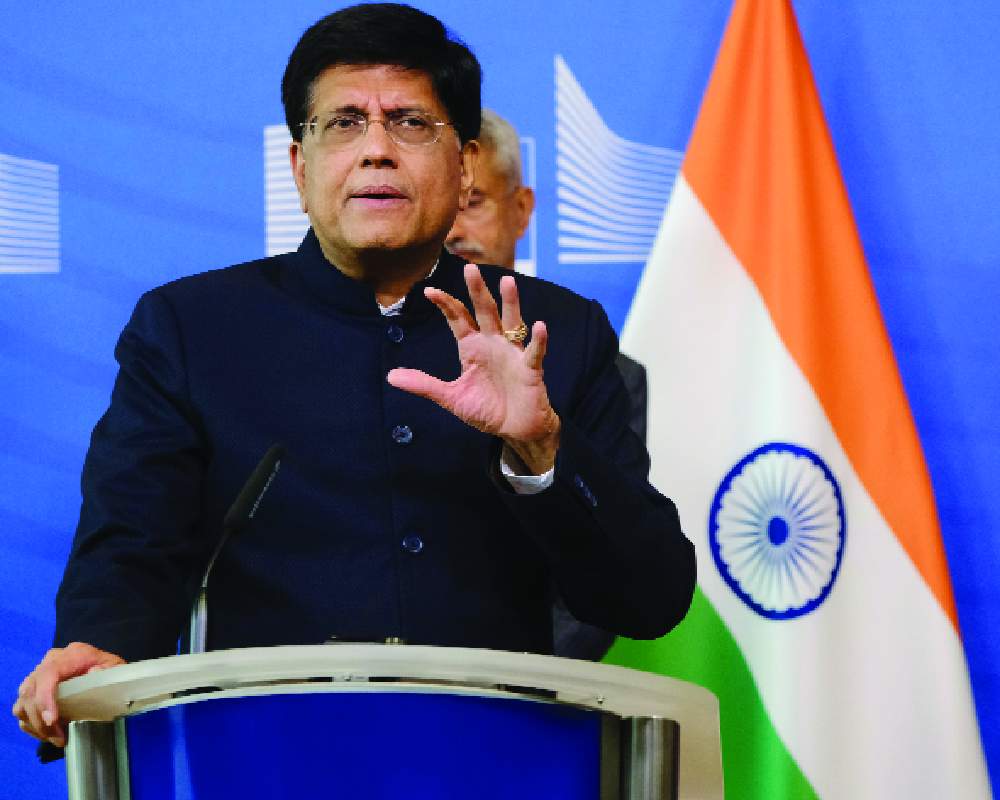
India’s commerce and industry minister, Piyush Goyal, met the US trade representative, Jamieson Greer, in Washington. Experts contend that the meeting will accelerate the bilateral trade talks, and yield a much-needed breakthrough. Those who are in know confide that a deal is already on the table. “India has agreed to many of the US’ demands, and so has the latter to the former’s concerns. It is now a matter of finalising the import duties on a few more-sensitive American products,” says one of them. This explains why Goyal earlier hinted that a pact would be in place by November this year. The deal may be announced in late-November or early December.
November or December will be perfect timing to announce it. By then, the crucial festive season of Dussehra-Diwali, and other festivals will be done. America will get ready for the Christmas-New year celebrations, and its buying season. Indian consumers, enthused and excited by GST cuts, will finish their immediate shopping, vacations and entertainment. They will be in a good mood, with praises for the Government, which took a bold step on GST. American consumers will feel happy that when New Delhi cuts tariffs, Washington will do the same, and Indian imports (medicines and others) will become cheaper. More importantly, the local price slashes due to lower GST tax rates will set the tariff cat among the tax pigeons. For, they will logically set the tempo and momentum for similar cuts in import duties. This is because generally local taxes on specific products and import duties on them move in tandem.
The reasoning is reasonable. If domestic tariffs are cut, local prices fall, which gives undue advantages to local manufacturers vis-à-vis imports, if the duties on them remain high. In such a scenario, the landed prices of imports are higher than local goods. Hence, it is inevitable to correct the situation, and correspondingly reduce the import duties. Except, of course, in cases where the Government has deliberately kept the import tariffs high to offer protection to local producers. Now, think carefully, and understand slowly. As GST across products and categories are down, import duties across the same need to be cut similarly. The stage is set for the India-US deal.
Under the bilateral pact, which is going through finishing touches, New Delhi will accede to Washington’s demand to cut tariffs on American manufactured products. This is a long-standing demand of the US. In cases, the entry barrier may be zero, while others will attract 5-20 per cent. Indian policy-makers can explain this to the Indian industry. They had no option given that GST rates are down, mostly zero or five per cent, and they had to offer the same rates, five and zero per cent, to the Americans. There will be no need to justify this to the Indian consumers, who will be mightily pleased that both local and imported products will be cheaper.
Once New Delhi accepts lower entry tariff barriers for American goods, the only issue it will need to contend with will relate to agriculture and dairy products. In these categories, it will put its foot down, and contend that the politics of the central regime is at stake. It cannot move backwards on these two fronts, since they will alienate the electorate, and anger vote banks. Washington, as an interim measure, is more likely to agree, if it sees open, easy and cheaper entry for hundreds of its manufactured products. It will send a huge message within the US electoral constituents. The US president Donald Trump has repeatedly maintained that he would ‘Make America Great Again’ by boosting its manufacturing. Access to a large market like India is like putting the best foot forward.
Where does this leave the oft-repeated slogans such as self-reliance, buy-Indian-shun-foreign, chip-to-ship and Atma-Nirbhar? There will be ready and impressive answers. If India reduces the tariffs for American goods, the US will reciprocate, and lower the existing 50 per cent tariff to maybe 20 per cent, or less. This will allow the Government to claim that now Indians can ship more goods to the US. This will boost local manufacturing, and help woo foreign investments. In the case of India-China trade, while the deficit remains lopsided against India, a new era will attract Chinese investments to set up large self-reliant plants locally. Both will provide a fresh fillip to ‘Make in India,’ which is one of the foundations of a future self-reliant Bharat. It is time to remove those irritating chips on the shoulders, especially in the short run.