Forget basic manufacturing, let go of conventional sectors, and no point in thinking about energy and mining. As the present is tense with trade, economic, and geopolitical disruptions, large businesses and nations seek to ring-fence futures. While India wants to become a traditional global manufacturer through ‘Make in India,’ Europe, Japan, China, South Korea, and Taiwan wish to use FDI (Foreign Direct Investment) to target ‘future-shaping industries.’ The latter hope to target sectors that will reshape the global economy.
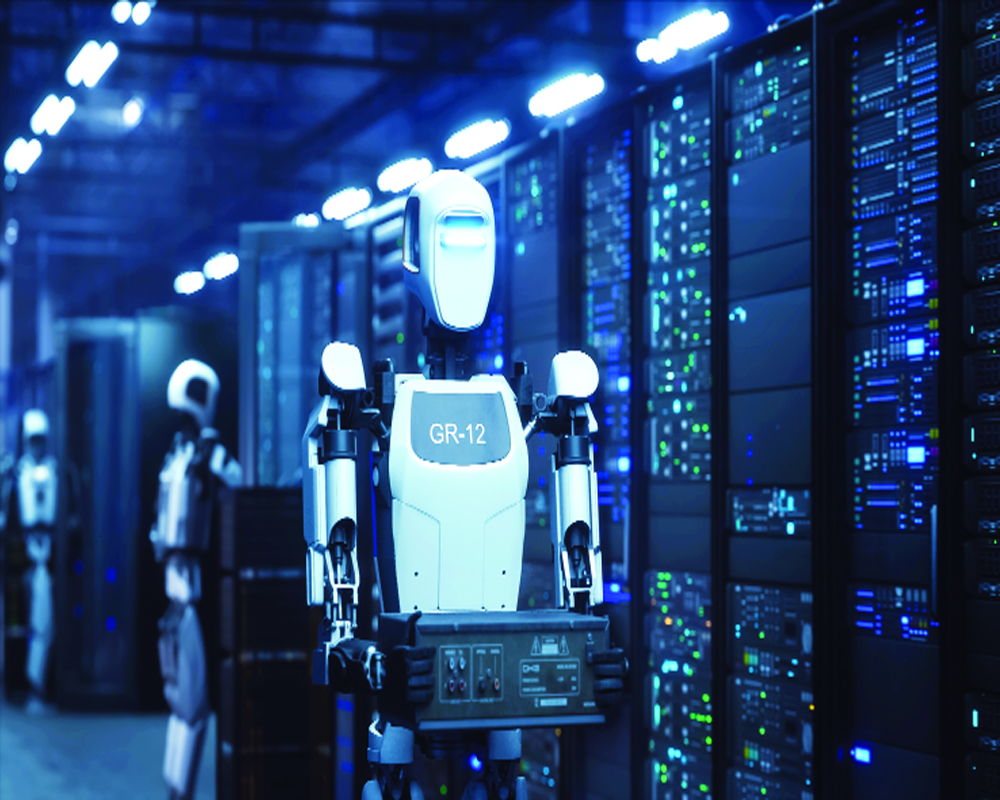
Data centres that power Artificial Intelligence (AI), semiconductor fabrication facilities, electric vehicles, advanced manufacturing (robots), and battery-making are on the radar of those who hope to push the business borders, and enter new geographies. According to a recent McKinsey study, an analysis of 2,00,000 FDI projects, which were announced from 2015 till May 2025, shows the way the FDI winds are blowing, or easing, across sectors. The annual average of the greenfield FDI quantum was up from $1.14 trillion in 2015-19 pre-Covid period to $1.4 trillion in the 2022-25 post-Covid one.
However, while 28 per cent of the money in greenfield (new) ventures was targeted towards future-shaping industries, i.e. advanced manufacturing, and communications and software (AI), in 2015-19, the figure jumped to 38 per cent in 2022-25. The percentage envisaged for conventional industries (basic manufacturing, and operational and professional services) was down from 45 per cent to 24 per cent as a comparison between the two periods. There was a bump in energy (green) from 23 per cent to 31 per cent.
It is true that India has grand plans to forge ahead of the rest of the world in green energy (electric vehicles and battery-making), as well as semiconductors and data centres. But the primary focus is to build the plants in India, and become the global suppliers, after attaining viability and momentum through local sales. There is nothing wrong in the strategy, as the US too hopes to do the same. In comparison, the other global manufacturers in Europe and Asia wish to go out, and plant their high-tech business flags elsewhere.
One can think of dozens, maybe hundreds, of reasons why India cannot emulate America, at least not for another two decades or three. But there are three unique traits about future-shaping sectors that will limit India’s expansion and endeavour. First, they are the ones where the winner-takes-most of the revenues, profits, and global market shares. Second, they are highly advanced in technology terms. Finally, they require huge capital. In the three aspects, the US tech and other giants are way ahead of the Indian firms.
As a nation, America has a better ecosystem. As the recent past proves, it is eager to host innovative and established MNCs in its bid to ‘Make America Great Again.’ More importantly, the US can, and does, deploy “powerful carrots and sticks” to woo and force mega inflows of foreign and domestic investments into the country. As some of the bilateral trade deals indicate, America has forced Japan, European Union, and others to promise mega investments in local plants, largely in hi-tech and future-looking segments.
The McKinsey study is clear that the 2022-25 FDI plans are not uniform. Large expectations about AI have “accelerated cross-border investment in communications and software. Data centres, a key piece of infrastructure needed for AI, have accounted for 85 per cent of announced greenfield FDI in this sector… or about $170 billion annually,” states the report. If current trends continue, data centres will account for $370 billion in 2025. Of the quarter of the FDI earmarked for advanced manufacturing, a third is for semiconductor fabs, and another third for electric vehicles and batteries.
McKinsey expects that most plans will fructify. Announcements may not imply commitments, and potential projects may be derailed, and delayed. “Still, past studies have found that FDI announcements reliably predicted capacity creation on the ground, with realisation rates between 60 per cent and 80 per cent. Our analysis finds that, since 2022, more than half of the largest announced projects in future-shaping industries are under construction or already-operational,” states the study. This gives a new meaning to projects that are being announced due to America’s pressures.
Despite a slowdown in overall FDI plans in 2025, thanks to ongoing uncertainties, and firms waiting for clarity, future-shaping industries are on a high. FDI commitments in these areas reached $840 billion, compared to an annual average of $490 billion (2022-24), or an increase of more than 70 per cent. This was “driven entirely by increases in data centres globally and in semiconductor fabs, particularly in the United States,” states the report. Past records may hint that Trumpism is working. But given the arm-twisting, some of the US-specific plans are likely to get derailed, rather than delayed.
What is crucial is that while the current global hubs in segments may remain intact, they will lose their importance. FDI may create new hubs in the rest of the world. According to McKinsey, new FDI-driven data centres outside the US and China, current hubs, may be nearly twice the 2022 capacity. Battery capacity outside China, an existing hub, can be four times higher. Leading-edge semiconductor fabs outside of South Korea and Taiwan may be five times more. This may augur well for India if it shifts from basic manufacturing, and focuses more on the sectors of the future.
In advanced Asian nations, if one looks at geographical trends, FDI outflows may be three times higher than inflows. Thus, nations like Taiwan, and South Korea, which were predominantly the attractors of foreign money, will aggressively invest abroad. For Europe, excluding inter-regional flows, outflows and inflows will almost balance out. The US, which was once the most important source of FDI for most nations, will attract inflows that may be two-and-a-half times to three times higher than outflows. China and Hong Kong together may witness negative inflows, and positive outflows. By 2030, FDI-driven projects may “account for a majority of total capacity growth outside core hubs.”
For India, the lessons are clear. Unlike the traditional wisdom, i.e., to seek money from the US, Europe, and Japan, it needs to look eastwards towards China, South Korea, and Taiwan. The latter three will be the largest drivers of FDI in the future and, hence, the main candidates to woo and attract. The current trend to enhance India-China economic friendship needs to be concretised and cemented for the next couple of decades. This implies that New Delhi needs to show urgency to sort out the border issues with Beijing.