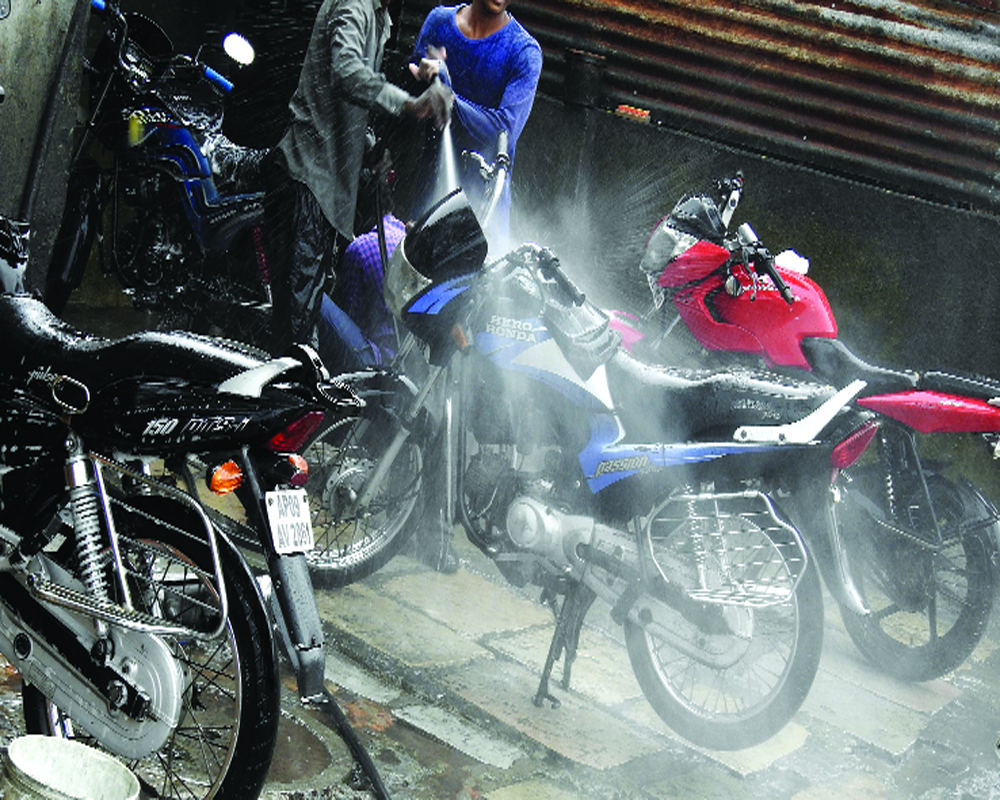
About two weeks ago, before the impact of GST 2.0 was felt in the markets during Navratri, and the time when the social media platforms were in a frenzy over expected price cuts, this columnist singled out a product category that would prove to be the acid test. Its sales would establish the success of Narendra Modi’s regime in incentivising consumer spends by lowering GST rates, and reducing slabs. The product was the more-humble two-wheeler.
The argument was that the purchases of motorcycles and scooters, more than the cars and SUVs, represented the real purchasing power, and actual buying intent, of a vast majority of the so-called middle-class Indians. While the SUVs grab headlines, and hog social conversations, the smaller and cheaper two-wheeler drives the country’s GDP and growth. The latter is the product revered and revved by the aspiration-led consumer. On average, annual two-wheeler sales are five times that of passenger cars.
Go by this columnist’s metric, and let us gauge the success of GST 2.0 in reviving sentiments, and propelling purchases. Some may argue, and rightly so, that just over a week (Navratri started on September 22, which was when the new rates kicked in) is too short a time to measure success or failure. But the two-wheeler sales in September 2025, which includes the Navratri period, do indicate a significant uptick in a change in sentiments, and purchasing intent.
Look at the numbers. Hero Motorcorp, the leader of the pack, sold 6,72,220 units, up six per cent compared to the same month last year. With 5,68164 units, the number two player, Honda, clocked a similar growth. TVS Motors grew by a higher 11 per cent, with sales of 5,23,923 units, and Bajaj Auto clocked eight per cent growth with 4,30,853 units. There was a surprise joker in the pack, albeit a smaller one. Royal Enfield of the Bullet model fame sold 1,24,328 units, a massive growth of 43 per cent during the month.
More importantly, the increase in sales coincided with changes in consumer sentiments. For example, C Voter conducts regular surveys to track such emotions and behaviour. Since 2021, two-thirds of Indians stated that they find it either ‘very difficult’ or ‘difficult’ to manage the family and household budgets. However, a survey by the same agency a week after the launch of GST 2.0 revealed that the percentage was down by 10 per cent, from 66 per cent to 56 per cent.
In simpler words, consumers now feel more confident and optimistic. This is surely the effect of GST because in the July and August surveys, a higher proportion of respondents said that they expected the financial situations to be worse in the next one year. The latest poll reverses this mindset. Most interesting is the recent finding that rural consumers are more confident and optimistic than their urban counterparts. The Reserve Bank of India’s recent bi-monthly consumer confidence survey reaffirms C Voter’s findings.
Therefore, while one cannot establish a clear cause-and effect between the surveys and two-wheeler sales, there is a correlation. The fact remains that there is a smart reversal of trend, or at least it seems so. If it continues, this year (2025-26) may witness record sales of two-wheelers. Remember, in the recent past, the record is 21.5 million units that were sold in the pre-Covid 2017-18. Maybe this year will break the seven-year itch that plagues the segment.
What is surprising, though, is that the sales of cars and SUVs, which were predicted to take off after GST 2.0, were quite dismal. Although footfalls to the showrooms zoomed, and so did the bookings, monthly sales wavered between manufacturers. The leader, Maruti Suzuki, saw a drop in domestic sales in September 2025 compared to the same month last year. The saviour proved to be exports, which jumped by more than 50 per cent, although a small base. On an overall basis, the monthly vehicle dispatches were a tad higher.
Hyundai, another major carmaker, witnessed a small growth in September, but Mahindra and Mahindra and Tata Motors saw healthy upticks. Tata Motors’ domestic sales grew by 45 per cent, riding on Navratri period. Mahindra’s growth in the domestic market was a more sober 10 per cent. One can zoom in on several factors for the difference between two and four wheels. A major reason is that cars, unlike two-wheelers, have a larger waiting period, and need to be stocked. Thus, most showrooms carried the older and higher price tags, and had to give massive discounts out of their pockets.
Second, the prices of bigger cars went up, as they were sunk into the highest sin tax GST category. Most consumers now prefer to buy the larger cars, compared to the entry-level and mid-level ones. Hence, there was little enthusiasm to line up for the more expensive cars, whose price tags had gone up. Maybe the potential buyers decided to wait till Diwali, rather than purchase their vehicles before Dussehra. Maybe, they will wait for the hectic wedding season in December.
But this story is not just about vehicles. As more data begins to pour in, there will either be more confirmation of a revival in consumer buying, or an indication that Navratri excitement was merely a blip. According to the findings of the latest post-Navratri C Voter survey, 37 per cent of the respondents said that they would either ‘definitely,’ or ‘maybe’ purchase a vehicle in the next three months. In the previous surveys, the number was usually at about 25 per cent.
The two-wheeler story is possibly being replicated in other segments. Anecdotal evidence suggests that the sales of budget smartphones, which are purchased by aspirational Indians, and which had initially cratered and stagnated since 2021, picked up momentum in this festive season. According to the finance ministry, consumer spending during Navratri was the highest in the past 10 years. The extent of the increase may be 10-20 per cent. This may hint at a release of the pent-up and curbed demand, which may not be sustainable.
Private consumption expenditure accounts for nearly 60 per cent of the GDP of India. The bulk of this comes from the aspirational Indians, although the purchasing power of the upper middle class and rich is much higher. In value terms, the larger assets matter. But the volumes count, which crop up in the two-wheeler numbers. The more fascinating sector to watch will be real estate. If the sales of budget houses, as opposed to villas, boom, GST 2.0 will be a grand success, an open-and-shut case, no questions asked.
The author has worked for leading media houses, authored two books, and is now Executive Director, C Voter Foundation