Uttarakhand became a separate state on November 9, 2000 after years of public demand for governance suited to mountain life. People wanted schools, hospitals and markets closer to remote valleys. They wanted decisions shaped by local voices, terrain and culture rather than by models designed for the plains.
Twenty-five years later, the state has built its own institutions and identity. Yet the core demands that fuelled the statehood movement remain partly unmet. Distance, fragility and uneven development still define life in much of the hills.
Population and Mobility
Uttarakhand has about 11.6 million people, roughly 0.8 per cent of India’s population. It records about 1 per cent annual growth, close to the national average. The population density — 213 people per sq km — seems comfortable, but it hides the lived reality of fragile terrain, forest cover and scattered settlements. Large parts of the state comprise mountains, glaciers, steep slopes and river valleys. People cluster in the plains and larger towns; many hill villages have only a few households. This means a child seeking schooling, a patient seeking medical care, or a farmer seeking a market may travel long distances. “Normal” density does not translate into easy or equal access.
Literacy in 2011 was 78.82 per cent. Male literacy was 87.40 per cent, female literacy 70.01 per cent. The gender gap remains wide and shapes long-term access to opportunity. A recent projection puts the sex ratio at 886 women per 1,000 men, well below the national average. This reflects deeper concerns about social norms, unequal access and migration patterns. Migration, in fact, is one of Uttarakhand’s most persistent realities. Young people and families move out for education, work and healthcare. “Ghost villages” in remote hills continue to haunt policymakers. As people leave, remote areas lose not only numbers but energy and aspiration. The plains and urban centres draw talent and resources; the hills watch communities shrink.
Economy and the Fragile Mountain
Uttarakhand’s economy has expanded over two decades. About 47.4 per cent of workers depend on agriculture, forestry and fishing; 31.4 per cent work in services; and 20.3 per cent in industry and construction. Exports reached `13,239 crore in FY25 (till February), and FDI from 2019-24 totalled `1,691 crore. The nominal per-capita income is about 40 per cent higher than India’s average.
But progress is uneven. Most industrial activity is concentrated in the plains — in Dehradun, Haridwar and Udham Singh Nagar — where the land is flat, connectivity is smooth and markets are accessible. Remote hill districts remain marginal to investment and job creation. Capital continues to concentrate where terrain is easy and infrastructure predictable.
High-altitude and remote districts still receive very little investment. This gap is evident in agriculture. The sector employs almost half the workforce, yet incomes remain low. Farms are small in size, irrigation facilities are scarce, and market access is weak. More labour does not necessarily lead to higher income.
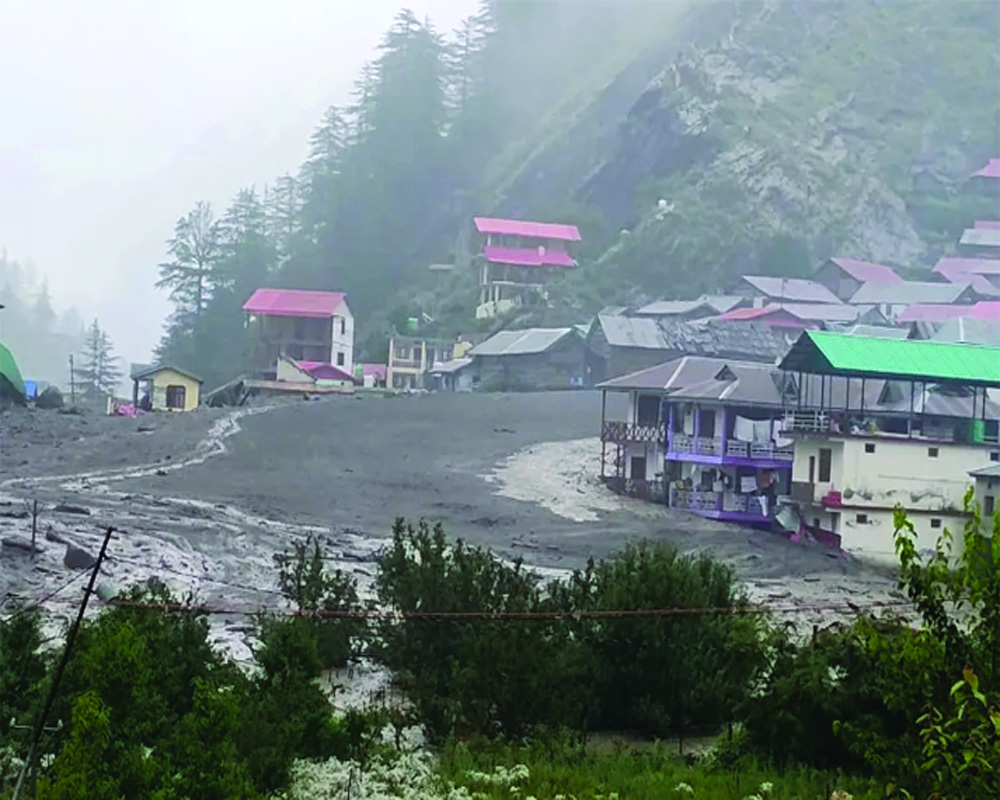
The mountain environment provides vital resources — water, forests, medicinal plants and tourism — but also faces landslides, flash floods and glacial events that disrupt life and limit growth. Despite 13.6 per cent growth in FY25, environmental fragility continues to constrain development. Nearly half the workforce remains in farming, forestry and fishing, while only a fifth works in manufacturing and construction. Industry struggles in scattered terrain, and private investment between 2019 and 2024 — about `1,691 crore — remains low. Roads, hydropower and tourism projects have improved access but often lie on fragile slopes or near key water sources, increasing the risk of landslides. Economic expansion frequently carries an ecological cost.
Public service delivery in higher districts demands more time and money. Schools and clinics take longer to build. Staff must be willing to serve in distant areas. Electricity lines and utilities must travel farther. Even short road stretches can take years to complete. Policies designed for flat, dense regions do not meet the needs of scattered mountain settlements.
Investment and services thrive in accessible districts such as Haridwar and Udham Singh Nagar. Remote hill districts see fewer jobs. Many young people migrate in search of work and education. Over time, these areas lose both population and capacity. This reflects a centre-periphery pattern: places with good roads and markets grow, while remote areas fall behind.
Uttarakhand has gained economic momentum, but its mountain districts still bear the burden of distance, environmental risk and uneven state presence. A more grounded development approach must recognise these constraints if growth is to be shared more evenly. Future policy must address these structural limitations rather than apply models designed for the plains. Only then can growth translate into meaningful inclusion across the highlands. Sustainable development in such terrain demands tailored policy frameworks that recognise altitude, fragmentation, ecological fragility and dispersed settlement — rather than simply replicating plains-based models.
Governance: Capacity and Delivery
Statehood promised governance that recognised mountain life. Uttarakhand has made measurable gains on paper. Fiscal rules maintain discipline; the deficit is capped at 3 per cent of GSDP for 2023-26. National reviews place the state among the better performers in public finance. Yet institutional strength at the top has not fully translated into delivery on the ground. In remote places, many trips are delayed or cancelled because transport is unreliable. Broadband connectivity is irregular. Schools and colleges are sparse beyond district towns.
A centre-periphery pattern is evident. The plains act as the centre of services and authority. The hills remain peripheral — marked by higher costs, slower delivery and a weaker institutional presence. Panchayats carry local knowledge but lack budgets and trained staff. Rules often assume flat land, dense settlement and stable weather conditions common to plains but not to mountains. Effective governance must account for altitude, seasonality, scattered villages and disaster risk.
Beyond the Silver Jubilee
Uttarakhand now needs a second phase of development. The mountains are not one uniform space. The high Himalayas, mid-hills and plains each face different realities. Planning must reflect these distinctions. Travel takes longer, and services cost more. Livelihoods are intimately tied to altitude and season. Policy must recognise these layers.
Young people should have real choices at home. Local crops, herbs and forests can anchor value chains. Digital work hubs can reduce migration. Tourism must support small enterprises rooted in local culture. When skills grow locally, communities thrive. Roads, power projects and hotels should be planned with safety in mind. More construction should not mean more risk. Sometimes, restraint signifies progress. Uttarakhand’s silver jubilee is a turning point. A mountain state should build in ways that protect its people, culture and land.
The writer is the Head of the Department of History and Civilisation at Gautam Buddha University, Noida. She specialises in South Asian history and international relations, with a focus on the Himalayan borderlands; views are personal