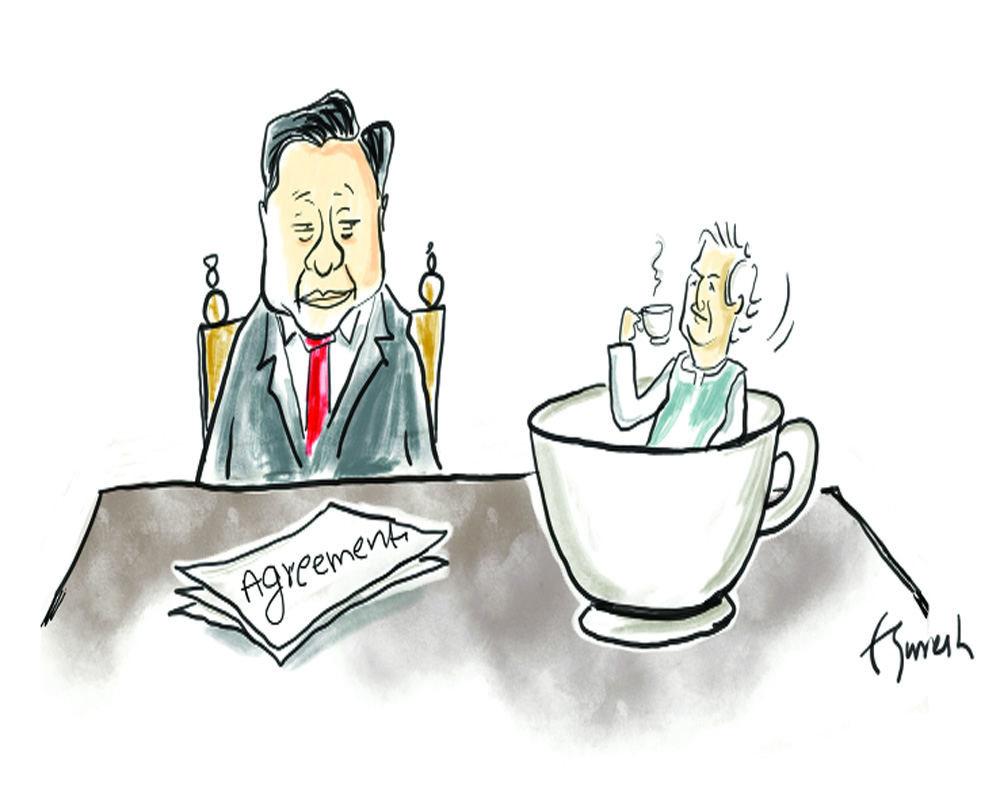
Coupled with new agreements like the Mongla Port expansion, Yunus’ China visit signals a deeper geopolitical realignment that threatens to reshape regional dynamics and compromise India’s core security interests
Bangladesh’s recent diplomatic overtures, particularly the four-day first state visit of its interim government head, Mohammad Yunus to China, from March 26 to March 29, 2025, have raised significant concerns in New Delhi. His provocative statements about India’s northeastern region, coupled with the agreements signed during the visit, have far-reaching strategic implications.
“We are the ‘only’ guardian of the ocean in the region,†Yunus declared, attempting to strategically downplay India’s maritime role and challenge its pivotal position in the region. These kinds of statements from top Bangladeshi authorities should not be taken at face value but analysed more seriously, as they reveal deeper, ill-intended motives toward India. Moreover, he added, “The seven states of India, the eastern part of India, are called the Seven Sisters. They are a landlocked region of India. They have no way to reach out to the ocean. So this opens up a huge possibility. This could be an extension of the Chinese economy.†This provocative statement by Yunus, while sitting in China, has deep strategic connotations. By referring to India’s northeast and, in the same breath, suggesting that this “opens up a huge possibility for the extension of the Chinese economy,†Yunus was, in effect, strategically inviting Beijing and signalling an increasing willingness to facilitate an expanded Chinese strategic presence in a region of immense sensitivity and importance to India. Such remarks reflect a dangerous mindset, as they hint at Bangladesh’s willingness to collaborate with China in a manner that could compromise India’s national security in the region.
The timing and nature of these statements indicate that Dhaka is not only seeking investment but also indirectly highlighting India’s “strategic vulnerabilities†in the northeast to China. The references to India’s northeastern states as “landlocked,†combined with the implicit invitation to China, appear to be an indirect encouragement for Beijing to expand its influence in Bangladesh as part of its broader strategic game plan against India. By revealing his intentions to bring Beijing closer to India’s critical geopolitical chokepoint-the Siliguri Corridor, a narrow stretch approximately 60 km long and 22 km wide that connects mainland India to its northeast-Yunus implies that India’s geopolitical weaknesses could be exploited.
Moreover, this “strategic gameplan†aligns with Beijing’s long-term geostrategic objectives of encircling and squeezing India by strengthening its footprint in South Asia and the Indian Ocean region. Beijing is engaged in a geostrategic and geopolitical rivalry with India, claiming several parts of Indian territory and challenging India’s sovereignty and territorial integrity. Bangladesh openly welcoming China into India’s strategic backyard sends a troubling signal to New Delhi.
Furthermore, during this visit, Yunus signed an agreement with China for the modernisation and expansion of Mongla Port. Beijing pledged $400 million for this project, aiming to enhance the port’s infrastructure and increase its capacity. This development will limit New Delhi’s strategic space and allow greater Chinese strategic penetration into the Bay of Bengal region. China was already conducting extensive surveillance and other activities against India through its presence there. If this agreement materialises, it will further expand China’s presence and pose a greater threat to India’s security interests in the region.
Bangladesh’s actions do not demonstrate a commitment to regional stability. Bangladeshi authorities are consistently pursuing an anti-India agenda through their provocative rhetoric and actions. Moreover, they accuse India of propaganda, exaggerating events, and spoiling bilateral relationships. However, they act as if they have no agency and fail to acknowledge their role and responsibility in escalating tensions. The release of anti-India elements from jail, the persecution of minorities, and the rewriting of history to diminish India’s role in Bangladesh’s liberation further highlight this stance. Their double standard is evident in how Bangladesh continues to take actions that threaten India’s security interests in the region.
Moreover, a standard narrative in Bangladesh accuses India of favouring the Awami League government, particularly Sheikh Hasina. However, this overlooks the fact that she was the elected leader of Bangladesh, chosen by the Bangladeshi people to represent them. As a result, following diplomatic traditions, New Delhi had to engage with her government, as it does with any ruling administration of any country in the world. It would have been inappropriate for New Delhi to engage directly with opposition parties there, as this could have been perceived as interference in Bangladesh’s internal affairs.
At the same time, such engagement would have strained India’s relations with Hasina’s government, as she might have viewed it as an attempt to undermine her government. Moreover, India has played a crucial role in Bangladesh’s development, contributing significantly to infrastructure, power, energy, and various other sectors, demonstrating a broad engagement. Furthermore, India’s engagement with Hasina was motivated by pragmatic national security considerations rather than favouritism. For example, during her term, she limited the strategic foothold of China and Pakistan in the region, kept anti-India elements in check, and did not provide sanctuaries to insurgent groups seeking to destabilise India’s northeast. In contrast, when the BNP was in power, insurgency and infiltration into India’s northeast were common.
Bangladesh’s current leadership must recognise that while India has no issues with its partnerships with other countries, as is its right, however, doing so at the expense of India’s security interests will undoubtedly raise concerns in New Delhi. While India respects Bangladesh’s right to have engagements with multiple countries, recent agreements with Beijing, such as those on the Mongla Port and the Teesta River Comprehensive Management and Restoration Project — made without considering India’s larger interests and potential security implications — are particularly worrisome. Bangladesh must also recognise China’s well-documented ‘debt-trap diplomacy,’ which has already ensnared countries like Sri Lanka and Pakistan.
Through its grand geostrategic Belt and Road Initiative (BRI) dual-use infrastructure projects, it has gained control over the strategic assets of many countries such as Sri Lanka’s Hambantota Port and Pakistan’s Gwadar Port. Bangladesh risks falling into a similar trap by allowing China to deepen its economic and strategic presence.
India has long been a key partner in Bangladesh’s development, but Dhaka’s recent actions signal a departure from this cooperation. Yunus’ remarks not only misrepresent India’s geographical realities but also indicate a willingness to allow China to exploit India’s strategic vulnerabilities.
Bangladesh must recognise that its national interests are best served by maintaining balanced relations with its neighbours rather than aligning with a power that has clear expansionist designs in the region. India, on its part, must recalibrate its approach to ensure that its security interests remain uncompromised while continuing to engage Bangladesh diplomatically.
(The writer is an Associate Research Fellow at the International Centre for Peace Studies (ICPS), New Delhi. He specialises in India–US relations, Indo–Pacific studies, and South Asian security issues. Views are personal)