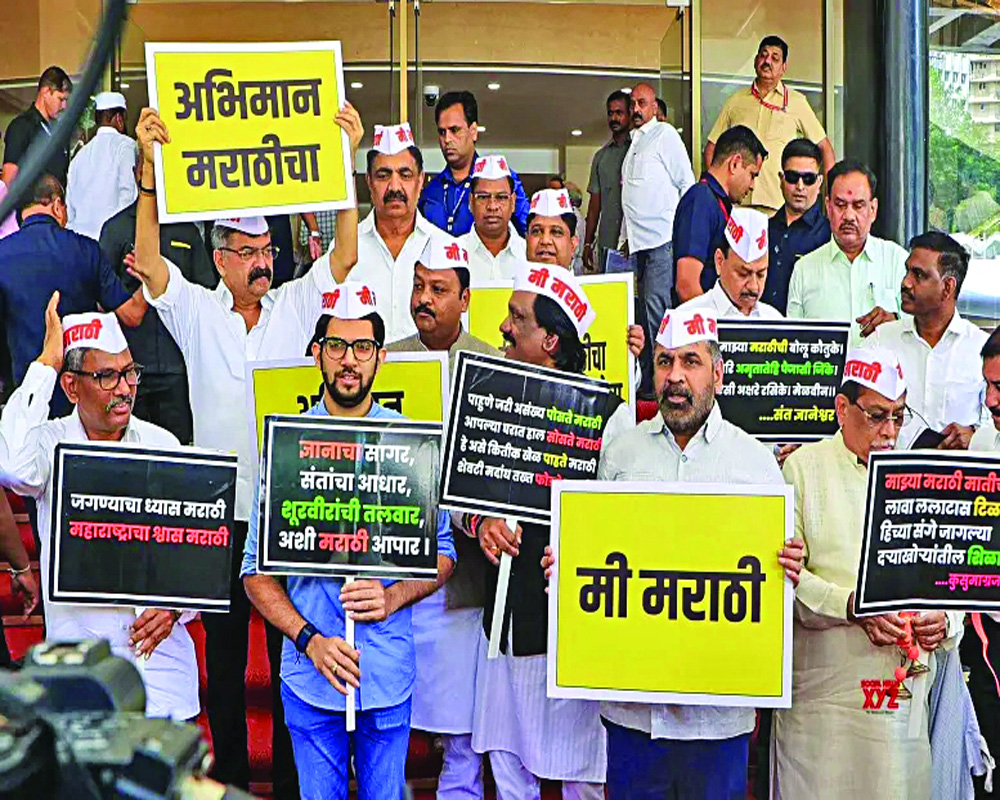
As elections near, Maharashtra’s politics increasingly weaponises language, with migrant workers bearing the brunt of a narrative that contradicts India’s constitutional ethos
The politics of language has long been a contentious issue in India, often manipulated by vested interests to stoke regional sentiments for electoral gains and political self-aggrandisement. In Maharashtra — a state whose very name derives from the Hindi word rashtra (nation) — linguistic divisions are being weaponised to fuel social unrest, especially as elections approach. The recent spate of violent incidents targeting Hindi-speaking migrant workers, who are integral to the state’s economic fabric, has cast a shadow over Maharashtra’s image as a progressive and inclusive hub.
These attacks, often carried out by fringe elements associated with parties like Raj Thackeray’s Maharashtra Navnirman Sena (MNS) and Uddhav Thackeray’s Shiv Sena (UBT), expose a troubling surge of linguistic chauvinism — one that undermines the country’s cherished motto of “unity in diversity” and threatens India’s global image, especially as it champions the vision of One Earth, One Family, One Future. Home to Mumbai — India’s financial capital — and Pune, a major industrial hub, Maharashtra owes much of its economic prowess to migrant labour. These workers, many of whom come from Hindi-speaking states such as Uttar Pradesh, Bihar, and Jharkhand, are the backbone of key sectors including construction, manufacturing, and services. Estimates suggest that migrant workers contribute nearly 10 per cent to India’s GDP, with a substantial share stemming from their labour in Maharashtra. Yet, these very individuals — who toil to build the state’s infrastructure and fuel its growth — are increasingly being targeted for their lack of fluency in Marathi. These incidents, often orchestrated for political mileage, have provoked national outrage. What is more alarming is the apparent inaction by law enforcement agencies, which seems to have emboldened such elements further. This lack of accountability not only shields the perpetrators but also risks denting India’s image as a progressive, inclusive nation — particularly when the country is actively branding itself as Viksit Bharat. With the Brihanmumbai Municipal Corporation (BMC) elections on the horizon, linguistic agitations have taken centre stage in Maharashtra’s political discourse. Parties like the MNS and Shiv Sena (UBT), desperate to reclaim relevance in the state’s shifting political terrain, appear to be resorting to divisive tactics to rally their voter base. By targeting Hindi-speaking workers, they aim to inflame regional pride and position themselves as protectors of the Marathi Manus (Marathi people). Yet this brand of politics reeks of opportunism and stands in stark contradiction to the inclusive ethos that has long defined Maharashtra. The Italian philosopher Niccolò Machiavelli’s assertion that “politics has no relation to morals” seems particularly apt. These political actors relentlessly target vulnerable migrant workers while remaining conspicuously silent about high-profile figures — Bollywood celebrities, corporate tycoons, and politicians — who have built their careers and fortunes in Maharashtra despite lacking proficiency in Marathi.
Historical Ties, Shared Heritage
The narrative of linguistic exclusivity promoted by certain political groups sits uneasily with Maharashtra’s rich historical and cultural legacy. Icons of Marathi pride — Chhatrapati Shivaji Maharaj and his son Chhatrapati Sambhaji Maharaj — embodied an inclusive spirit that transcended linguistic barriers. Historical accounts record that Hindi-speaking communities played a critical role in aiding Shivaji’s daring escape from Mughal custody in 1666. A priest from Kashi, in a Hindi-speaking region, conducted his coronation in 1674, bestowing upon him the title of Chhatrapati. Sambhaji, celebrated for his valour, was also a scholar of Hindi, credited with authoring three significant literary works in the language — Saatshtak, Nakshikha, and Nayikabhed. His court welcomed Hindi poets such as Kavi Kalash, a trusted confidant and advisor. These historical instances reaffirm the deep cultural and linguistic bonds between Marathi and Hindi-speaking communities —a legacy of coexistence starkly at odds with today’s divisive rhetoric. Prominent pre-independence Maharashtrian leaders like Lokmanya Tilak, Gopal Krishna Gokhale, and Kaka Kalelkar recognised Hindi’s potential as a unifying force in India’s diverse linguistic landscape. They advocated Hindi as a link language, capable of bridging regional divides without eroding local identities. Many Marathi poets, authors, and journalists have also enriched Hindi literature, further underscoring the shared linguistic heritage between the two languages, which share nearly 80 per cent of their vocabulary.
Hindi as a Link Language
India’s linguistic diversity is both its strength and its complexity. With 22 officially recognised languages, 121 spoken by over 10,000 people, and more than 19,500 recorded mother tongues, communication across regions remains a formidable challenge. In this context, Hindi has emerged as a vital bridge, facilitating socio-economic integration and national cohesion. Political scientist Baldev Raj Nayar, in his seminal work Hindi as a Link Language, argued that Hindi’s structural affinity with other Indian languages and its expansive cultural reach make it uniquely positioned to foster national unity. Unlike regional languages tied to specific identities, Hindi operates as a neutral conduit for dialogue, supporting communication without threatening local linguistic vibrancy. This insight is particularly relevant for Maharashtra, where diversity has historically been a source of strength — not division. Maharashtra’s political leadership must transcend parochialism and work to heal rather than fracture society. Law enforcement agencies must act decisively against those who incite or perpetrate such violence. The judiciary, too, has a constitutional duty to uphold the right of every citizen to live and work anywhere in the country, free from discrimination. Civil society — media, academia, artists, and community leaders — must resist the narrative of linguistic chauvinism. Educational institutions can champion multilingualism, fostering appreciation for the country’s linguistic richness. Political parties, for their part, must abandon cynical identity politics in favour of addressing real issues: unemployment, infrastructure gaps, education, and social welfare — challenges that transcend language. The contributions of Hindi-speaking migrant workers to Maharashtra’s development are undeniable. From constructing Mumbai’s skyline to powering Pune’s factories, they have been vital to the state’s success. Protecting their dignity and rights is not only a moral imperative but a pragmatic necessity for sustained growth. The politics of linguistic division is a perilous path — one that jeopardises both the social fabric of Maharashtra and the broader Indian ideal of unity in diversity. By targeting vulnerable communities, political opportunists dishonour the legacy of Maharashtra’s greatest icons and betray the values enshrined in the Constitution.
As India moves forward on the global stage, its progress must rest on the pillars of coexistence, respect, and inclusion. Only then can Maharashtra — and indeed the nation —embody the true spirit of Viksit Bharat.
(The author is a senior journalist, political commentator and communication strategist)