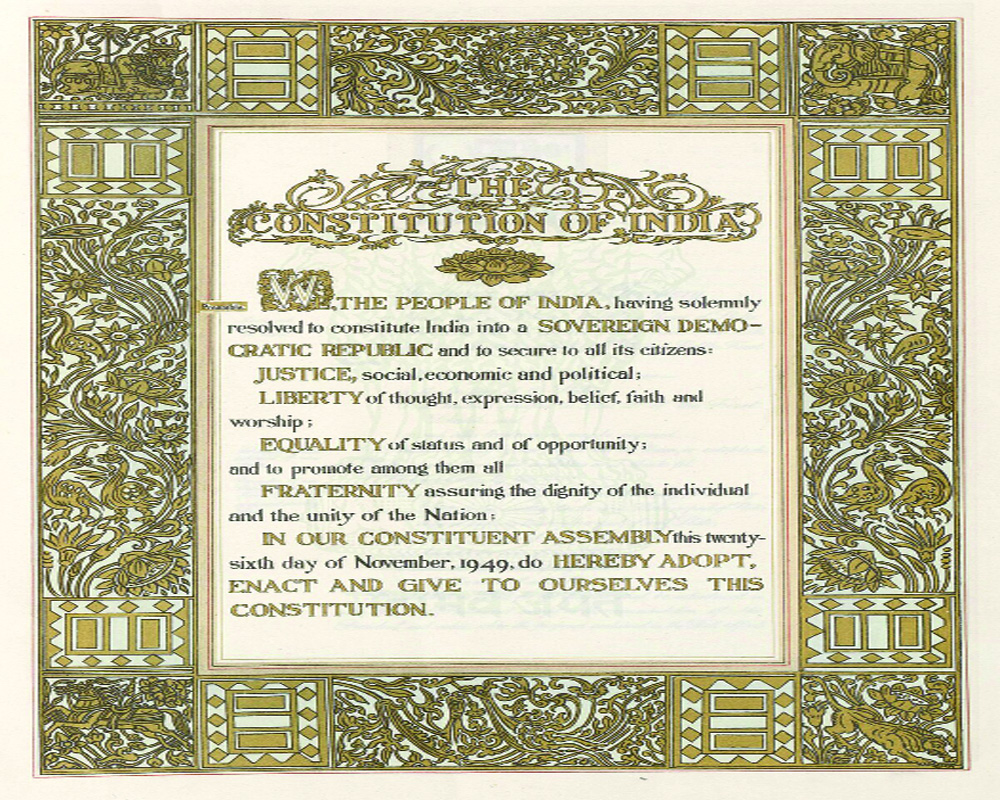
It has been 75 years since India adopted and accepted its Constitution, marking a historic milestone in its journey as an independent nation
The Constituent Assembly convened for the first time in December 1946, with Sachidananda Sinha serving as its interim chairman on December 9. Shortly after, Rajendra Prasad was elected as the permanent chairman on December 11, 1946.
The drafting process began on August 29, 1947, and the final document came into effect on January 26, 1950, marking India’s transition into a sovereign, democratic republic.
Upon its adoption, the Constitution replaced the Government of India Act, 1935, becoming the fundamental governing document of the nation. The Drafting Committee, formed on August 29, 1947, was chaired by Dr
B R Ambedkar. Other members included N Gopalaswami Ayyangar, Alladi Krishnaswami Ayyar, KM Munshi, Syed Muhammad Saadullah, N Madhava Rao, and TT Krishnamachari. The committee presented its draft on February 21, 1948, and after extensive deliberations, the Constitution was adopted on November 26, 1949. Dr Rajendra Prasad, as the President of the Constituent Assembly, signed the final document.
The members of the Constituent Assembly were elected by the Union and State Legislatures. Prominent leaders included Jawaharlal Nehru, Rajendra Prasad, Sardar Vallabhbhai Patel, Dr B R Ambedkar, Maulana Abul Kalam Azad, Syama Prasad Mukherjee, and others. The Assembly also had representation from various communities: Scheduled Castes, Anglo-Indians, Parsis, Christians (except Anglo-Indians), and Gorkhas. Legal experts such as Alladi Krishnaswami Ayyar, Benegal Narsing Rao, KM Munshi, and Ganesh Mavlankar played crucial roles. Women leaders, including Sarojini Naidu, Hansa Mehta, Durgabai Deshmukh, Rajkumari Amrit Kaur, and Vijaya Lakshmi Pandit, also contributed significantly.
The Structure and Drafting of the Constitution The Indian Constitution consists of 25 parts, 12 schedules, 106 amendments, 448 articles, and 117,369 words. Alongside the English version, an official Hindi translation exists.
Amendments and Political Influence: The Constitution has undergone significant changes over the years. A notable amendment took place during Prime Minister Indira Gandhi’s tenure. Through the 42nd Constitutional Amendment, the words “Socialist†and “Secular†were inserted into the Preamble. This amendment remains a subject of debate, as the original Constitution did not contain these terms. The amendment, introduced by the Congress government, reflected the ideology of a specific political party rather than the original intent of the Constitution. A recent case regarding this amendment was under deliberation in the Supreme Court, with Justice Sanjiv Khanna commenting on socialism as a concept for collective welfare. However, the case was eventually dismissed. The repeated amendments to the Constitution, often driven by political motives, have raised concerns about the distortion of its original framework. So far, the Constitution has been amended 105 times, with additional amendments proposed. This makes it the most extensively modified Constitution among democratic nations. In contrast, the United States, despite being a democracy for over 200 years, has only made 25 amendments to its Constitution, which remains significantly shorter and less complex.
A Constitution Borrowed from Many: Unlike countries such as Britain, Israel and New Zealand, which function without a written Constitution and rely on traditions, India’s Constitution incorporates provisions from multiple sources, including Britain, Australia, Canada, the United States, France, and the Soviet Union. The legal expert BN Rau played a crucial role in compiling these provisions, yet his contributions are often overlooked. His research formed the foundation upon which Dr B R Ambedkar and the Drafting Committee built the Constitution.
The original manuscript of the Constitution holds historical significance. A replica of this document includes a unique signature in Tamil by MC Veerapagu, a member of the Assembly from Thoothukudi. His signature, highlighted in preserved documents, serves as a reminder of the diverse voices that contributed to India’s foundational legal text.
Politics and the Constitution
It is essential to recognise that a Constitution is a foundational governance framework, separate from political parties. When political entities modify it to serve their interests, its original purpose is diluted.
A Constitution must ensure collective harmony, balanced by legislative and judicial oversight. The debate over secularism and socialism remains contentious. The Constitution’s secular integrity should not be manipulated through selective amendments or political rhetoric. Instead of distorting its essence, efforts should focus on preserving its foundational principles for the benefit of all citizens.
(The writer is an advocate and political activist; views are personal)