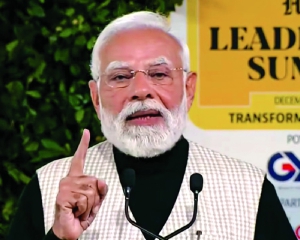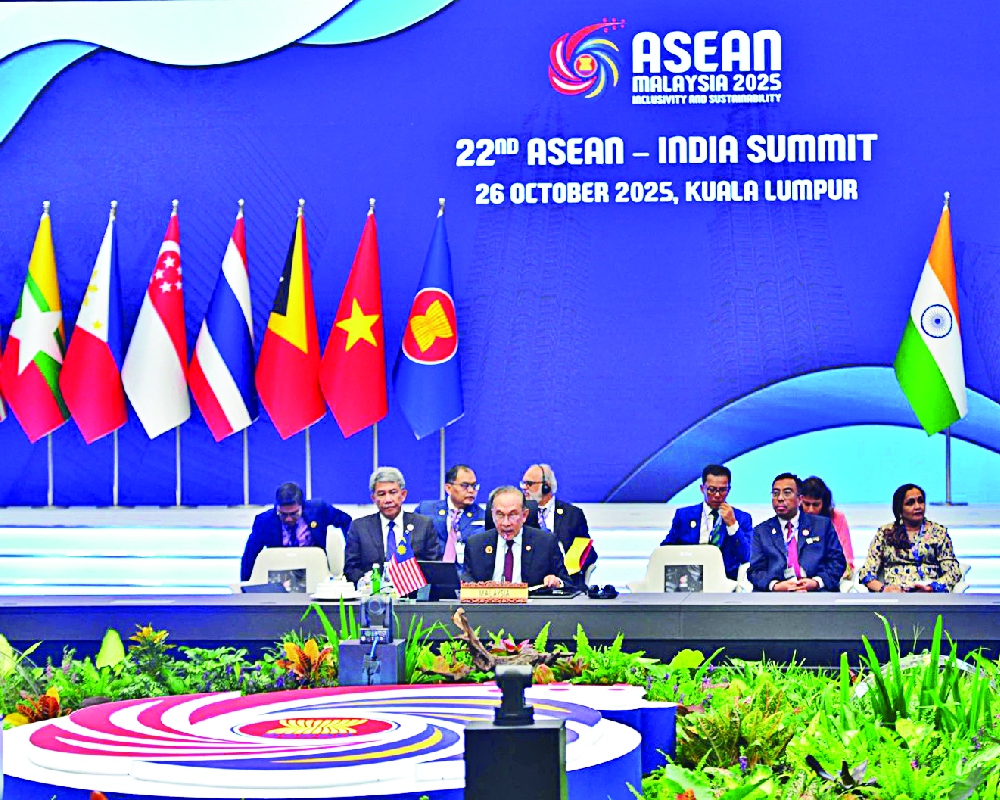
India-ASEAN strategic partnership has continued to prosper despite the prevailing “era of uncertainties,” said Prime Minister Narendra Modi in his virtual address to the 22nd India-ASEAN Summit held in Kuala Lumpur. His statement was well contextualised, given the long-standing “cultural capital” between India and ASEAN, while echoing the spirit of companionship from the Global South.
The relationship between India and the Association of Southeast Asian Nations (ASEAN) is rooted in centuries of cultural, economic, and maritime interactions. Ancient trade routes across the Bay of Bengal connected the Indian subcontinent with Southeast Asia, facilitating the exchange of goods, ideas, and philosophies. Institutions like the ASEAN-India Centre regularly publish works on themes such as maritime cooperation and cultural heritage. Indian influence remains visible in the region’s art, architecture, religion, and language, with Hinduism and Buddhism spreading widely across countries like Indonesia, Thailand, and Cambodia. In modern times, India’s engagement with ASEAN gained formal shape after the latter’s founding in 1967.
However, the relationship truly deepened in the early 1990s when India launched its “Look East Policy” to strengthen political and economic ties with Southeast Asia. This evolved into the “Act East Policy,” emphasising strategic, cultural, and connectivity cooperation under Prime Minister Modi’s leadership. Today, ASEAN represents a vital pillar of India’s Indo-Pacific vision, symbolising shared goals of peace, prosperity, and regional stability.
The India-ASEAN partnership, now in its fourth decade, stands as a testament to the shared economic and political aspirations of the two regions. This multi-theoretical approach allows India to position itself as both a strategic balancer and a normative bridge in the evolving Indo-Pacific order. Firstly, the
ASEAN-India relationship plays a vital stabilising role amid great-power competition in the Indo-Pacific.
Southeast Asian countries increasingly confront pressures to align with either Washington or Beijing, placing their autonomy and economic interests at risk. India offers ASEAN a third way — one grounded in mutual respect, non-interference, and shared democratic values, free from the strategic burdens of formal alliance systems. India’s contemporary engagement with ASEAN reflects a new strategic sophistication — a “third way” approach that avoids the binary logic of great-power rivalry while reinforcing India’s regional identity and cooperation.
This approach has matured into a fine balance between strategic restraint, economic collaboration, and cultural diplomacy, consciously downplaying any big-power ambitions. Secondly, India’s participation in ASEAN-led mechanisms such as the ASEAN Regional Forum (ARF), the ASEAN Defence Ministers’ Meeting Plus (ADMM-Plus), and the East Asia Summit (EAS) underscores its institutional commitment to the development of a viable regional framework.
As External Affairs Minister S Jaishankar stated: “We support ASEAN unity, centrality, and the ASEAN Outlook on the Indo-Pacific.” This evolving partnership allows ASEAN to engage a rising power that values regional institutions rather than seeking to dominate them. India helps bolster a rules-based order that supports the sovereignty and strategic space of Southeast Asian states. Since launching the Indo-Pacific Oceans Initiative (IPOI) at the 2019 EAS to promote sustainable maritime cooperation, India and ASEAN have intensified collaboration on maritime security, the blue economy, digital connectivity, and disaster resilience.
This also signals India’s institutional commitment to the broader architecture of the Indo-Pacific. Thirdly, it is important to understand that India-ASEAN engagement operates as a multilevel process, underpinned by a wide array of bilateral and multilateral institutional mechanisms. Beyond ministerial-level meetings and annual bilateral summits, the annual Delhi Dialogue (DD), hosted by India, continues to serve as a prominent Track 1.5 platform, bringing together government officials, academics, industry leaders, and civil society representatives from India and ASEAN. In parallel, numerous “sectoral dialogue mechanisms” (SDMs) spanning business and trade, energy cooperation, connectivity, digital infrastructure, education, and climate change have broadened formal engagement between India and ASEAN. This reinforces India’s belief in multipolarity and regional agency, countering the tendency towards bipolar confrontation. By supporting ASEAN’s “centrality,” India ensures that Southeast Asian countries retain agency in shaping the regional narrative and achieving the ASEAN Community Vision 2045.
India’s Act East Policy serves both as a partner and a parallel path to ASEAN’s Vision 2045. Both frameworks envision a connected, stable, and prosperous Indo-Pacific driven by development rather than confrontation.
If ASEAN seeks to be the “epicentre of growth,” India, with its democratic and demographic strengths, positions itself as a natural collaborator in realising that vision by 2045.
The writer is an Assistant Professor at Deshbandhu College, University of Delhi, and was a Delegate to the 2nd India-ASEAN Youth Summit