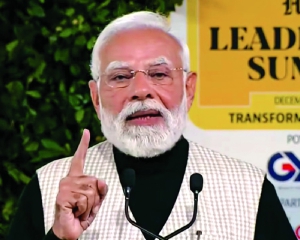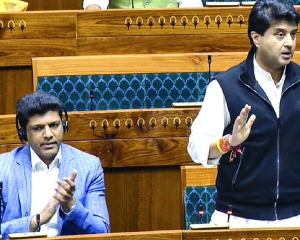
The cat is out of the bag. Rather, the rabbit is out of the policy-maker’s hat. Even better, the import cat is verbally placed among the Indian manufacturing pigeons. Look at it in any given animal contour, reality bites. The Union commerce and industry minister, Piyush Goyal, chided local industrialists at a public event. He said that whenever the Government talks about minor import quotas via bilateral trade pacts, which constitute a few percent of the domestic demand, the industry “will make a big fuss, and you will cry about it.” He added, “I feel very disappointed when that happens.” The fact is that reactions, and lobbying against imports, shows the Indian industry in a “very poor light, it shows weakness.” Moreover, when the minister tries hard to understand the reasons behind the criticisms, and how 2-3 per cent imports can hurt the overall market dynamics, “I am given very ridiculous responses.”
Of course, the remarks were aimed at the growing worries and anxieties among sections of the Indian industry, which are alarmed at the rapid rate with which New Delhi is on a treaty-signing spree with several nations and blocs such as the UK, European Union, and the US. As India opens the gates for imports from these nations at zero or minimal duties, the industry is on the back foot. It feels that imports are likely to swamp the Indian markets at their expense. What will start as a trickle initially, what the minister dubs as 2-3 per cent of the market share, will become an avalanche in a few years. This goes against self-reliance, or Atma-Nirbharta, which is being adopted by the Government. Developed nations like the US and China support their industries with huge subsidies. This is not true in India, where the industry needs to fend for itself.
However, there are a few voices that support Goyal. Commenting on the minister’s comments, the Mumbai-based Harsh Goenka tweeted, “Our Commerce Minister Piyush Goyal is absolutely right. We cannot demand open access to global markets while hiding behind tariff walls at home. Competitiveness comes from exposure and courage, not protection. Time for Indian industry to drop the crutches, and start running.” The fact remains that even the US has used tariff walls to encourage its exports, and force other nations to open their markets. When it comes to import threats, it uses other mechanisms to reduce entry, as it did with several products through the Section 302 investigations, which allows it to hike tariffs. In the recent past, the US hiked import duties on branded medicines to 100 per cent, but later withdrew it due to pressures from domestic buyers.
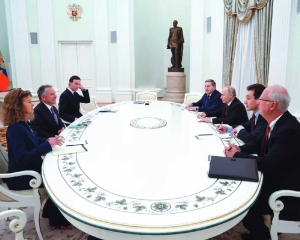
Apart from an overall comment, Goyal’s observations are being read by experts and observers in a specific manner. The latter contend that such utterings may be indicative of a forthcoming bilateral pact between India and the US. The trade negotiations are on, and some Indian ministers have hinted that a deal may be finalised by this November or December. Sources contend that American manufacturing imports will get a free ride, and attract minimal duties that range from zero to five per cent. The contentious points relate to farm and dairy products, which are politically-sensitive. Even in these cases, the Government will allow American imports. Recent media reports indicate that American corn to make ethanol locally is a possibility. This will enable the Government to assuage the feelings of the farmers as the corn will not be sold in the market. It will only be for industrial use. There may be similar sub-deals.
This may partially explain why Goyal was quite categorical while making the recent comments at a public forum. He said, “Ultimately, when we do FTAs (bilateral or regional Free Trade Agreements), we will need the support from all sectors. It cannot be that we want open markets everywhere but our industry is left out when you open the Indian market. That cannot work.” In essence, he wants the Indian industry to accept what happens in the future, especially with the US. If New Delhi needs to accept a few demands by Washington, so be it. In the current disruptive situation, where the Indian economy may feel extreme pain, it is better to give in a bit, and extract whatever we can from the other side. In this give-and-take, a few segments will get hurt. But some will benefit. If the economy gains, sector-specific losses are acceptable.
Possibly, it is time to learn from the Chinese experience. For years, Indian policy-makers, industrialists, and Civil Society have urged a reduced dependency on Chinese goods. There were protests, angry rhetoric, and slogans to stop using Chinese products. Despite these words and actions, the truth lies elsewhere. Imports from the Red Dragon have consistently increased, and the trade deficit, i.e., the difference between imports and Indian exports, has zoomed. There are some sectors that are totally dependent on Chinese supplies. In fact, many of Indian exports to the western world are dictated by imports from China. Think of iPhones and generic medicines. Although the Indian industry has the option to export to China, it does not have enough products that can compete in that market. The fear within the industry is that this should not happen with the US, Europe, or the UK. The FTAs need to be balanced.