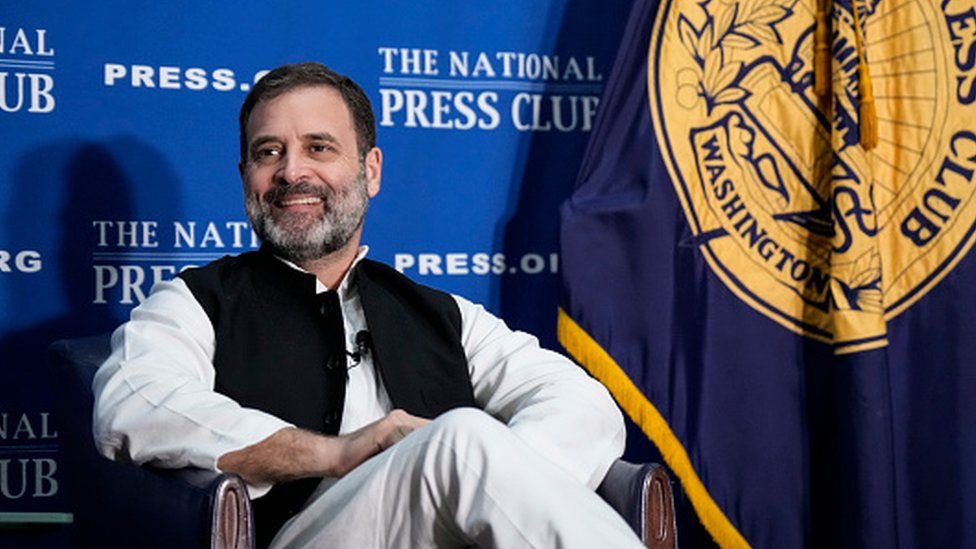
Rahul Gandhi’s recent foreign visit has once again set off a familiar debate — one that questions his priorities, political seriousness, and timing. As the country heads towards a crucial electoral phase, critics argue that a responsible leader should be investing his energy in preparing strategies, strengthening his party, and connecting with people at the grassroots. Instead, Gandhi’s decision to travel abroad has invited sharp criticism from the ruling dispensation, which claims he treats politics as a “part-time venture” rather than a lifelong commitment. The controversy gained traction when the RSS mouthpiece Organiser published an article raising a series of probing questions from the Sangh’s perspective.
It asked whether Gandhi’s trip represents genuine foreign engagement or political absenteeism. The article further questioned in what capacity Gandhi, who currently holds no formal government position, is representing India during his overseas interactions. The publication also raised doubts about whether the Congress leader — who lacks specialised expertise in trade, economics, or international relations — can meaningfully influence bilateral relations, or whether these meetings are largely ceremonial in nature.
Finally, it posed the most critical question: do these visits serve to enhance Rahul Gandhi’s personal image abroad while diverting attention from pressing domestic issues? These concerns, though sharply worded, are not entirely new. Over the years, the BJP and its ideological affiliates have built a narrative portraying him as inconsistent, detached, and politically uncommitted. Each foreign visit is presented as proof of his lack of seriousness, an argument that has persisted despite Gandhi’s recent efforts to reconnect with the public through initiatives like the Bharat Jodo Yatra. However, the debate cannot be reduced merely to partisan attacks.
It also raises an important question about how Indian political leaders, particularly those in opposition, should engage with the wider world. In a globalised era where issues such as climate change, migration, technology, and economic policy transcend borders, it is not unusual for senior political figures to travel abroad, build networks, and exchange ideas. As Leader of the Opposition in Parliament, Gandhi occupies a legitimate constitutional position that allows him to undertake such visits to strengthen dialogue, explore partnerships, and present an alternative political vision for India.
Supporters of Gandhi argue that his trips reflect an attempt to expand India’s democratic conversation beyond national boundaries. By engaging with global thinkers, political leaders, and civil society institutions, he seeks to share perspectives on India’s social and political evolution while listening to how other democracies are grappling with similar challenges. In this view, his foreign visits are an expression of curiosity, openness, and democratic dialogue — qualities essential for a modern political leader.
Yet, even among his well-wishers, there is unease about timing. The Congress Party is at a crucial juncture: rebuilding state-level organisations, refining its electoral message, and managing internal rivalries. With key elections approaching, Gandhi’s absence from the domestic political scene — even temporarily — creates a leadership vacuum that can be exploited by opponents. At a time when his party needs visible, day-to-day direction, international trips, however meaningful, risk being perceived as detachment from immediate political realities. Optics matter deeply in politics. Even if Gandhi’s visit is rooted in legitimate dialogue and global outreach, perception often overrides intention. The ruling establishment and its media allies have perfected the art of turning optics into narratives. The visual contrast between a prime minister constantly engaging with citizens across India and an opposition leader addressing international audiences abroad is powerful and easily weaponised. Without clear communication from Congress about the goals and outcomes of such trips, the perception of misplaced priorities becomes difficult to counter.
At the same time, the Organiser’s framing of Gandhi’s travel reflects a deeper ideological contest. Questioning his authority to “represent India” implies that only those in power have the legitimacy to speak internationally about the nation. This is a narrow interpretation of democracy. In truth, every elected representative — whether in government or opposition — has a stake in shaping India’s image abroad. In many mature democracies, opposition leaders routinely meet foreign dignitaries, participate in policy dialogues, and articulate alternative viewpoints without being accused of undermining national interests.
The criticism also raises a larger philosophical question: should leadership be judged solely by physical presence or by the quality of engagement and ideas? A modern leader’s responsibility extends beyond managing electoral machinery; it also involves broadening perspectives and preparing for a rapidly changing world. Gandhi’s international outreach could serve that purpose if it is strategically aligned with domestic objectives and accompanied by transparency about its agenda. Nevertheless, Gandhi’s challenge lies precisely in bridging this gap between action and perception. His past absences from key domestic moments have left a lasting imprint on public opinion. Even when his intentions are legitimate, they are viewed through the prism of an established stereotype. This underscores the need for a more robust communication strategy from the Congress to proactively frame its visits not as leisure trips, but as efforts to represent an inclusive, democratic, and forward-looking vision of India. Another aspect worth considering is the potential outcome of these visits. If Gandhi’s meetings abroad lead to meaningful dialogues on trade, technology, education, or environmental collaboration, they could strengthen his image as a serious statesman. But if they are seen as mere photo opportunities, the criticism of “self-aggrandisement” will grow louder. The credibility of such initiatives ultimately depends on whether they yield tangible intellectual or policy dividends that can enrich domestic debate.
It is also worth recalling that the opposition’s role in a democracy is not just to criticise the government but to represent alternative ideas before the global community. When the ruling leadership dominates India’s global narrative, it becomes even more important for opposition figures to present a nuanced picture of the country’s democratic ethos. Gandhi’s engagement abroad could serve that balancing role — if communicated with clarity and purpose.
Ultimately, the current controversy reflects two parallel truths. First, Rahul Gandhi, as a national leader, has every right to engage internationally and build relationships beyond borders. And second, that timing and perception remain politically decisive. With elections looming and the Congress still battling organisational weaknesses, every action by its top leader will be scrutinised not just for intent but for political symbolism.
The broader takeaway is clear: leadership today is measured not only by what one does, but also by how it is perceived. Rahul Gandhi’s task is not to stop travelling but to demonstrate how such journeys connect with India’s domestic aspirations and his party’s broader political mission. Only then can he transform the narrative from one of “wrong priorities” to one of global engagement with national purpose.
The writer is a policy analyst