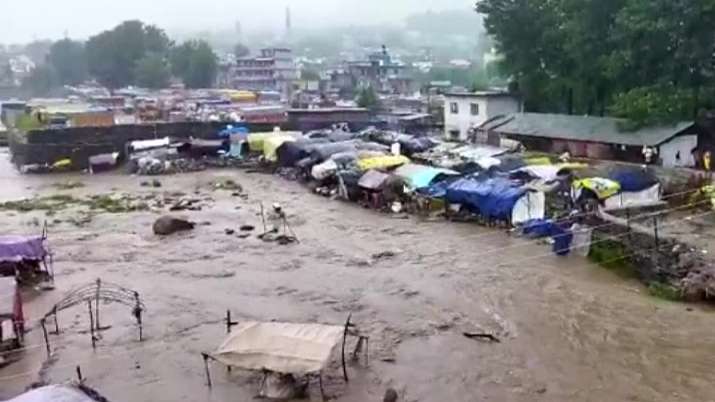
The rains this year in Uttarakhand came with a fury that felt both familiar and new. Rivers swelled within hours. Roads cracked and vanished. Hillsides gave way as terrified families ran uphill, clutching their children. For outsiders, such scenes seem sudden and shocking. But for those who call the Himalayan valleys home, this fear returns every monsoon. Every season brings the dread of cloudbursts and collapsing slopes. The Himalayas, mighty as they are, remain fragile — a landscape where beauty and danger coexist. Here, rivers are gods, floods are remembered in songs, and disasters are often told as divine retribution. To live in these mountains is to live in reverence — balanced between awe and fear. For centuries, the rhythm of the monsoon has guided every aspect of Himalayan life. Farmers sow when the rains arrive. Pilgrims to the Char Dham temples plan their journeys by its pulse. Traders once timed their crossings of high passes by their breaks. But the rhythm is now broken.
Uttarakhand normally receives around 1,162 mm of rainfall during the monsoon season. This July alone, 239 mm poured down within just the first 10 days. Rain that once spread across months now falls in violent, concentrated bursts. Scientists confirm what locals already sense — extreme rainfall events are increasing. The heaviest storms release more water than ever before. For mountain farmers, the difference between steady rain and a cloudburst is the difference between life and ruin. A single night of torrential rain can wash away entire terraces, erode topsoil, and turn careful construction into rubble.
In Dehradun, even the state capital, a cloudburst this year left neighbourhoods submerged. Cars floated through narrow lanes; families stood waist-deep in water inside their homes. The city, once imagined as a safe valley refuge, could not withstand the monsoon’s rage.
The other side of the Himalayan story is written in ice. Glaciers, the ancient water towers of Asia, are melting faster than ever. As they retreat, they leave behind glacial lakes — deceptively calm and scenic, yet dangerously unstable. In Uttarakhand’s Alaknanda catchment, glacial lake area has grown by over 239 per cent between 1990 and 2020. Across the Himalayas, such lakes are expanding, their natural barriers made of loose rock and moraine instead of solid dams. A landslide or sudden inflow can cause them to burst catastrophically.
The 2021 Chamoli disaster was one such warning. Within minutes, a torrent of rock, ice, and water swept away hydropower projects and entire villages. Survivors described it as “the mountain exploding.” Downstream communities had no warning — only devastation.
This danger does not stop at state borders. In Sikkim, a glacial lake outburst in October 2023 sent the Teesta River roaring through valleys, collapsing bridges, breaching dams, and destroying army camps. For the Lepcha people, the tragedy echoed an ancient belief — that floods arrive when humans lose harmony with nature, and the Mother Creator sends waters to cleanse the land. The mountains themselves are weakening. Satellite studies reveal that much of the Himalayan terrain is now highly erosion-prone. The risk is greatest where forests have been thinned, and highways and tunnels have sliced through fragile rock.
When heavy rain falls on disturbed slopes, it no longer seeps into the soil — it rushes down, carrying boulders, trees, and houses in its path. In Dharali, Uttarkashi, the Bhagirathi River rose overnight, wiping out homes and farmland. In Himachal Pradesh, this year’s floods swept through Kullu and Manali, submerging apple orchards and bridges. Families who had lived by these rivers for generations saw everything vanish.
Much of this damage, locals say, is self-inflicted. Roads to pilgrimage sites cut deep into unstable hillsides. Hydropower tunnels blast through fault lines. Hotels rise on floodplains where rivers once meandered freely. For engineers, every new road marks progress; for the mountains, each cut is a wound. The floods of 2023 were a grim reminder that nature always collects its dues.
Floods are not new to the Himalayas. The British gazetteers of Kumaon and Garhwal record dozens of them — awed by the violence of rivers that could erase entire valleys. In 1893, when a landslide dam on the Birahi Ganga burst, the Alaknanda valley was devastated. Elders in Garhwal still tell their grandchildren stories of “the flood of Birahi.”
In Himachal, old families remember how the Beas once changed its course overnight in 1975, taking orchards and temples with it. In Assam’s foothills, folk songs still speak of the Brahmaputra swallowing villages whole. These memories endure not only as grief but as warning — a reminder that rivers are never truly tamed, and that respect is the first rule of survival.
While science attributes floods to rainfall and melting glaciers, mountain folklore offers another explanation — divine anger. In 2013, after Kedarnath was ravaged, many saw it as Shiva’s “tandava,” his cosmic dance of destruction. Others said it was the wrath of Nanda Devi, whose sacred sanctuary had been violated.
In Kumaoni jagars — ritual ballads — floods appear as punishments for human arrogance. In the oral epic Malushahi, storms and rivers are forces that decide fate. Himachal’s legends speak of Parashurama unleashing waters to drown sinful lands. The Lepcha myth of Sikkim and the Apatani traditions of Arunachal share a common lesson: when humans forget humility, the rivers remind them who truly rules these mountains. Across the Himalayas, rituals continue to express this ancient respect for rivers. In Uttarkashi, villagers float lamps on the Bhagirathi before opening irrigation canals. In Pithoragarh, lamps are lit on bridges at the onset of the monsoon.
In Himachal, offerings are made to the Beas and Sutlej before the sowing season. In Arunachal, rituals appease river spirits before fishing begins. These are not mere customs. They are acknowledgements of a deeper truth — that rivers have agency, that nature must be approached with reverence. Such rituals remind communities that preparedness and humility are part of survival itself. Behind every flood statistic lies a human story. Farmers in Pithoragarh watch their terraces crumble into rivers. Mothers in Chamoli lie awake through nights of thunder, fearing the next landslide.
Children in Rudraprayag miss months of school because the roads are gone. Shopkeepers in Dehradun clean their stores after every flood, only to lose their goods again. The poor suffer the deepest scars. A washed-away field or home is not easily rebuilt. Debt replaces soil as their foundation. Yet resilience persists — Kedarnath was rebuilt, pilgrimage routes reopened, and terraces were replanted. Stories of survival travel from village to village, keeping collective memory alive.
Floods are part of the Himalayan destiny — these are young, shifting mountains. But the toll need not be so brutal. Forecasts must reach every remote village. Glacial lakes must be closely monitored. Roads and hydropower projects must heed the geology they intrude upon.
Science can mitigate risk, but cultural wisdom must also guide us. The songs, myths, and rituals of mountain people hold deep ecological truths — about balance, limits, and reverence. Floods, then, are not merely natural disasters. They are messages carried by water — reminders that to live in the Himalayas is to live humbly, prepare constantly, and remember always that rivers are both givers and takers of life.
The writer is Assistant Professor, Gautam Buddha University, Noida