Vande Mataram. Sujalam suphalam malayaja-sitalam, sasya-syamalam mataram! The first stanza of the national song translates to: “I bow to thee, Mother-rich with waters, rich with fruits, cool with the southern breeze, verdant with crops and fields-Mother!” This heartfelt ode to Mother India by the great poet Bankim Chandra Chattopadhyaya is once again at the centre of a political storm. The political class across the country agrees with and bows to its sentiment, yet it is being fiercely debated in Parliament. The debate over Vande Mataram in Parliament on December 8 was more than an exchange of rhetoric; it revealed the complicated intersections of heritage, nationalism, and electoral politics in contemporary India.
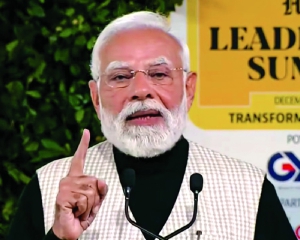
When Prime Minister Narendra Modi invoked Bankim Chandra Chattopadhyaya’s iconic hymn, it carried enormous symbolism-drawing upon a century of collective memory, pride, and sacrifice. Yet it also raised an uncomfortable question: should such a sacred piece of India’s freedom struggle become the subject of partisan debate? Should not our freedom struggle and its symbols remain sacrosanct? Vande Mataram occupies a sacred space in India’s national imagination. Born out of Bankim’s Anandamath, it emerged as the rallying cry of the freedom struggle, uniting Indians across communities during the anti-colonial movement. Tagore’s voice at the 1896 Congress session, Bhikaji Cama’s flag in Stuttgart bearing its words, and the chants during the 1905 anti-Partition protests all cemented its status as a symbol of resistance and aspiration. It was never merely a poem; it was an emotional force field. This is why its invocation in Parliament is both powerful and
fraught with the danger of the song itself being drawn into political crossfire.
Prime Minister Modi’s speech wove together strands of spirituality, nationalism, and cultural pride. He recalled Gandhi’s admiration for Vande Mataram and used it to position his government as the custodian of a nationalist legacy. But, coming ahead of the 2026 Bengal elections, it can also be construed as an electoral plank. As observers noted, cultural symbolism served not just as homage but as political strategy. Bengal’s pride in Bankim, Tagore, and its reformist icons makes any such invocation deeply consequential in the state’s political arena. India’s cultural symbols belong to the nation, not to any party-neither the Congress nor the BJP. When political actors selectively elevate one icon while denigrating others-such as the recent remarks against Raja Ram Mohan Roy-they risk distorting the pluralistic, composite spirit that animated the Bengali renaissance and the freedom movement.
Bankim, Tagore, Roy, Vivekananda, and many others did not belong to a party; they belonged to the nation at large. They represented an expanding universe of ideas that shaped modern India. Appropriating or diminishing them harms the national cause-the nation loses more than it gains. When symbols like Vande Mataram become contested rather than cherished, their universal appeal-and their power to unite-dissipates. That is a loss not just for politics, but for the nation.