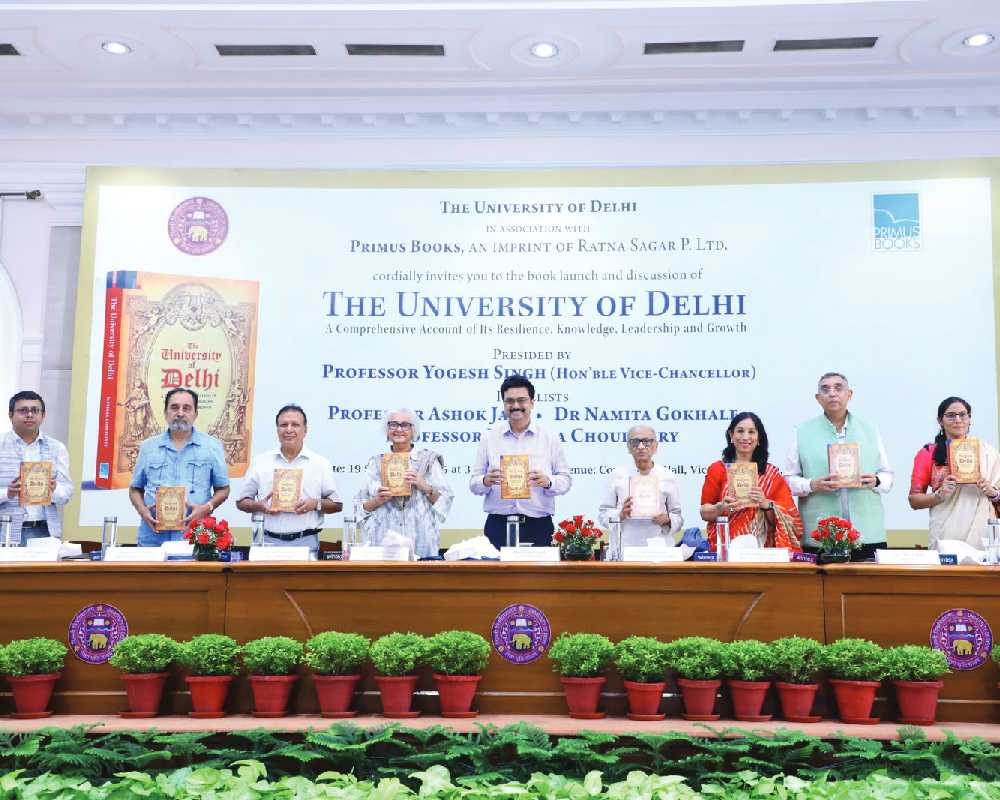
Prof Yogesh Singh, Vice-Chancellor, University of Delhi, said that despite historical constraints of funds and functionaries, the University has steadily expanded its scope and impact. He noted that the annual Government grant to the University, which was only `25,000 in 1922, has grown to more than `1,000 crore in the current fiscal year. This, he said, symbolizes the University’s growth and the faith the nation places in it.Prof Yogesh Singh was speaking while presiding over the book launch held at the Convention Hall of DU. On this occasion, the book “The University of Delhi - A Comprehensive Account of Its Reliance, Knowledge, Leadership, and Growth” authored by Professor Manisha Chaudhary of the Department of History, University of Delhi, was formally launched.
The book launch was attended by Professor Ashok Jain, Fellow of the National Academy of Sciences, India and Former Director, CSIR-NISTADS, Dr Namita Gokhale, Writer and Co-founder & Co-director of the Jaipur Literature Festival, Professor Balram Pani, Dean of Colleges, University of Delhi, Professor Rajni Abbi, Director, South Campus, University of Delhi, Dr Vikas Gupta, Registrar, University of Delhi, Anoop Lather,Chairperson,the Cultural CouncilUniversity of Delhi and PRO, ProfessorManisha Chaudhary, Author of the bookand Dr Prasun Chatterjee, Deputy Head, Primus Books. The event was accompanied by a panel discussion that brought together eminent scholars, administrators, writers, and students to deliberate on the history, challenges, and achievements of the University of Delhi.
On this occasion, Vice Chancellor Professor Yogesh Singh congratulated Professor Manisha Choudhary for her work and reflected on the themes of the book. He spoke about the role of leadership in navigating institutional challenges, particularly issues of friction, mismanagement, and underutilization of resources. Professor Singh also emphasized the University’s contributions beyond academics — including its role in the national independence movement and in nurturing and promoting patriotic values in post-independence India. During the panel discussion, Professor Ashok Jain, eminent scientist, highlighted the strong emphasis that the University has placed on science and experimentation since its inception.
He noted that in its early years, Delhi University prioritized fields such as quantum physics, astrophysics, chemistry, and biology. He emphasized that this scientific spirit continued in later decades, demonstrated by landmark initiatives such as the establishment of the Institute of Informatics and Communication in 1997, which focused on emerging areas of informatics and communication. Dr Namita Gokhale, noted writer, spoke on a more personal note about her long association with Delhi University. She credited the institution with making her a lifelong learner and giving her the resilience to maintain a student-like curiosity throughout her career. She reflected on how the University shaped her intellectual foundations and her outlook as a writer.
Speaking on book, Dr Vikas Gupta, Registrar of the University, commended Professor Manisha Choudhary for her painstaking research and the meticulous use of scattered historical material to bring out a comprehensive account of the University’s history. He emphasized that the book is not just a chronicle but an important academic contribution that maps the University’s growth, resilience, and leadership over the last century. Author of the Book, Professor Choudhary spoke about the motivation behind writing the book and the challenges of assembling and interpreting archival material. She highlighted the critical role of both academic and administrative leadership in shaping the University’s identity.
She traced the University’s journey from its first Vice-Chancellor, Hari Singh Gour (1922-1926), to its present Vice-Chancellor, Professor Yogesh Singh, underscoring how successive leaderships navigated constraints and opportunities. She also gave insights into the foundational ideas, processes, and struggles that led to the establishment of the University, its constituent colleges, and other institutions such as the School of Open Learning and the Non-Collegiate Women’s Education Board.
Dr.Prasun Chatterjee, representing Primus Books, shared the vision and collaborative effort that went into bringing the book project to reality. He appreciated Professor Choudhary’s dedication and expressed the publisher’s commitment to supporting works that document India’s institutional histories. Following the panel discussion, an engaging question-and-answer session took place where students, professors, and other attendees interacted with Professor Choudhary. She responded to their queries, further elaborating on the book’s themes, her research methodology, and the challenges of writing a comprehensive institutional history.