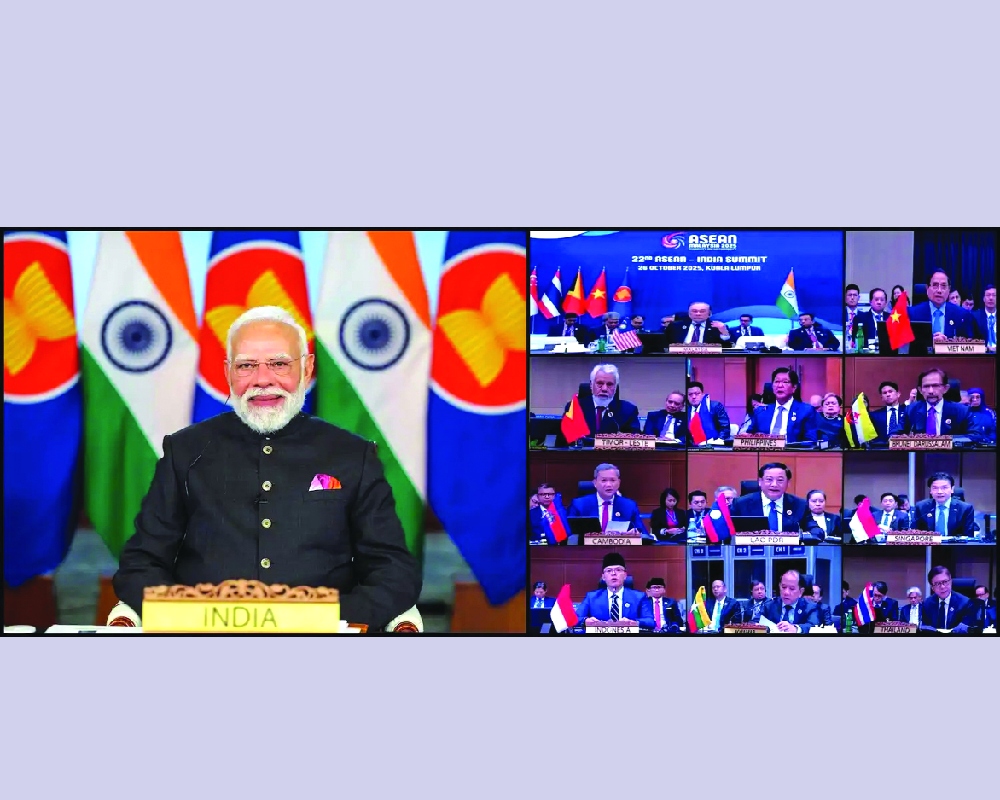
When the 22nd ASEAN-India Summit convened in Kuala Lumpur in 2025, the diplomatic choreography was carefully scripted: India’s Prime Minister addressed the summit virtually, while the External Affairs Minister was physically present. More than mere logistics, this arrangement sent an unmistakable signal. It said: India is deeply engaged with Southeast Asia, but it is not frantically rushing into every summit as though it must assert a place in a unipolar hierarchy. Rather, India seeks to fashion a role in a multipolar order—one in which it stands as a pole in its own right, especially on behalf of the Global South.
At the heart of that message lies an assertion: India sees its partnership with ASEAN not as an adjunct of its foreign policy but as a cornerstone in the architecture of Asia’s emerging order. Together, India and ASEAN embody nearly one-quarter of humanity, linked by geography, history, trade and shared strategic concerns. For India’s “Act East” policy and its Indo-Pacific vision, ASEAN remains the essential fulcrum.
On the economic front, the figures underscore why ASEAN matters. Trade between India and ASEAN in 2023-24 reached approximately USD 120.9 billion, with Indian exports at USD 41.2 billion and imports from ASEAN at USD 79.7 billion. That trade imbalance—imports significantly outstripping exports—has been a source of concern for New Delhi and was on the agenda for review. Indeed, the Prime Minister publicly called for an early review of the ASEAN-India Trade in Goods Agreement (AITIGA), emphasising the need for reciprocity and removal of non-tariff barriers. Economic pragmatism, however, was matched by a strategic pivot.
India announced that 2026 will be celebrated as the ASEAN-India Year of Maritime Cooperation — an unmistakable sign that the partnership is turning seaward. The Indo-Pacific sea-lanes carry 90 percent of India’s trade by volume. Protecting these arteries through joint patrols, exercises and information exchanges with ASEAN nations has become an imperative rather than an aspiration. Connectivity defines the next chapter of India-ASEAN cooperation.
Two major projects — the India-Myanmar-Thailand Trilateral Highway and the Kaladan Multi-Modal Transit Transport corridor — aim to link India’s northeast to mainland Southeast Asia by road, river and sea. Beyond infrastructure, digital corridors and fintech collaboration are becoming new bridges of engagement. For both sides, connectivity is a matter not only of commerce but of resilience, development and shared prosperity.
India’s diplomatic choice to send its External Affairs Minister while the Prime Minister joined virtually was more than optics. It underlined New Delhi’s commitment to autonomy. India signals that it will engage, collaborate and commit — but on its own terms. This balanced diplomacy rejects the idea of unipolar submission or bloc politics, standing instead for an inclusive, multipolar Asia.
Through this approach, India also reaffirms its identity as a voice for the Global South. In its summit address, India called ASEAN and itself “fellow travellers of the Global South,” bound by history, values and the shared urge to democratize global governance.
This positioning blends leadership with solidarity: leadership through offering development alternatives and security partnerships; solidarity through empathy with nations seeking equitable growth beyond the glare of the great powers.
Behind the summit diplomacy lies India’s wider geopolitical calculus. India is increasingly attentive to actors it regards as destabilising—such as Pakistan or Turkey’s global diplomatic activism—and is working to build partnerships that strengthen regional stability rather than simply reacting. While the ASEAN summit may not explicitly centre on India-Pakistan or India–Turkey bilateral frictions, the broader strategic logic applies: by deepening ties with ASEAN, India both expands its network of friends and limits room for adversaries to exploit regional alignments. For example, when cross-border terrorism from Pakistan triggered Indian military responses in 2025, India paired deterrence operations with diplomatic outreach to isolate sponsors and supporters of terror.
Within ASEAN’s maritime and connectivity initiatives, India also sends a signal that it will not tolerate peripheral instability undermining regional integration.
This recalibration also reflects an evolving self-image. For too long, external narratives have labelled India as a “third-world” country: large, poor, dependent. India contests that label not merely with words but with trajectory. Its economy is projected to join the world’s top three. Its services and digital economy are globally competitive. In multilateral fora such as the ASEAN-India summit, India sought to show that it is not seeking assistance but offering partnership: in maritime security, in connectivity, in digital transition, in green growth. The declaration of 2026 as the maritime-cooperation year is part of this identity-building
All of which brings us to the heart of the matter: India, the ASEAN summit in 2025 and the global order are deeply interconnected. The summit is not an end in itself—but a node in a larger endeavour, a signal that India intends to help design Asia’s future architecture rather than merely adapt to it.
By privileging substance (connectivity, maritime cooperation, trade review) over spectacle (grand-state visits, headline-photo-ops), New Delhi tries to assert that its rise will be systematic, strategic and sustained.
For India, the real test lies ahead. Can it convert the framework of strategic partnership with ASEAN into genuine economic integration, speed up connectivity projects, deepen maritime cooperation into operational synergy and build the institutional mechanisms that allow ASEAN-India ties to become a durable part of Asia’s geopolitical spine? Can it manage the neighbourhood—Pakistan, Bangladesh, Myanmar, even Turkey’s global diplomacy—while projecting itself as a stabilising influence rather than a jack-of-all-things? Can it shift deep-seated perceptions—especially in China, ASEAN capitals and elsewhere—that India remains a developing country bound by capacity rather than a peer to global great powers?
Should New Delhi answer those questions with credible action, the Kuala Lumpur summit will be remembered not as another diplomatic waypoint but as a milestone in India’s emergence as a global stabilizing power. In an era hungry for leadership that transcends binary rivalries, India is positioning itself as first among equals — a state that seeks neither dominance nor dependence, but co-creation of the rules and institutions that will govern Asia’s future.
In that sense, the 22nd ASEAN-India Summit ought to be more than diplomacy at work; India and ASEAN now stand on the same horizon, looking toward a shared order where partnership, not rivalry, defines progress.
The author is a former DGP of Assam and presently the General Secretary of the Think tank— Society to Harmonise Aspirations for Responsible Engagement—SHARE