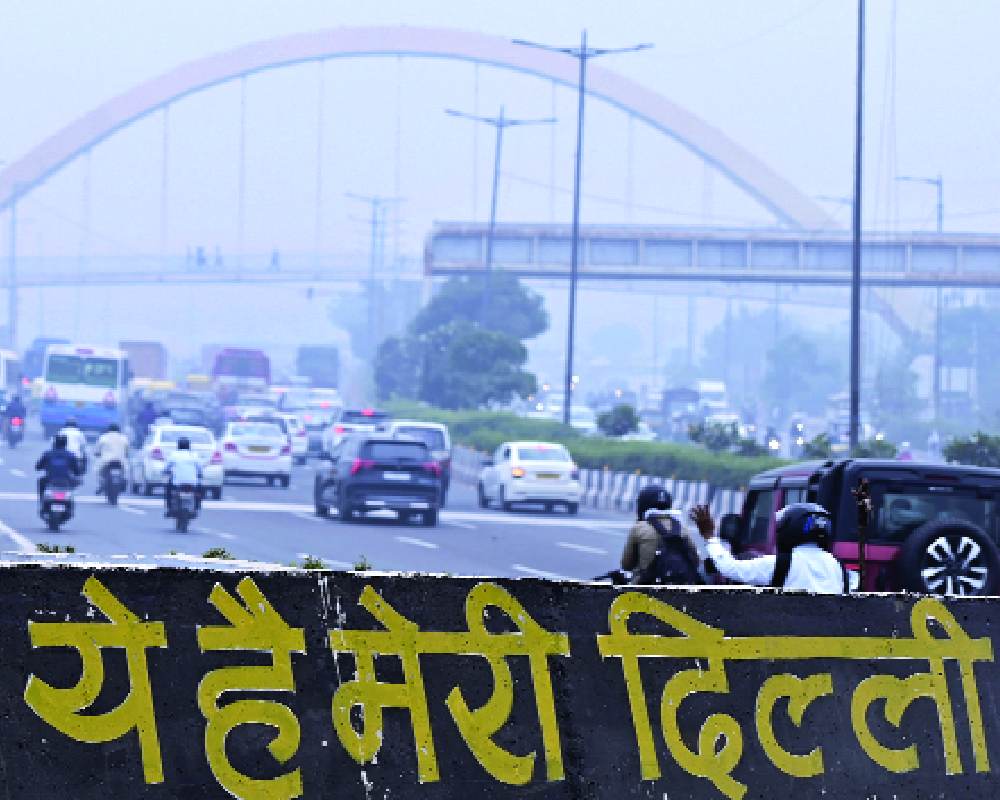
Falling temperatures, persistent smog, and stagnant winds have combined to trap pollutants, pushing pollution levels to alarming highs as the air quality in Delhi deteriorated to the “very poor” category on Thursday after remaining “poor” for the past few days. The AQI stood at 373, categorised as very poor according to data from the Sameer application, which provides hourly updates published by the Central Pollution Control Board (CPCB).
A blanket of haze shrouded the national Capital on Thursday, with people complaining of eye irritation and cough, as air quality stood close to the “severe” level. Experts blamed meteorological conditions that trap pollutants near the surface for the rise in the pollution level.
The India Meteorological Department (IMD) said the haze is expected to persist during early morning and late evening hours through the week, as particulate matter continues to accumulate near ground level.
Delhi, which has been witnessing a fall in air quality since Diwali, recorded ‘very poor’ air quality with an AQI of 373, a sharp rise from 279 a day earlier. Smog significantly reduced visibility, with the CPCB recording PM 2.5 levels at 184.4 and PM 10 at 301.9. Vivek Vihar (426), Anand Vihar (415), Ashok Vihar (414), Bawana (411), Wazirpur (419) and Sonia Vihar (406) saw “severe” category air quality.
In the NCR region, Noida recorded an AQI of 372, Ghaziabad 364, Greater Noida 330, Gurugram 248 and Faridabad 166. Experts said the yellowish smoke enveloping the city is smog — a mixture of fog and pollutants that reduces visibility and poses serious health risks, especially for vulnerable groups. The Air Quality Early Warning System for Delhi reported that the city’s ventilation index — a measure of the atmosphere’s ability to disperse pollutants — remained below the favourable level of 6,000 m²/s.
Weak winds under 10 kmph and high humidity prevented pollutants from dispersing, resulting in a hazy sky.
Satellite data for October 29 detected 283 farm fire incidents in Punjab and 10 in Haryana, indicating a continued impact of stubble burning on Delhi’s worsening air quality.
“The dip in minimum temperature helps in forming a layer of haze as pollution settles in the lower atmosphere,” said Mahesh Palawat, the vice-president of meteorology and climate change at Skymet Weather.
According to him, winds blowing from the east at 2 kmph to 5 kmph and a rise in humidity worsened the air quality on Thursday. Medium and low clouds have obscured the sky, and isolated light rain was recorded in Noida and Faridabad, he said.
Doctors at city hospitals say they have been receiving a rising number of patients with complaints of cough, breathlessness, chest tightness and nasal congestion.