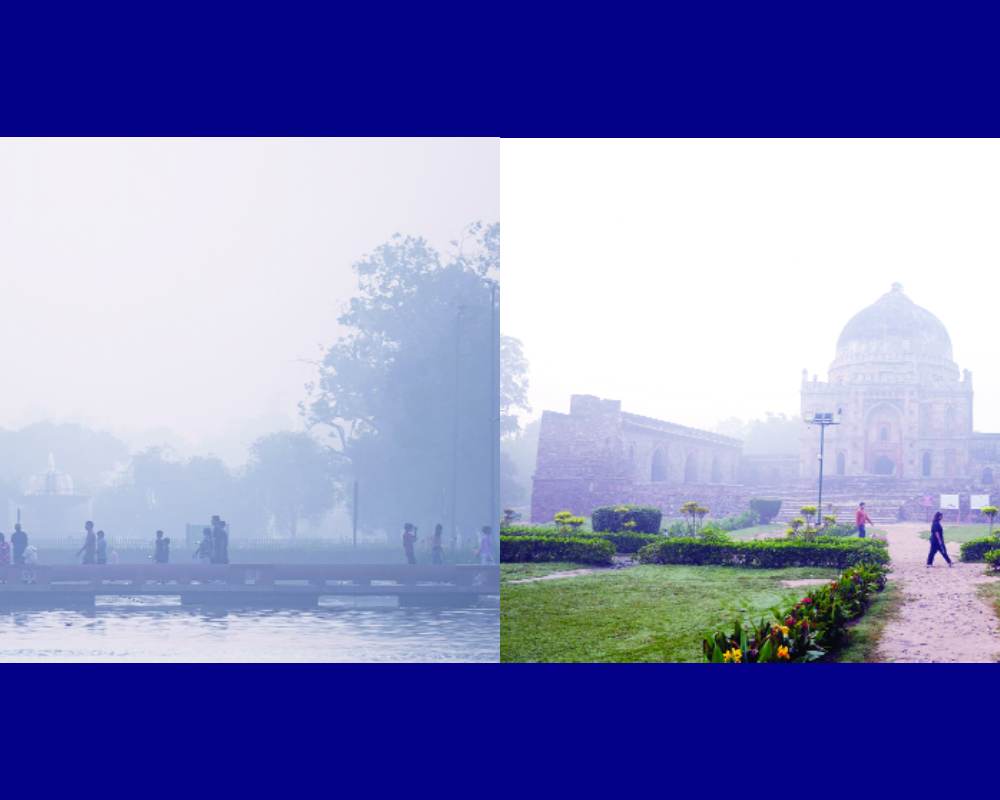
Two days after Diwali, the national Capital remained blanketed by haze on Wednesday with air quality in the “very poor” category, which has sparked a war of words between AAP and the ruling BJP over who to blame for the situation.
Delhi’s air quality deteriorated slightly on Wednesday as wind speeds dropped again. Its 24-hour AQI stood at 353 at 4 pm, according to the daily national bulletin released by the Central Pollution Control Board (CPCB). This marks the highest AQI recorded so far this season, up from 351 on Tuesday and 345 on Monday.
A visible haze shrouded the city during the day, with winds failing to exceed 7 kmph. The India Meteorological Department (IMD) warned that suitable dispersion of pollutants is unlikely in the coming days. “The wind direction has shifted from easterly to westerly, but speeds remain low. Nighttime winds are almost calm, and during the day they reach only 5-7 kmph,” said Krishna Mishra, senior scientist at IMD. He added that a weak western disturbance is expected around October 27, but it is unlikely to bring significant rain or an increase in wind speeds. Wind speeds briefly increased on Tuesday, helping clear the emissions from Diwali firecrackers. However, they began to drop again from Tuesday night as temperatures fell.
Forecasts from the Centre’s Air Quality Early Warning System (EWS) indicate that Delhi’s AQI will likely remain in the ‘very poor’ category till Saturday, after which it may fluctuate between ‘poor’ and ‘very poor’ for the next six days.
Chief Minister Rekha Gupta on Wednesday logically responded to the hue and cry over pollution in the aftermath of use of firecrackers on Diwali. The CM said there was a decrease in pollution on the day after Diwali compared to previous years. She added that, upon comparing pollution data with that of previous Governments, the numbers have plummeted, while emphasising that her Government is doing whatever is possible for Delhi. Her assertion came a day after monitoring stations showed that Delhi’s air pollution hit a four-year high on Diwali, with particulate matter 2.5 peaking at 675.
The Chief Minister said she will meet a Punjab minister on Thursday to inform the State Government about Delhi’s concerns over crop residue burning, a major cause of pollution in the national Capital during winters.
“The pre-post-Diwali gap (between average AQI) this year is less compared to the previous year, even though firecrackers were allowed this time,” the Chief Minister said at a press conference. She insisted that her government was taking all necessary steps with “greater alertness” to curb pollution.
On the other hand, AAP and Congress leaders accused the BJP Government in Delhi of shutting down pollution monitoring stations in the city, while Environment Minister Manjinder Singh Sirsa blamed stubble burning in Punjab for deteriorating air quality.
Punjab Pollution Control Board data showed the state recording 415 farm fire incidents between September 15 and October 21 this year, down from 1,510 during the same period last year.
The sharp drop comes amid a delayed paddy harvest as rains lashed the State until the first week of October. Damage caused by the floods in Punjab also delayed crop harvest at some places.
AAP’s Delhi unit president Saurabh Bharadwaj, in a statement, alleged that the BJP Government “committed data theft at a government level” by showing AQI readings of around 350 when actual levels had crossed 1,700, an official statement said.
“Multiple monitoring stations operated by CPCB, Delhi Pollution Control Committee (DPCC), India Meteorological Department and IITM went offline at the same time and came back only after winds cleared the air. This is dishonesty and manipulation against the people of Delhi,” he claimed.
Responding to the charges, Sirsa claimed that “Arvind Kejriwal has not only ruined Delhi but also Punjab. The air of AAP-ruled Punjab is polluted now. The state once had very clean and fresh air.” Sirsa on Tuesday accused the AAP Government of Punjab of forcing farmers to burn crop residue to send pollution levels up in the national Capital.
Meanwhile, AAP MLA Sanjeev Jha charged that the BJP Government had “erased” DPCC and CPCB data to “hide” the truth.
Delhi BJP president Virendra Sachdeva charged that statements issued by AAP leaders blaming firecrackers for pollution are a reflection of their “political frustration” as well as proof of their “anti-Sanatan policy” to appease the minorities.
Although there has been a slight increase in pollution in Delhi recently, the primary cause is not firecrackers, but the growing incidents of stubble burning in Punjab due to the “negligence” of the AAP Government in that State, he alleged.
Forecasts from the Centre’s Air Quality Early Warning System (EWS) indicate that Delhi’s AQI will likely remain in the ‘very poor’ category till Saturday, after which it may fluctuate between ‘poor’ and ‘very poor’ for the next six days. An analysis by the Centre for Research on Energy and Clean Air (CREA) identified October 20 and 21 as the city’s worst PM2.5 pollution days of 2025 after January.
Delhi Congress president Devender Yadav said that, like in the past few years, when Kejriwal was in power, Delhi has become the most polluted city not only in the country but also in the world, as the Capital has been turned into a gas chamber even before the onset of winter.
The Congress leader said that due to garbage accumulation and the general deterioration of sanitation conditions in the city, mosquito breeding has reached alarming levels.