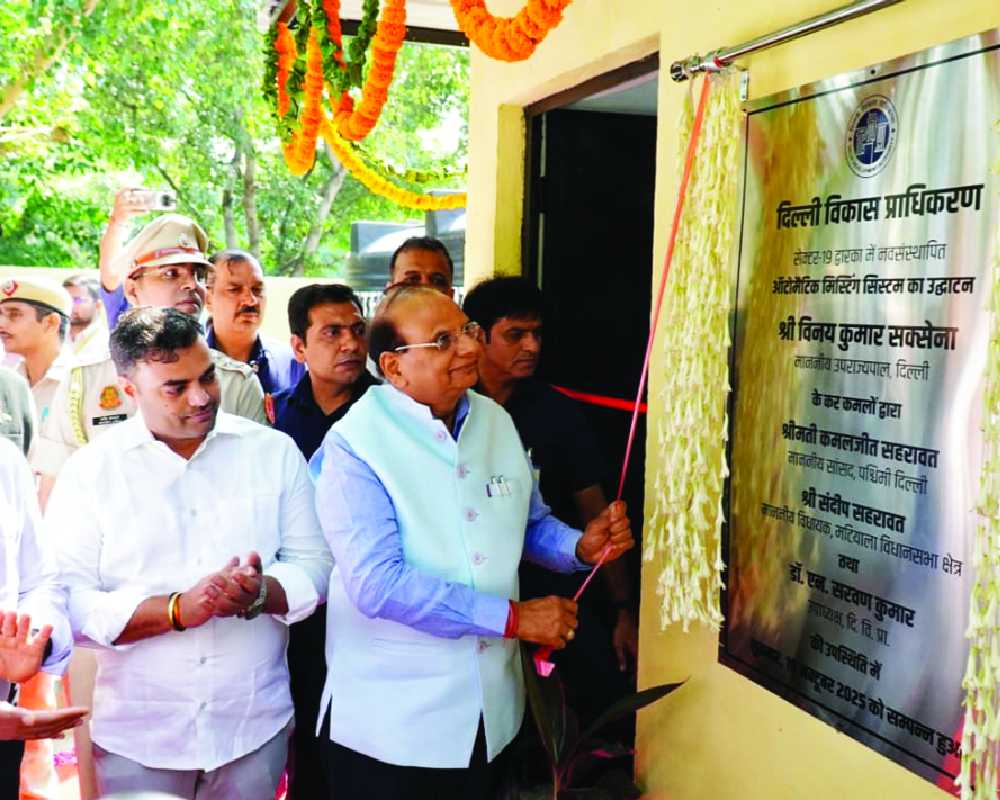
In its effort to combat the menace of air pollution that intensifies in Delhi every winter, Lieutenant Governor Vinai Kumar Saxena on Friday inaugurated the Automatic Anti-Smog Misting System at Sector-19, Dwarka. The initiative undertaken by the Delhi Development Authority (DDA) is aimed at reducing airborne pollutants, improving ambient air quality and protecting public health, particularly children and the elderly. Matiala MLA Sandeep Sehrawat, and Vice Chairman, DDA N Saravana Kumar were also present on the occasion.
In November last year, when the national Capital was reeling under severe air pollution, the Lt Governor took it upon himself to launch and monitor the trial run of anti-smog mist spray in Dwarka. A 550 metre stretch of DDA Road No. 224, extending from the junction of Road No. 201-224 to Sector 6 Marg, was identified. The installation then featured, 14 existing electric poles, each outfitted with 30 misting nozzles positioned at a height of three meters (9 ft approx).
However, the newly installed modified and automated misting system, inaugurated on Friday covers a larger stretch of 6.8 km stretch along Road number 224 and 210, from Chandanwari Apartments in Sector-10 to Omaxe Mall in Sector-19, and from Command Tank in Sector-20 to the red light near Sector-21 Metro Station. A total of 166 streetlight poles on the central verge have been fitted with 30 high-pressure misting nozzles each, positioned at a height of 5 metres. This will ensure that the mist spray goes higher in the air and thus prove more efficient in settling the smog.
The nozzles will release RO-treated water at a discharge rate of 2.8 litres per hour. It will help to reduce suspended particulate matter, dust, and fine pollutants such as black carbon in the air thereby contributing to improved air quality in the area. Speaking at the occasion, Saxena said, “Every winter, Delhi faces severe air pollution issues that affect everyone. The inauguration is a step in that direction. The Government is taking several measures to combat this menace. I appeal to the people to take every possible step to curb air pollution. Even small measures can have a big impact on the city’s air quality.”
Emphasising upon people’s participation, he added that behavioural measures, when combined with technological solutions like the anti-smog misting system, can significantly improve air quality and reduce health risks for vulnerable groups. The anti-smog misting system would serve multiple purposes. The mist sprayed in the air when falls on the ground, would also help in settling the dust particles on the roads that are otherwise suspended in the air, with vehicular movement.
Further, the mist released in the air would prevent settling of dust on the plants and trees along the stretch. To ensure smooth operations DDA has constructed three pump houses to maintain water supply for. An advanced RO system will purify the water, and reduce the Total Dissolved Solids (TDS) from 2000 to 50, making it suitable for mist spraying. The waste water generated from RO purification will be used for irrigation purposes, thereby ensuring maximum utilization and minimum wastage of water. Delhi experiences deterioration in air quality during winters, with AQI reaching even hazardous levels, sometimes over 1000.
Various factors such as vehicular emissions, construction dust, and crop residue burning in surrounding areas intensify the gravity of the situation. The Dwarka anti-smog misting system is expected to serve as a model for similar installations across Delhi. The Delhi Development Authority is committed to implementing more innovative, technology-driven, and sustainable measures to combat such challenges.