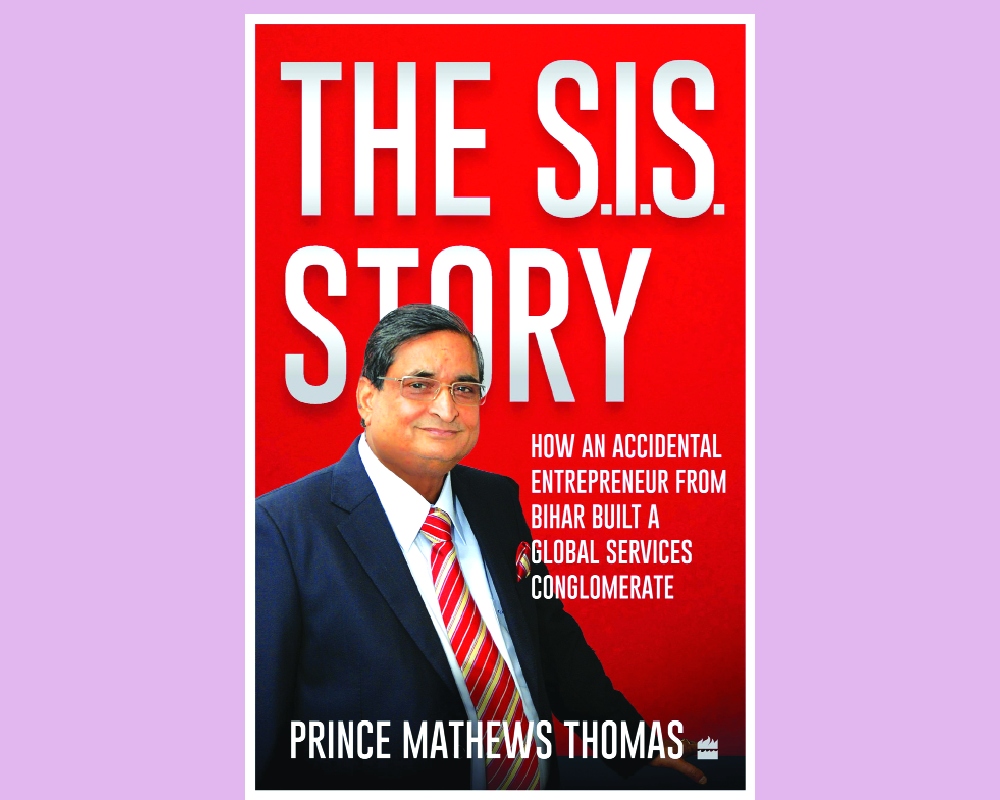
The most transformative stories of Bharat don’t unfold in Delhi’s power corridors but in the industrious heartlands of India. As Bihar moves from political rhetoric and electoral promises towards electing its state government, The SIS Story by Prince Mathews Thomas on Security and Intelligence Services (SIS) and its founder, RK Sinha, is an inspiring account emerging from the state of India’s entrepreneurial spirit long before the phrase “Make in India” was coined.
The book celebrates how vision, discipline, and relentless effort can turn a Patna-based security start-up into a multinational leader, making it stand tall as one of the few listed companies from Bihar, as also remarked by SEBI chairman UK Sinha.
The SIS Story is not just a business biography that celebrates the journey of RK Sinha, a journalist turned entrepreneur, who, inspired by the popular socialist leader Jayaprakash Narayan, founded the Security and Intelligence Services group in 1974 with the intent to provide employment to ex-servicemen and youth from Bihar, but is also a feat of immense symbolic and economic importance, highlighting how RK Sinha and his son, Rituraj, managed to build a company that not only created wealth but transformed millions of lives through employment. What began as a modest security services firm has now evolved into a global conglomerate with operations spanning Asia-Pacific, Australia, and New Zealand. The book allows readers to trace not only the company’s growth but also the moral and cultural ethos that underpins it.
The first part of the book chronicles RK Sinha’s journey from humble beginnings to pioneering technology and modern management in a Bihar-based firm in the early 1990s. He represents a man ahead of his time, deeply rooted in Indian values, whose “founder’s mentality,” as Thomas shares in the book, revolves around the three principles of ownership, challenging the status quo, and frontline obsession.
The most moving portions are those where the company’s culture is built from the ground up. RK realised early that his “product” was the guard himself. The “boot camp” system for training recruits in Bihar became a model of skill development decades before “Skill India” entered the national vocabulary. His insistence on grooming raw youth into disciplined professionals gave SIS both scale and soul. As India liberalised, RK helped shape an entire industry. The formation of the International Institute of Security and Safety Management (IISSM) and the ASIS chapter in India gave the private security sector its first professional platform. Thomas paints these years of SIS growing from a regional player to a national brand vividly, often fending off multinational rivals like Group 4 and Securicor with sheer ingenuity and relationships.
The passing on of the baton to Rituraj Sinha marks the book’s second act. Rituraj infused technology, management systems, and strategic partnerships. The “Seven Finger Model”, a performance matrix devised mid-air on a flight, became a defining management innovation, quantifying growth and efficiency. When SIS later sought capital, this professionalism paid off.
The 2008 acquisition of Chubb’s Australian operations, a company seven times SIS’s size and a deal far riskier than Tata Steel’s Corus acquisition, is narrated like a corporate thriller, redefining the narrative around Indian firms buying and turning around Western companies.
Subsequent chapters capture SIS’s diversification into cash logistics, facility management, and tech-led services. Rituraj’s focus on data-driven leadership, the creation of OneSIS and VProtect platforms, and his vision for a professionally run conglomerate underline how the company continues to evolve.
Prince Mathews Thomas, quite like his biography on Ratan Tata, avoids corporate jargon and instead humanises the story with anecdotes. Quite true to his style, Thomas brings both clarity and empathy to this narrative, showing how SIS’s journey mirrors the aspirations of middle India.
At a time when Bihar’s headlines are dominated by politics and migration, The SIS Story offers a counter-narrative of success born from the same soil. It is a tribute to self-belief and institutional thinking, a reminder that transformative enterprises can emerge from anywhere if led with purpose. R.K. Sinha’s journey from Patna to a global boardroom embodies what “Make in India” truly stands for: building with integrity, employing with compassion, and expanding with vision.It is not just the story of a company; it is the story of Bharat’s quiet revolution.
(A senior publishing professional, Lipika Bhushan is the host of TheIndicPen podcast and founder of MarketMyBook. She tweets @LipikaB); views are personal