Nestled amid the whispering pines and mist-kissed hills of Pangot, a quiet village near Nainital, something beautiful is taking shape — not just in the form of delicate crochet patterns, but in the renewed confidence of the women who create them. Here, threads are not just intertwined into yarn but into dreams, dignity, and independence — all thanks to the vision of a 29-year-old Ridhi.
What began as a humble idea in a schoolgirl’s mind has today grown into ‘Baini’ — a grassroots enterprise transforming lives, one crochet stitch at a time. The name Baini, which means “sister” in Kumaoni, embodies the warmth, unity, and shared purpose of the women who are part of this movement.
“I was born and brought up in Nainital,” Ridhi recalls, her voice reflecting both nostalgia and determination. “Even as a student, I often saw women in the mountains carrying bundles of grass and firewood from forests. I wanted them to have home-based livelihood opportunities because they don’t have the luxury of time to work outside.”
Years later, after completing her Master’s in Sustainable Development from TERI School of Advanced Studies (TERI SAS), Ridhi found herself working a 9-to-5 job — until a new creative pursuit unexpectedly changed her course. “I picked up crocheting as a side hobby during my job — a craft I learned from my mother around that time,” she recalls. “When my friends began showing interest in the products I made, I realised it could become more than just a pastime.”
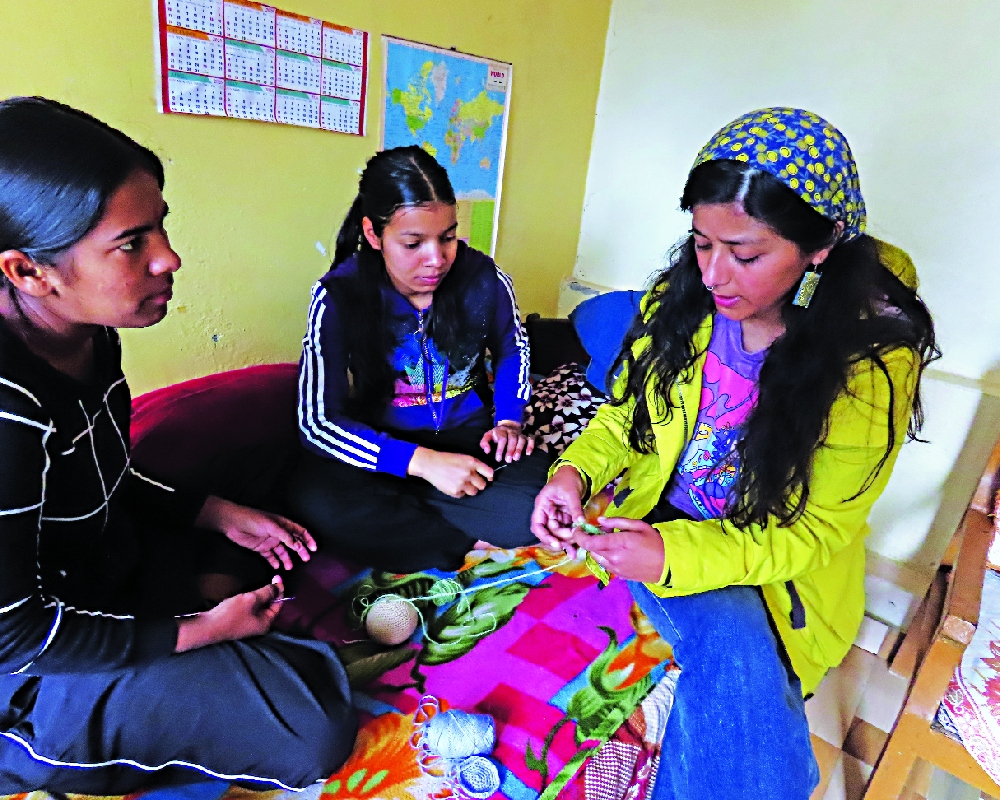
In 2022, armed with yarn, hooks, and hope, Ridhi left behind the city and moved to Pangot. There, she began teaching crochet to a small group of local women. “Initially, people were sceptical. Some girls were hesitant to join because they didn’t understand what I was trying to do,” she says. “But when they saw others earning and enjoying the craft, they came forward. That gave me strength.”
Today, Baini has blossomed into a vibrant collective. Women artisans, many of whom had never worked for an income before, now earn between `2,000 and `7,000 a month — creating intricate crochet products ranging from earrings, flowers, and toys to bags and sweaters. The group has its own retail outlet in Pangot and supplies products to cafés and stores in Nainital, Bhimtal, and nearby towns.
Every crochet loop, every handmade petal tells a story - of resilience, patience, and purpose. Ridhi has personally trained each artisan, ensuring not just skill-building but confidence-building too. “I’ve taught crochet to all the girls myself,” she says with quiet pride. “Currently, we’re training 15 more women in collaboration with Green Hub and Royal Enfield. The idea is to make sure no woman feels she has to leave her home or village to find work.” The initiative has not only brought financial independence but also emotional strength to these women — a quiet revolution of self-belief unfolding one loop at a time. Many of them say that Baini has changed their lives, allowing them to step out of their homes, meet new people, and discover their own worth.
Neha, who has been associated with Baini for three years now, was visibly shy when she first joined. Having learned crocheting directly from Ridhi didi, she now confidently makes earrings, toys, gloves, and much more — all while managing her household work. “I am happy to be a part of Baini,” she says with a smile that reflects pride as much as gratitude.
Another young woman, who was earlier confined within the four walls of her home, shared how her association with Baini transformed her world. “We were not allowed to go out of our house much,” she said softly. “Now I am able to meet my own expenses. I felt a different kind of association after joining Baini. I got new employment, and now I can support myself — something that wasn’t possible earlier. At home, we are treated differently now, and I even get to visit new places,” adds another.
Then there is Divya, who has been with Baini for four years. Her journey mirrors the transformative power of this initiative. “Earlier I used to sit idle at home, doing nothing and just passing time,” she says. “But after joining Baini, I can work from home, earn some money, and I feel so happy and lucky to be part of it. I’ve learned so much here and gained confidence to step out.”
Their stories — humble yet powerful - mirror the transformative essence of Baini. Each woman, through her craft, is weaving her own narrative of self-reliance and pride. What began as Ridhi’s individual dream has now become a collective tapestry of empowerment, where every thread represents a woman’s newfound purpose. Running a business in a remote Himalayan village wasn’t easy. “Being a first-generation woman entrepreneur, I had little understanding of how a business runs. It was a very hands-on learning process,” Ridhi admits. “But I’ve also had immense support - from people who believed in me, from customers who appreciated our work, and from the girls whose enthusiasm kept the initiative alive.” The visual identity of Baini — a Kumaoni woman gazing through a wooden window frame — pays homage to the region’s “ghasiyaris”, the grass-cutting women whose strength inspired Ridhi’s mission. Each product, crafted with care and creativity, reflects a fusion of tradition and modern design — much like the women behind them, blending heritage with hope.
The growing popularity of Baini has taken the products beyond the hills. They are now showcased in exhibitions, featured in local stores, and sold online through Baini Uttarakhand’s Instagram page (@bainiuttarakhand), also Delhi. Plans are also underway to expand further into Dehradun and other areas — taking the story of Uttarakhand’s women to new markets.
Ridhi’s initiative is a reminder that empowerment doesn’t always begin with grand revolutions — sometimes, it begins with a single thread. Her journey beautifully captures how an idea, when nurtured with compassion and purpose, can ripple through lives like a handwoven pattern, adding warmth to every heart it touches.
“I believe when you teach a woman a skill,” Ridhi says, “you don’t just give her livelihood — you give her freedom. And when that happens, the entire community changes.” In Pangot, that change is visible — in the laughter of women who once carried only bundles of wood but now carry dreams; in the colourful threads dancing between their fingers; in every handmade flower blooming not just on crochet hooks, but in lives. From a single girl’s dream to a sisterhood of strength, Baini is proof that when women weave together, they don’t just make crafts — they craft a future.
(The writer is Chief Reporter with The Pioneer, Chandigarh); views are personal