Where stone towers rise in resilience and poetry outlasts empires, Tamil Nadu emerges as the living heart of the Dravidian world. Its legacy is etched not only in temples and song, but also in the food that has carried its people through centuries of faith, struggle, and celebration. Nestled in the southeastern corner of India, it has always been shaped by its geography-the Bay of Bengal stretching endlessly to the east, the fertile Kaveri delta watering the plains, and the rocky uplands of the Deccan plateau testing the endurance of its people. These natural contours influenced where people settled, how they worshipped, and above all, what they ate. Tamil Nadu has, for over two thousand years, been a cradle of civilisation, evidenced in Sangam poetry, in the engravings of its temples, in the rhythms of Bharatanatyam and Carnatic music, and in the enduring food traditions that carry forward memory through taste.
Long before the 1st century CE, Tamilakam, as the land where the Tamil-speaking people resided was called, flourished under what came to be known as the “three crowned kings”-the Cheras, Cholas, and Pandyas. They were called crowned kings and not dynasties because they did not exercise a strict hereditary or unbroken rule; there were changes in power amongst them, but they served collectively as references to the prestige of the Tamil country for centuries. The courts of these crowned kings produced the poetry of the Sangam age, which told not only of conquests but also of landscapes, livelihoods, and meals. Poets categorised lands into five ecosystems, specifying typical foods for each. Rice and dairy in the marudham (plains), honey and millets like samai (little millet) and thinai (foxtail millet) in the kurinji (mountains), salt and fish in the neithal (coast), tubers and cattle produce in the mullai (forests) and hardy grains like kambu (pearl millet) in the arid palai (dry land). Markets in Tamilakam flourished as pearls from the Gulf of Mannar, pepper from the Western Ghats, and fine textiles from the Madurai region were traded at Rome and Southeast Asia and gold, wine, and luxury goods made their way to Tamilakam.
Cities such as Madurai, Vanchi, and Uraiyur grew into prosperous centres where culture and cuisine were inseparable from trade and geography. I think what stands out here is how naturally the land dictated the menu; food was not chosen, it was lived.
By the 4th century CE, the Pallavas rose to power, making Kanchipuram their centre. Rulers like Mahendravarman I and Narasimhavarman I crafted stone monuments at Mamallapuram; however, their impact extended beyond buildings. They fostered education using both Tamil and Sanskrit, and set up temple kitchens offering daily meals. These temples are where the celebrated Kanchipuram idlis, steamed rice cakes, were born. In time, it was seasoned with pepper, cumin and ginger and steamed with mandharai leaves as offerings for religious figures during lengthy ceremonies.
As the influence of the Pallavas declined, the Cholas emerged, whose power and wealth derived from the rich Kaveri basin. Starting with Vijayalaya and Aditya I, and ending with Rajaraja Chola I (985-1014 CE) and Rajendra Chola I (1012-1044 CE), the Cholas grew an empire that extended to Sri Lanka, the Maldives, and across the sea to Southeast Asia. Their Brihadisvara Temple at Thanjavur, consecrated in 1010 CE, still displays the wonders of the Chola people, and its inscriptions speak of kitchens, meals, and prasadam-grains transformed into sacred food so that people would be reminded that sustenance was divine. Tamil food also diffused with Chola empire rule; Chinese records tell of the Brahmin Kaundinya marrying the Cambodian princess named Soma and establishing the kingdom of Funan. The Tamil King Rajendra Chola’s naval expedition (1025 CE) further cemented Tamil relations with Southeast Asian royal households. When Angkor Wat began to emerge during the time of Suryavarman II (1113-1150 CE), stone engravings of Tamil-Khmer interaction began, with spices, rice, and coconut oil shipped East, while palm sugar and fermented fish returned to Tamil ports. It was the Pandyas who resettled Madurai in the 13th century, especially during the reign of Jatavarman Sundara Pandyan I (1251-1268 CE), who replenished temples and supported poetry, but their resurgence ended with northern incursions. Malik Kafur attacked Madurai in 1311 CE, and the Madurai Sultanate arose, and its Persian flavors of saffron rice, meat gravies, and nascent biryanis began to penetrate Tamil kitchens.
Power shifted yet again in 1371 CE, when the Vijayanagara Empire took over Tamil Nadu, ruling through their Nayak governors. Though they were royal governors, the Nayaks became wealthy and powerful promoters of arts and festivals, and did the same for food, adding Telugu and Kannada flavours to the mix: coconut-thickened gravies, spiced green chilli chutneys, and immense feasts that spread into temple courtyards for festivals. By the end of the 17th century, Tamilakam was under the rule of the Marathas, under Ekoji Bhonsle, whose Thanjavur court came to introduce rasavangi and pitlai — vegetable curries with tamarind and lentils — as well as festive puran poli, a sweet flatbread, which are cherished to this day. Legend even places the birth of sambar (a thick, tamarind-based lentil stew) in a Maratha kitchen, when a cook improvised a tamarind-lentil stew that would grow into one of Tamil Nadu’s defining dishes. Soon after, the Nawabs of Arcot introduced refinement through their biryanis, perfected with seeraga samba rice, whose small grains absorbed spices more deeply than basmati, creating a dish that became synonymous with Tamil feasts. Finally, under colonial rule, food was reshaped once again: French Pondicherry married sauces with Tamil curries, British Madras popularized filter coffee, and bakeries introduced bread and pastries into local homes. By the 20th century, what had once been confined to temples and royal kitchens flowed freely into restaurants and everyday mess halls, democratising a heritage that had absorbed every influence yet remained unmistakably Tamil.
History never stood still. The dynasties rose, the empires faded, yet the kitchen fire blazed bright. Through invasions, trade, and shifting rulers, it was the mortar and pestle, the simmering pot, and the shared meal that held families and communities together. The cuisine of Tamil Nadu reflects its history, a tapestry of regional flavors shaped by geography and culture. In Chettinad, cooks from Sivaganga and Pudukottai favored bold spices such as black pepper, fennel, and the rare kalpasi, particularly in lamb dishes and rich gravies. In
contrast, western Tamil Nadu’s Kongunadu region embraced simpler fare rooted in tradition, including millet porridge, rice blended with lentils, and coconut-based gravies. Further south, Nanjilnadu drew influence from Kerala, enhancing fish stews with coconut and serving them with tapioca. The areas of Chennai and Kanchipuram, historically known as Tondaimandalam, were renowned for their refined, temple-linked vegetarian dishes, such as tangy puliyodarai and the distinctive Kanchipuram idlis. Madurai, by comparison, emphasized hearty street foods, with specialities like kari dosa immersed in mutton gravy, complemented by the chilled sweetness of jigarthanda. Tamil cuisine carries stories across generations, representing not only methods of cooking but also ways of living.
Daily life often began with idlis, soft dumplings made from fermented rice and lentil batter, served with sambar or coconut chutney. More than sustenance, they offered comfort and continuity. From the same batter emerged the dosa, a thin, crisp pancake browned on steel, delicate at the edges yet soft within, enjoyed either with clarified butter or filled with spiced potatoes, offering nourishment that sustains body and spirit alike.
Dosa and idli began the mornings, while sambar and rasam sustained the day. Typically paired with rice, they completed meals-a testament to how Tamil cooks combine flavor with nourishment. Rasam, however, is distinct: a lighter, zestier broth made from tamarind (and at times tomato), sharpened with pepper, cumin, and occasionally garlic. In the rainy season, it provides warmth or soothes a scratchy throat, exemplifying how Tamil food unites taste with healing. Evenings often concluded with simple curd rice-cool yoghurt mixed into rice, seasoned with curry leaves and mustard seeds, sometimes enhanced with cucumber or pomegranate. Though modest in appearance, it remains consistently satisfying; for many Tamils, this dish comforts both body and spirit, embodying a sense of completion. Street vendors elevate everyday fare into spectacle, with kothu parotta showcasing inventive cooking. In night markets, the rhythmic clatter of spatulas breaking flatbreads on hot griddles fills the air, as cooks chop parottas and blend them with onion, egg, rich sauces, and ground meat, creating a sizzling, flavorful medley that is as entertaining as it is filling. Sweet traditions carry their own stories, such as Tirunelveli halwa-a rich, glistening confection of wheat and ghee, perfected by a single shop over generations and guarded like a family heirloom. Its silky strands pull apart like fabric before melting on the tongue, proof that culinary mastery, like culture itself, is passed faithfully from one generation to the next. In every dish, history lingered. What was once prasadam, or a royal indulgence, became an everyday comfort food. Flavors that once marked temples or palaces slowly found their way into homes and streets, reminding each generation that heritage could be tasted as much as it could be remembered.
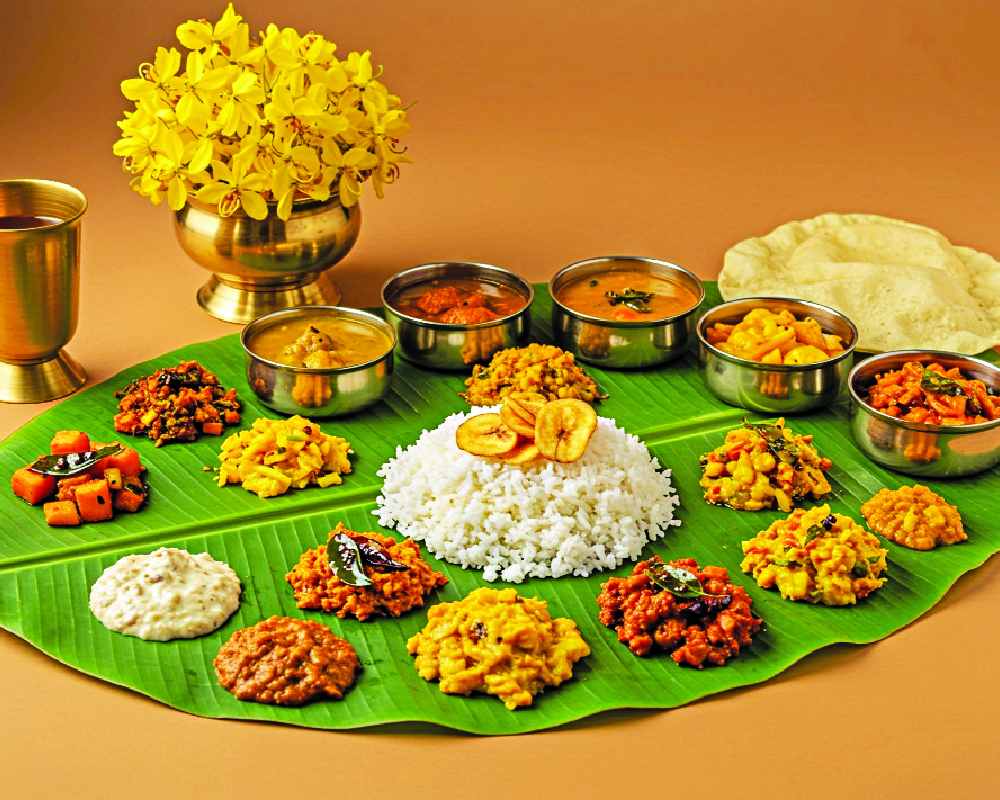
As you walk into a temple kitchen early in the morning, Tamil cuisine comes alive. There is ghee boiling in a brass vessel, moong dal is being roasted, and sponge pongal thickens on the fire, with chants sung simultaneously. At home, the banana leaves have been washed and laid, rice is mounded in the center, gravy is poured around the rice in a clockwise fashion, and sweets are placed on top like the ritualised order of a hymn. The stone mortar is sanctified with the grinding of spices, an iron tawa lifts a dosa as thin as paper, and a brass uruli (traditional round, shallow cooking vessel) makes simmering sweet puddings. Even the oil comes from land and sea: gingelly oil caramelises the pickles, groundnut oil crisps the fritter, and coconut oil melds together seafood curry. Each tool and ingredient is not merely functional but a custodian of continuity, linking today’s kitchen to centuries past. Tamil cuisine has never been static. From Sangam rice preparations to Pallava prasadam, Chola pongal to Pandya appams, Sultanate biryanis to Maratha sambar, Portuguese chilies to British filter coffee, every layer has been absorbed without erasing what came before. Today, millets, ragi (finger millet), kambu (pearl millet), and varagu (kodo millet), return to the foreground. A response to climate change and access to health, ancient ways still presage what is to come. Tamil food is limitless; dosas in Singapore, parottas in Malaysia, Chettinad curries in London, curd rice in New York lunch bags. Yet, wherever it goes, its essence remains.
And so, the responsibility rests with us. To pass on Tamil cuisine not only to preserve taste alone, but also to preserve health, heritage, and belonging. By consciously continuing these practices, whether through family kitchens, festivals, or modern reinterpretations, we ensure that Tamil culture does not just survive but thrives. These meals are not relics of a bygone age; they are solutions for the future, sustaining both body and spirit. In carrying them forward, we act not just as cooks or consumers, but as stewards of a living legacy that has endured for millennia and must endure for generations yet to come.