Telangana, located on India’s Deccan Plateau, is known for its attractively rugged landscape, picturesque rivers and lakes, and long historical continuity. The Krishna and Godavari rivers meander through its fertile fields, while smaller lakes and tanks, many engineered centuries ago, continue to fascinate by its beauty besides serving as essential water sources. Hyderabad, the capital, is renowned for its breathtaking architecture and exotic cuisine while towns such as Warangal, Nizamabad, Karimnagar, and Khammam reflect regional development grounded in agriculture, technology, and cultural heritage. The varied geography and long historical heritage of this area have shaped a distinct cultural identity that continues to evolve in modern India.
Archaeological discoveries have identified sites like Padavulagutta, Ragonda, and Eturunagraram as cradles of prehistoric life inhabited by people in the Stone Age who lived close to the rivers and used tools crafted from quartzite.The historical narrative of Telangana, however, begins more than two thousand years ago when the region was part of the Satavahana domain known for their administrative and trade systems that nurtured agriculture, coin production, and commercial exchange with other parts of India and overseas networks. Sites in Phanigiri and Kotilingala have revealed coins, pottery, and relics that demonstrate its wide trade connections besides the presence of Buddhist monastic institutions. During this era, the early growth of Telugu as a language of the people is known to have begun alongside Prakrit and Sanskrit.
The eminent pre modern dynasty of the region was the Kakatiya dynasty, which emerged between the 11th and 14th centuries with Warangal as its capital. The Kakatiyas consolidated the region’s famed agricultural economy through the construction of extensive irrigation tanks and implemented administrative practices with local village participation. Their rule is also distinguished by its patronage of architecture and intricate designs in sculptures. The Thousand Pillar Temple in Hanamakonda and the fortified structures of Warangal stand testimony of Kakatiya exquisite craftsmanship. Telugu inscriptions were widely used and promoted the language as both an administrative and literary medium. The period also recorded increased participation of women in governance, most notably under Rani Rudrama Devi, whose leadership is embellished in regional history.
Following the decline of the Kakatiyas due to invasions from the north, the region entered a phase of political transition. The Bahmani Sultanate and later the Qutb Shahis established control, contributing influences that blended with existing Telugu culture. The founding of Hyderabad by Muhammad Quli Qutb Shah in the late sixteenth century positioned Telangana as a center of Indo Persian art, architecture, and literature. The Charminar and Golconda fort are standing examples of refined planning and craftsmanship from this period that have stood the test of time. Diamond production from Golconda mines flourished and elevated the region’s commercial status globally.
By the eighteenth century the Asaf Jahi Nizams, a dynasty founded by Mir Qamar-ud-din Siddiqi in 1724 consolidated authority and developed the princely state of Hyderabad. Under the Nizams, Hyderabad grew into the main center of administration, health care, and education. Universities, hospitals, railway networks, and public projects expanded infrastructure and helped promote a sophisticated urban society. At the same time, rural Telangana experienced neglect and hardship through feudal agrarian systems, which led to organised resistance movements in the mid twentieth century. These struggles influenced political developments after India gained independence in 1947 and the princely state of Hyderabad eventually integrated into the Indian Union in 1948. Telangana later joined with Andhra regions to form Andhra Pradesh in 1956. Following the principles of equitable distribution of resources and recognition of cultural identities, a separate Telangana state came into being on June 2, 2014. Today Telangana is building upon both historic continuity and modern development strategies specially in infrastructure and information technology to define its own future within the country.
Diverse religious traditions have made Telangana what it is today over many centuries. Early evidence from excavations confirm the presence of Buddhism in various parts of the region. Monasteries, stupas, and inscriptions show that Buddhism held cultural and educational influence during the Satavahana (1st century BCE to 3rd century CE) and Ikshvaku (3rd to 4th century CE) periods. Although Buddhism gradually declined, the values of community and simple ritual practices remained evident in social customs.
Hinduism however, held a prominent position once the Kakatiya dynasty (12th - 14th century CE) with their capital in Orugalu (modern day Warangal) came to power. They controlled a large portion of Eastern Deccan and are recognized for their contribution to art, literature and architecture.The Ramappa Temple, constructed under the patronage of Kakati Ganapati Deva during this period is famous for its detailed carvings and unique structural characteristics, and remains to this day an important heritage site. Devotion to Lord Rama is central at Bhadrachalam where a large number of pilgrims converge especially during the Sri Rama Navami festival. Sri Sita Ramachandraswamy temple built here, on the banks of the Godavari River, is the site where the periodical Pushkaram and Maha Pushkaram are celebrated with enthusiasm and mirth. Local guardian deities such as Pochamma and Maisamma continue to be worshiped in villages through seasonal and agricultural festivals that have helped reinforce a relationship between community and environment.
Islamic heritage coexists harmoniously in Telangana particularly in Hyderabad where historic mosques, Sufi centers, and community institutions are a part of the city’s culture. The Makkah Masjid built during the 17th century is one of the largest mosques in India accommodating over 10,000 devoted worshippers and regularly attracts visitors from far and near. Sufi dargahs including Yousufain dargah reflect a spiritual culture that values inclusiveness and prayer as a shared human expression that is practiced with much enthusiasm even in modern times.
Telangana is also home to Christian, Jain, and Sikh communities whose places of worship contribute to a landscape of plural faith traditions. Tribal communities maintain distinct spiritual practices centered on nature, ancestral memory, and seasonal cycles. This religious diversity forms an integrated social structure where public festivals, neighborhood rituals, and culinary traditions reflect mutual influence and respect that is the hallmark of the region’s harmony and community living. These histories and beliefs are expressed clearly in Telangana cuisine, which is both practical and yet exotic. Local agriculture and climate have shaped a food system where millets and sorghum play a major role. Telangana cuisine is usually grouped into three major culinary streams; Telangana inland cuisine, Hyderabadi cuisine, and tribal cuisine. Each stream differs in ingredients, cooking techniques, flavor profiles, and social context but together they reflect a common cultural identity of the state.
Telangana inland cuisine is known for its simplicity yet intricate cooking techniques and strong flavors. Cereals such as jonna (sorghum), sajja (pearl millet), and occasionally ragi (finger millet) are commonly used as the base. These grains are cooked in the form of roti, which are thick breads traditionally cooked on a flat griddle till they are puffed and tanned. Meals are generally paired with pappu, which in the local dialect means lentils, and are prepared with seasonal greens or vegetables. Tamarind adds sourness to many dishes especially in pulusu which is a type of tangy stew, also a part of the menu. Red mirchi (chili), used extensively, gives the cuisine its distinctive color and spicy heat. Gongura (sorrel leaves) is prepared in several forms including gongura pacchadi where the leaves are combined with chilies and garlic to produce a sharp and sour flavor. Curries such as vankaya (brinjal), sorakay (bottle gourd), and beans provide balance with texture and nutrition to the meal. Among meat dishes, mutton and natu kodi (country chicken) are widely popular. Another local favorite is dalcha, a hearty lentil stew often cooked with mutton or vegetables, slow-simmered with tamarind and spices to create a wholesome accompaniment to rice or roti. Telangana cuisine also features snacks and festival foods like sakinalu (rice flour and sesame coils) made during Sankranti, and sarvapindi which is a savory rice flour cake mixed with chana dal (split chickpea) and green chilies before being pan cooked to a firm consistency; ideal for a snack in-between meals.
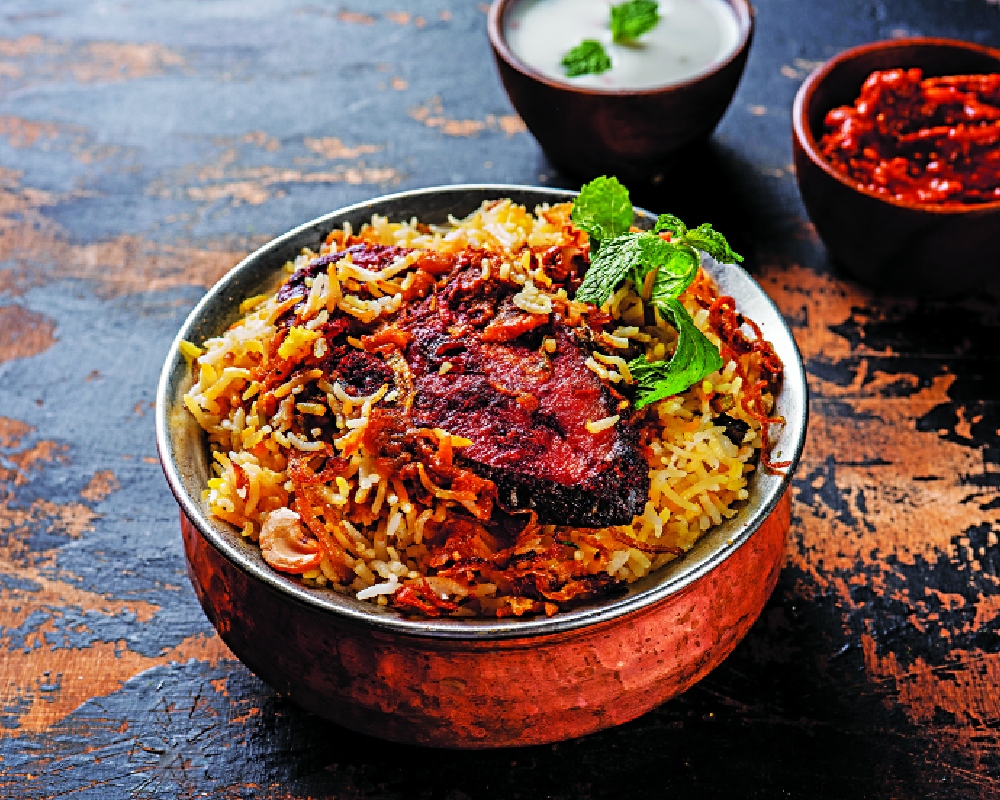
Hyderabadi cuisine, on the other hand, has witnessed multiple culinary innovations and evolved through interactions among Telugu, Persian, Turkish, and other regional influences under the Qutb Shahi and Asaf Jahi courts. The most popular dish of course is the famed biryani, where basmati rice is layered with marinated meat and cooked with spices including dalchini (cinnamon), elaichi (cardamom), and lavang (clove). The tradition of slow steaming allows flavors to merge thoroughly with every grain of rice and the exquisite colors of the spices shine through along with its unique aroma. Kebabs and kormas show the importance of tenderizing meat over time and are blended with herbs and spices like cumin, coriander chilli, garlic, ginger and yogurt for a distinctive flavour. Another iconic preparation is pathar ka gosht (mutton), where slices of marinated meat are cooked on heated stone slabs, absorbing a smoky char and retaining a succulent texture that reflects the Nizam’s fondness for culinary artistry. These mesmerizing meals once adorned the tables of royalty and nobles but over the years are staple and available even in small cafes by the road side. During the month of Ramadan, haleem made from gosht, broken wheat, and lentils are prepared in almost all households. A popular vegetarian dish is bagara baingan, where brinjal is simmered in a sauce containing sesame seeds, peanuts, and tamarind. To top off the rich and spicy meals, Hyderabadi cuisine adds widely recognized sweets to calm and soothe the pallet. Sheer khurma made from milk and seviyan (vermicelli) is prepared during Eid. Qubani ka meetha features dried apricots cooked until soft and usually served with cream is another favorite during the festive season. Hyderabad is also known for its bakery culture and Irani chai. Osmania biscuits and tea houses, many modest but very popular, are preferred meeting places where discussions and long conversations are held over chai and snacks.
In the northern pockets of Telangana, in Adilabad, Komaram Bheem Asifabad, and their surrounding forests, food is more than sustenance. It is a way of living with the land. Tribal communities here cook what the earth and seasons offer: sturdy millets, resilient maize, wild greens, foraged tubers, and berries that stain fingertips and sweeten the day. Their kitchens glow with open fires, where ingredients are rarely over-handled, allowing their natural flavors to speak. One of the region’s most beloved delicacies, bongu chicken, is prepared by slipping marinated pieces of meat into hollow bamboo and letting the flames do the work. The aroma that escapes is smoky, earthy, and deeply comforting. Mahua flowers, gathered at dawn, become both food and a festive drink, marking celebrations, stories, and rituals that weave communities together. Everything including drying, fermenting, and smoking is part of a knowledge system passed down quietly through generations, rooted in sustainability long before the word became fashionable.
Across Telangana, everyday meals unfold with their own thoughtful rhythm. First come cereals such as rice or roti made from sorghum or other millets, forming the heart of the plate. Then follows a gentle parade of sides: a comforting pappu or dal, a tangy pulusu simmered with tamarind, a crisp stir-fried vegetable, and a bright pickle that wakes the senses, often raw mango or lemon. Curd arrives last, a calming finish that cools both palate and body. The flavors may be bold, but every spice such as jeera, methi, and rai earns its place, not just for taste but for nourishment. Even the simplest home-cooked lunch is an exercise in balancing heat, tang, texture, and health.
Festivals and celebrations bring their own sweetness. In many homes, thin and delicate pootharekulu, a traditional local sweet, crackles with ghee, jaggery, or nuts tucked inside. Freshly fried ariselu, another sweet, gleams golden with jaggery and warm ghee and a festive must-have. During Sankranti and Ugadi, sweet treats like polelu-soft, stuffed lentil flatbreads fried in ghee-and fluffy appam, made from fermented rice and jaggery, mark the joyous mood of the season. In bustling Hyderabad, double ka meetha still reigns as the dessert that defines special occasions, while velvety cashew sweets such as jeedi pappu delight guests of every age.
As Telangana finds its voice on global platforms, from tech corridors to international food streets, its cuisine stands unique. Millets, once viewed as humble grains, are being celebrated for their fiber and protein-rich goodness, and their role in diabetes-friendly diets. Young cooks are reinventing age-old recipes, blending tradition with modern flair, while local entrepreneurs bottle the region’s bold flavors including pickles, spice mixes, and ready-to-cook meals and send them to shelves near and far. Culinary tourism is giving travelers a taste of what farmers and home cooks have preserved with devotion.
Even as cities rise and lives grow busier, the region’s food culture holds steady, reminding us of where we come from. These recipes carry the imprint of farmers sowing in dry soil, artisans crafting tools, and elders stirring pots with practiced hands. The turmeric that boosts immunity, the garlic that keeps the heart strong, the fenugreek that soothes digestion, all reflect a quiet science embedded in tradition. Slow cooking, fermentation, and the use of minimally processed ingredients are not trends here but wisdom.
Passing these culinary traditions to the younger generations is vital for preserving cultural continuity across Telangana.The future of Telangana cuisine depends on its continued practice not only as a source of pride but also for the nourishment and environmentally conscious methods it represents. The recipes and ingredients born here have enabled communities to survive and flourish through changing seasons and circumstances while ensuring wholesome, balanced diets. Preserving these culinary habits today allows us to protect a rich cultural legacy and promote healthier generations ahead. We must ensure that each individual shares the duty and honor of ensuring that this knowledge remains strong so that the vibrant tastes of Telangana stay alive in kitchens everywhere and every generation continues to enjoy the nutrition, comfort, and sense of identity they carry within them.
(The writer is Secretary, Cuisine India Society)