“We were never merely rulers of land. We were custodians of dharma.”— Maharaja Rameshwar Singh of Darbhanga
The region of Mithila is suddenly in the news today — people have seen the highest peaks of Himalayas from their rooftops on a clear beautiful day in North Bihar. I remember seeing the Himalayan ranges from the terrace of our house Kanhaiya ji Kothi, located right opposite the Kameshwar Singh Mithila University within the university campus. It was an exciting sight for kids who were living in the Gangetic plains of Prayagraj and had no mountains nearby to boast of. We would visit Darbhanga and our father’s & Mother’s village in Sarisab Pahi in Madhubani during summer or winter vacations and during occasions like weddings, thread ceremonies etc.
Kanhaiya ji Kothi was named after my grandfather Late Sh Kanhaiya Jha, who was the nephew of Maharaja Kameshwar Singh, and I have some really fond childhood memories of fishing in the lake, relishing summer fruits like white jamuns, phalsa, mangoes, Chiku, peach etc. that grew abundantly in our campus. Meeting relatives in Rambagh palace, Guest House and tasting the best ever homemade mango padads and pickles, that Mithila is so famous for.
As I was constantly attached to my grandmother’s tail, I also remember the love and pampering we received whenever we visited our relatives in Darbhanga and in Madhubani. My grandmother Lt. Smt. Krishnalata Bahuasin and the Maharani Adhirani Kamsundari of Darbhanga Kalyani Singh, were best friends and we often visited her at Kalyani Niwas, beyond her visits to our home in Allahabad and our trips to Sagar Apartments, Delhi where Maharani Sahiba lived. As she was technically my grandmother’s aunt-in-law, they could not address each other by name, so they addressed each other with the nickname ‘Prem’.
In the fertile plains of Mithila, where the Kosi and Gandak rivers carve their way through the heart of North Bihar, ruled a dynasty unlike most in India. The rulers of Darbhanga were not just feudal lords, appointed in history by the Mughal Emperor Akbar himself, but as cultural trustees of a sacred geography — Maithila, the land of Goddess Sita, of scholars, and of tantric seekers. From the late 18th to early 20th century, their patronage shaped the cultural, religious, and educational identity of eastern India. Their political contribution towards the freedom struggle of India was notable, so were their contribution to education. The still present Darbhanga Houses in New Delhi, Mumbai, Kashi, Patna, Kolkata, Simla, Allahabad, and many other cities tell a tale of a presence that was larger-than-life.
Long before the Bengal Renaissance stirred Calcutta, Raj Darbhanga had begun nurturing its own cultural awakening. Maharaja Lakshmishwar Singh (1858-1898) and his brother Maharaja Rameshwar Singh (1860-1929) were not just aristocrats — they were reformers, scholars, patrons of knowledge, and Siddha Tantriks. Maharaja Lakshmishwar Singh opened the royal court to intellectuals, poets, and artists, supporting the Maithili language and Sanskrit learning. He donated generously to educational and public causes across India — from the Indian National Congress sessions to the establishment of schools and hospitals in Darbhanga. His successor, Maharaja Rameshwar Singh, took that legacy further — blending faith, philosophy, and governance. A devout Tantrik and disciple of the mystic Swami Sivachandra, Rameshwar Singh’s influence extended from the ashrams of Mithila to the Kamakhya Temple in Assam, which he famously helped restore after the devastating 1897 earthquake.
His deep understanding of Tantra and Vedanta inspired a revival of ancient Indian knowledge systems that bridged the spiritual with the scholarly. Maharaja Rameshwar Singh was considered a ‘Rajrishi’ (the sage king) by his people and awarded the Kaiser-i-Hind medal in 1900. Maharaja Rameshwar Singh was made a knight commander of the Order of the Indian Empire (KCIE) on 26 June 1902, was promoted to a knight grand commander in the 1915 Birthday Honours List and was appointed a knight commander of the Order of the British Empire, Civil Division in the 1918 Birthday Honours List.
“Rameshwar Singh was the philosopher-king of modern India — a monarch who combined mysticism with modernity.”— Historian T. K. Mukherjee, Indian Cultural Review, 1954
Temples, Tantra & the Sacred Geometry of Faith
The religious vision of the Darbhanga Raj went far beyond piety. It was architecture as theology — stone as scripture. The Shyama Temples, built near the heart of Darbhanga, remains a living testament to this synthesis. Built on the place which had the funeral pyres of the Raj Darbhanga family, the group of temples is dedicated to Goddess Kali and Shiva, its dark sanctum, ornate pillars, and pond-laced surroundings mirror both Tantric symbolism and Mithila aesthetics.
Similarly, the Kankali Temple, the Manokamna Hanuman Temple (built by my grandfather Lt. Sh Kanhaiya Jha), and numerous shrines across Rajnagar and Darbhanga Fort display a continuity of ritual, design, and devotion. Many of these structures were constructed with precise astronomical alignments — reflecting the Raj’s obsession with sacred geometry, vastu and the rhythms of the cosmos.
Maharaja Rameshwar Singh’s connection with the Kamakhya Temple in Assam marked one of the most significant episodes in the late 19th-century revival of Tantric practices. He financed and supervised its reconstruction after the earthquake, ensuring the reinstallation of the yoni-pitha (the central seat of worship). His contribution re-established Kamakhya as one of India’s foremost Shakti Peethas, drawing pilgrims and scholars alike. He had achieved his Siddhi at the Bhuvaneshwari temple at top of the hill, where the priests still speak of the Darbhanga Maharaj.
Architecture of Grandeur: Reflections of a Stately Past
When we drove around Darbhanga, I often saw the opulent palaces, the university building, the statues and the temples that told the story of Raj Darbhanga, I think I was a bit curious but being children we took our homes, our lives, the Bentleys & the Dodges, and the opulence, for granted. Raj Darbhanga was a realm of poetry, music, and devotion; a confluence where Sanskrit learning met modern education, and where art, religion, and architecture became instruments of social transformation. Yet, I would also sometimes wonder why everything seemed to be falling apart and in decay.
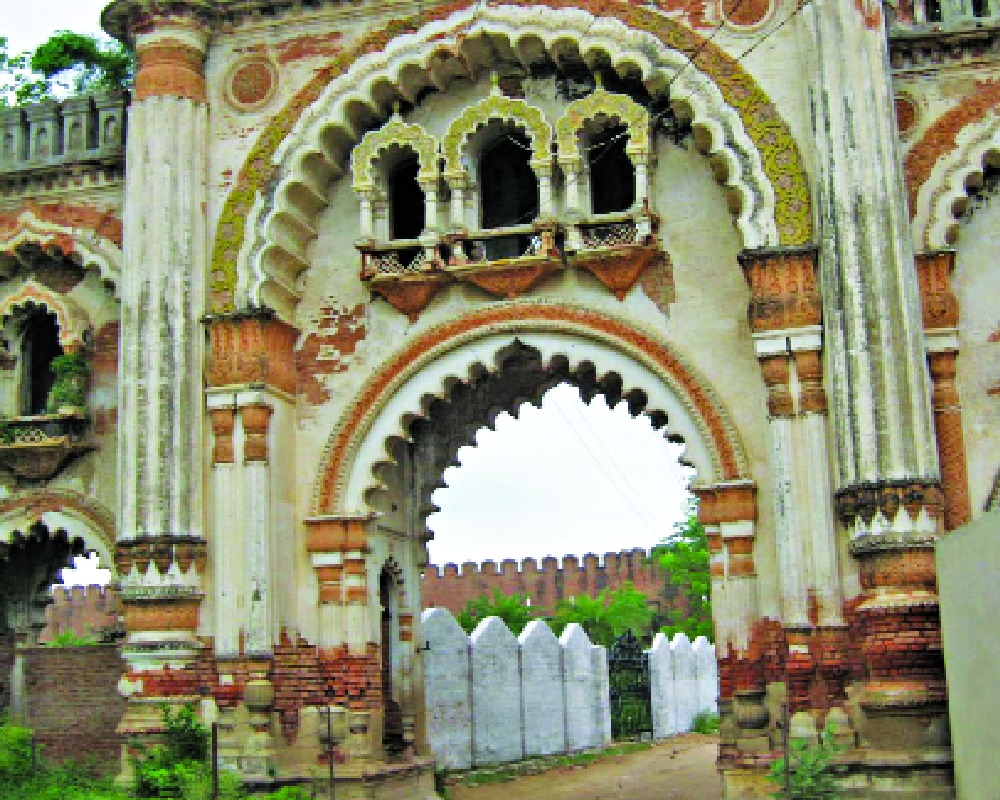
Among the most spectacular symbols of Darbhanga’s wealth and vision stood the Navlakha Palace at Rajnagar — an architectural masterpiece said to have cost nine lakh rupees (a fortune in its day). Built under Maharaja Rameshwar Singh, it combined European planning, Hindu ornamentation, and local materials. Sprawled over 1,500 acres with temples, lakes, gardens, and gateways, it was intended to rival any royal residence in India.
But the 1934 Bihar-Nepal earthquake reduced much of it to ruin. The cracked domes, broken spires, and overgrown courtyards still exude a melancholic beauty — a reminder of impermanence, as if the palace itself became a meditation on the cycles of creation and dissolution.
Nearby, the Darbhanga Fort (Rambagh Palace) — a walled city within a city — remains an enduring emblem of the Raj’s architectural might. Its high red-brick walls, watchtowers, and arched gateways blend military purpose with aesthetic grace.
The Lakshmi Vilas and Nargona Palaces, too, stand as reflections of a time when architecture served as both art and ideology. The Bela Palace, Sanskrit University, the Darbhanga Houses in New Delhi, Kolkata, Benares, Mumbai, Patna, and many other cities have been taken over by the Government and are thankfully considered heritage properties
Yet most of these structures today lie in neglect, some like 42 Chowringhee in Kolkata, have had the heritage buildings broken down to make space for wedding mandaps — mostly their grandeur fading under encroachment and time. Without active restoration, they risk becoming footnotes instead of living legacies.
The Darbhanga Gharana: The song of the Hindu soul
As a child I never thought that the Darbhanga Raj — one of the wealthiest and most influential estates in British India — was not merely a kingdom of power and palaces. It was a realm of poetry, music, and devotion; a confluence where Sanskrit learning met modern education, and where art, religion, and architecture became instruments of social transformation.
If architecture was the Raj’s visible art, music was its invisible soul. The Darbhanga court became the cradle of the Dhrupad tradition — one of the oldest forms of Hindustani classical music. The Darbhanga Gharana, established under royal patronage, produced maestros such as Pandit Ram Chatur Mallick and his descendants, whose deep, meditative renditions of Alap and Dhamar carried the resonance of temple chants.
I remember Pandit Ram Chatur Mallick paying a visit to my grandmother at our home in Allahabad. His visit had brought a lot of excitement and elaborate arrangements were made, of course, being a child at that time I did not understand why the fuss around the visit of this gentleman, but today I am grateful for his blessings.
The Maharajas’ love for music went hand in hand with their sense of spirituality — seeing raga as a path to self-realisation. Ustad Bismillah Khan, the shehnai legend, often recalled Darbhanga as one of the early courts that recognised classical music as a sacred art, not mere entertainment. He had a connection with Darbhanga from his childhood, indicating a long-standing relationship with the area and its royal patrons. Ustad Bismillah Khan was associated with Raj Darbhanga as a court musician, serving the Darbhanga royal family who were significant patrons of music in the region. Family legend says that the sound of his Shehnai set the stage for my parents and my aunt’s weddings in the 1960s.
Today, even as classical music struggles for mainstream space, the Darbhanga Gharana remains a living heritage — sustained by a handful of families who still practice in the ancestral style, their voices echoing through the ruins of palaces and temples.
The Media Visionary:
In 1931, Maharaja Kameshwar Singh established the newspapers The Indian Nation (English) and Aryavart (Hindi), to fulfill the wishes of his father Maharaja Rameshwar Singh, who believed in the power of media in nation building. It went on to become the voice of the people of Bihar and held great influence even in the power circles in New Delhi after India’s independence. The group also published a Maithili language magazine called “Mithila Mihir” that encouraged dialogue on art, culture, academics and literature of the Mithilanchal region.
Unfortunately, post the demise of the Maharaja, these publications did not survive the short-sightedness of the direct descendants of the Raj and the greed of the trustees from outside the family.
The Decline and the Dream:
After Maharaja Kameshwar Singh’s demise in 1962, the estate’s dissolution under the zamindari abolition act marked the end of an era. Yet his foresight ensured that the Raj’s wealth was reinvested in education and philanthropy. He donated vast tracts of land and properties to universities, trusts, and temples — ensuring that even in decline, the Raj’s values of knowledge and service continued.
Today, we the descendants of the royal family and heritage advocates in Mithila are calling for the revival of Raj Darbhanga’s heritage — through restoration of Navlakha Palace, heritage tourism around the Fort, and recognition of the Darbhanga Gharana as an intangible cultural treasure.
Reviving the Spirit and Legacy of Raj Darbhanga
Imagine Navlakha Palace reborn as a Museum of Mithila Culture, its corridors housing archives of Maithili literature, Paintings, Tantric manuscripts, and Dhrupad performances. Imagine heritage walks through the old Fort, or festivals of Maithili music and art, drawing visitors from around the world. In an age of cultural amnesia, Raj Darbhanga’s story reminds us that wealth and wisdom once walked together, and should be secured for future generations. Revival, however, starts with a dream and must go beyond just buildings and monuments. It is about restoring a worldview — one that believed culture was sacred, that faith could coexist with science, and that power found its noblest expression in service. The dream is not distant — only dormant.
(The author is Great granddaughter of Maharaja of Darbhanga Rameshwar Singh)