










Uttar Pradesh is a land shaped by rivers, roads, and centuries of history reflecting continuity amid change. At the heart of this landscape is the Triveni Sangam in Prayagraj, where the Ganga and Yamuna meet the mythical Saraswati. Rising from the Gangotri and Yamunotri glaciers in Uttarakhand, the Ganga follows a picturesque route through Devprayag, Haridwar, Kanpur, and Varanasi while the Yamuna travels through Yamunanagar, Delhi, Mathura, and Agra, carrying with it history and devotion. For millennia, pilgrims, poets, traders, and rulers have gathered on its banks in reverence, devotion and celebration. Here geography and spirituality blend. Bathing in these waters is believed to cleanse sins and grant liberation; rituals along the ghats mark births, deaths, and vows with solemnity. The Sangam shaped settlement patterns, inspired devotional traditions, and anchored festivals like the Kumbh Mela, which draws millions in astonishing displays of faith and organisation. It remains both a physical and symbolic center, where rivers, histories, and communities converge.
At dawn, standing on a ghat affords a vision of past and present interlaced not only of the rivers but the land they nourish. The air carries echoes of myth and memory, religion and philosophy as beliefs shaped over centuries continue to inform what this land means for present-day Bharat. It is here that the grand Ram Mandir was consecrated by Prime Minister Narendra Modi on January 22, 2024, on the birthplace of Lord Rama in Ayodhya. The history and legends of Lord Rama, who was born in the Treta Yuga have been eloquently recorded by Valmiki in the Epic Ramayana. After 14 years in exile, culminating in his victory over Ravana in Lanka, Rama returned to Ayodhya symbolising the victory of Dharma over adharma. This event, celebrated as Diwali, marks the restoration of justice and the ideal reign known as Rama Rajya. Even today Diwali is celebrated with joyful traditions: prayers are offered, gifts exchanged and sweets distributed in abundance. Ayodhya has now been transformed into a spiritual and cultural center celebrating the life and values of Lord Rama-truth, duty, and compassion.
In traditional accounts of the Dvapara Yuga, an age placed by some sources around 3100-3200 BCE, Lord Krishna, an avatar of Vishnu, is said to have been born in Mathura to Devaki and Vasudeva during King Kansa’s oppressive rule. Krishna was born in a prison cell and carried across the Yamuna to his foster parents Nanda and Yashoda. His life, playful yet philosophical, with a fondness for makhan (butter) and ghee (clarified butter), is celebrated in festivals, songs, and the Bhagavad Gita, which articulates a vision of duty (dharma), devotion (bhakti), and selfless action (karma yoga). In Mathura, the Krishna Janmabhoomi temple marks the sanctified site of his birth, and sweets like the famed Mathura peda (a milk-based treat offered as pras?da) remain integral to the devotional cuisine of the region.
Centuries later, between the 6th and 4th centuries BCE, Siddhartha Gautama (later the Buddha) is believed to have been born in Lumbini in the Shakya domain. He renounced princely life, practiced asceticism, and attained enlightenment at about age 35. His teachings - the Middle Way, the Four Noble Truths, and the Eightfold Path - spread through the region and shaped Buddhism’s vision of liberation (nirvana) and ethical conduct. Monastic communities of that era were centers of both learning and dietary discipline: simple grains, lentils, and local produce that sustained ascetics who traveled across pilgrimage routes, later became arteries for spice and ingredient exchange.
The region’s earliest chapters of history unfold across the mid-Gangetic plain, where settlements matured into organised states. Between the seventh and sixth centuries BCE, the Mahajanapadas of Kashi (centered in Varanasi), Vatsa (Prayagraj), and Kosala (near Sahet-Mahet) took shape. They featured fortified towns, early coinage, and deliberative assemblies. Varanasi and Shravasti grew as centers of learning and pilgrimage, as monks, merchants, and rulers converged, weaving networks of trade and faith. Along those trade routes, aromatic spices and condiments such as adrak (ginger), jeera (cumin), and haldi (turmeric) began to circulate, enhancing local cuisines and fueling early culinary exchange across regions.
Then with the rise of the Mauryan Empire (around 322-185 BCE), imperial governance extended over vast regions. Roads were surveyed, ferry routes regulated, and royal edicts inscribed on pillars. The Sarnath Pillar, crowned with the Lion Capital, became India’s National Emblem. Stupas and monasteries dotted the landscape as Buddhism and Jainism flourished under Emperor Ashoka. Art and sculpture thrived, and Ashokan edicts written in Prakrit and Brahmi script witnessed the linguistic and administrative uniformity of the Mauryan Empire. Later, between 320 and 550 CE, the Gupta era came to be celebrated as a golden age: temple architecture evolved, and literary and artistic forms matured. This period marked the beginning of a new Hindu temple style featuring a square sanctum (garbhagriha), flat or curvilinear towers (shikhara), pillared halls (mandapas), and ornate doorways. The Dashavatara Temple in Deogarh, dedicated to Vishnu, one of the oldest stone temples, features carvings depicting scenes from the Ramayana and Mahabharata. Scholars and poets linked cities like Varanasi, Mathura, and Kausambi that became centres of knowledge and learning. Under Chandragupta II (375-415 CE), the empire peaked, building on foundations laid by Samudragupta and Chandragupta I.
As Gupta influence faded, smaller kingdoms arose. From the sixth to eighth centuries, the Pushyabhuti dynasty ascended. Harsha Vardhana, whose reign ran from about 606 to 647 CE, made Kannauj a political and cultural pivot. In subsequent centuries, the Gurjara-Pratiharas, Kalachuris, and regional powers contended for dominance across the Ganga valley, each introducing their own cultural practices and dietary habits.
With the establishment of the Delhi Sultanate around 1206 CE, under the Mughals, Agra grew as an imperial center and monuments like the Allahabad Fort and the Taj Mahal were built. Over time, local cuisines selectively absorbed a few methods while retaining their core character. From about 1526 CE onward, Mughal rule made this region the heart of its empire. Agra flourished under Akbar (1556-1605). Fatehpur Sikri, built between 1571 and 1585, served briefly as imperial capital. Shah Jahan commissioned the Taj Mahal, completed in 1653, as a memorial of enduring beauty. Close to the sacred confluence, Akbar ordered the construction of Allahabad Fort in 1583. The fort overlooks the Sangam, encompassing the sacred Akshayavat tree and the Ashoka Pillar-an assertion of imperial presence over religious geography. Its massive walls, three galleries, and high towers mark it as among the grandest Mughal constructions in the region. As Mughal power waned, Awadh asserted its cultural identity. In 1775 Lucknow flourished as a capital and cultivated a refined etiquette and architecture (e.g., Bara Imambara), alongside further refinement in hospitality and cuisine rooted in old regional practices.
The revolt of 1857 shook cities including Meerut, Kanpur, Lucknow, Banaras, and Prayagraj. Qaisar Bagh was besieged, many structures ruined. In 1858, the British Crown assumed direct rule, redrew administrative lines, extended railways, and imposed new municipal systems. Nevertheless, deeper cultural patterns-settlements along rivers, artisan quarters, pilgrimage circuits-persisted. Even under colonial rule, architectural life evolved. In 1881, the Husainabad Clock Tower rose beside the Rumi Darwaza at nearly 67 meters. Its Gothic-Victorian form fused European mechanics with Mughal scale, becoming a timekeeper in a city rich with history.
The same forces that shaped civic life also molded cuisines. The rivers taught households to adapt to the cycles of the seasons: to store and preserve when floods receded, to stretch ingredients with care during lean months, and to celebrate abundance when the waters returned. Pilgrimage gave rise to foods that could be prepared quickly and served to travellers without losing flavour or sanctity, while royal kitchens refined the arts of patience, layering, and control of heat. Techniques and ingredients travelled along trade routes and later by railways, seeping from court to village, from temple courtyard to urban street. Courtly practices became part of daily life not through wealth, but through repetition and reverence for the art of cooking. These foods were not just flavourful; they were nutritionally balanced, built on dairy, pulses, grains, vegetables, nuts, and spices that sustained communities through agricultural cycles and sacred calendars.
Uttar Pradesh’s cuisine grew out of this landscape, a intricate blend shaped by rivers, pilgrimage, royal courts, and fertile fields. Across its plains, distinct regional traditions emerged, each with its own ingredients, philosophies, and flavours. In the central plains, particularly around Lucknow, Awadhi refinement took root. Slow cooking, subtle spicing, and layered aromas defined this tradition. Galouti kebab, made from minced meat pounded to delicate softness, was perfected in royal kitchens. Korma blended dahi (yogurt) with gentle spices to create a smooth gravy that envelops meat or vegetables. Awadhi biryani was slow-cooked, its layers of rice and meat infused with the fragrance of kesar (saffron) and browned onions. Nihari, a marrow-rich stew simmered overnight for depth, emerged as a celebrated delicacy. Sheermal, a tender flatbread scented with saffron, and shahi tukda, crisp-fried bread steeped in thickened milk, reveal how sweetness and subtlety harmonise in this culinary tradition.
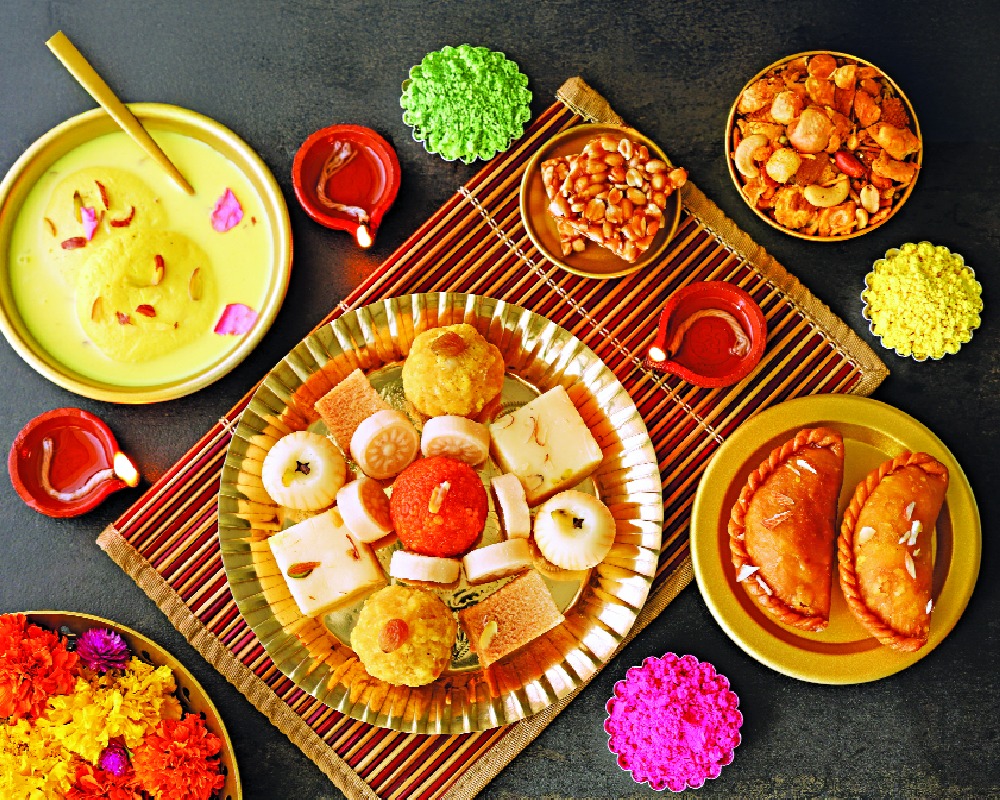
Further west, the Braj region of Mathura, Vrindavan, and Agra follows satvik principles inspired by Krishna bhakti, making milk, ghee, and butter the heart of daily and ritual cooking. Mathura peda is made by patiently reducing milk to khoya (milk solids) and sweetening it with cheeni (sugar) and elaichi (cardamom), while malaiyo is a delicate winter froth created by exposing milk overnight to dew, whipping it with saffron and nuts, and serving it at dawn in earthen cups. Makhan mishri is nothing more than freshly churned makhan (butter) with mishri (rock sugar)-Lord Krishna’s beloved snack-while bedai is a spiced urad dal (black gram lentils)-filled puri, paired with crisp, syrup-soaked jalebis. Gujiya, prepared during Holi, encloses khoya and nuts in a flaky pastry shell before frying and dipping in sugar syrup, creating a festival sweet that embodies both ritual and exuberance. Complementing these, malpua brings a crisp-edged pancake crafted from fermented wheat batter and milk, fried golden and steeped in saffron-cardamom syrup-its airy lightness and lingering sweetness captures the essence of Braj’s indulgent confections. In the Bhojpuri belt of eastern Uttar Pradesh, cuisine is hearty and agrarian, built around sarson ka tel (mustard oil), seasonal vegetables, and direct flavours. Litti chokha combines roasted wheat balls stuffed with spiced sattu (roasted gram flour) flour and smoky mashed vegetables drizzled with mustard oil. Thekua is a crisp, gur (jaggery)-sweetened biscuit traditionally made during Chhath Puja. Chana (chickpea) ghugni is a spiced chickpea dish, while parval (pointed gourd) ki mithai transforms pointed gourd into a sweet by stuffing it with khoya and nuts-a blend of rustic creativity and celebration.
The bustling pilgrimage towns of Varanasi and Purvanchal developed a street food culture where devotion and appetite meet on the roadside. Tamatar chaat-tangy, spiced tomatoes cooked down with chutneys and hing (asafoetida)-anchors this world, served in clean leaf bowls and topped with sev (chickpea flour noodles) and dhaniya (coriander). Kachori-sabzi pairs flaky, spiced puris with a thin, tangy potato curry, while dahi vada consists of lentil dumplings soaked in spiced yogurt. Malaiyo and rabri, both milk-based delicacies, sweeten winter mornings, and lal peda offers a rich caramel flavour unique to Banaras’s sweet shops.
In the northern reaches, cuisine reflects simplicity and terrain, relying on millets, pulses, greens, and fresh chutneys. Across the state, temple and fasting cuisines create dishes free of onion and garlic, following satvik principles. Panchamrit blends milk, dahi (curd), shahad (honey), ghee, and sugar as a sacred offering. Aloo-tamatar sabzi with poori brings together jeera (cumin)-scented tomato gravy and puffed wheat breads, while sabudana (tapioca pearls) khichdi and halwa sustain fasts with gentle sweetness and balance.
Certain dishes embody the culinary philosophy of Uttar Pradesh with clear example. The galouti kebab of Lucknow is less a recipe than a ritual: gosht is trimmed, minced repeatedly until smooth, mixed with roasted spices, nut paste, kaccha papita (raw papaya), salt, and fat, then shaped into thin patties, seared briefly, and brushed with ghee. Korma is also an elegant dish: yogurt-marinated meat or vegetables meet ghee and whole spices in the pot, cooked slowly until the sauce gleams and the aroma deepens with a touch of kewra (screwpine essence) or cardamom.
Awadhi biryani layers par-cooked rice and seasoned meat in a sealed pot, cooking slowly so each grain separates perfectly and absorbs saffron and spice without breaking. Nihari embodies patience-bones and meat simmer overnight with onions and warm masala, emerging by morning as a soothing stew enriched by collagen. Sweets complete the story. Mathura peda, made from patiently simmered milk, carries the sheen of ghee and the scent of caramelised sugar. Bedai with jalebi pairs blistered lentil-filled puris with syrupy spirals, a morning ritual in Agra and Mathura. Gujiya’s flaky, nut-filled crescents capture the festival spirit of Holi, passed from kitchen to courtyard with laughter and colour. This diversity of cuisine, its exotic flavours and aromas, complex and intricate cooking patterns provides both a fulfilling meal and nourishment making it a memorable experience difficult to replicate.
What, then, does Uttar Pradesh offer to a future that values heritage alongside innovation? Perhaps the same lesson it has offered for centuries: the most durable forms of civility are built from traditions, scriptures, and culture. The state’s ceremonies continue, from river processions to harvest gatherings, weddings to the vast Kumbh Mela. The older world has not disappeared; it has been folded into modern life with quiet elegance. Preserving these traditions is not only about taste or nostalgia. Uttar Pradesh’s cuisine has long balanced flavour with profound nourishment, combining rice, dals, sabzi, milk, ghee, and spices to create meals that sustain and delight. To keep this inheritance alive is to value both heritage and health. We are joining a living chain that teaches proportion, generosity, and care. Uttar Pradesh’s kitchens remind us that balance is its greatest strength, and that grace, like its flavours, endures.
It is our collective responsibility to move beyond simple appreciation and actively champion this heritage. We must not only rediscover the ancient balance of these kitchens, but dedicate ourselves to teaching this refined wisdom-its rhythms, its recipes, and its civilising legacy-to the next generation, ensuring it is proudly practiced for centuries to come.
(The writer is Secretary, Cuisine India Society)







