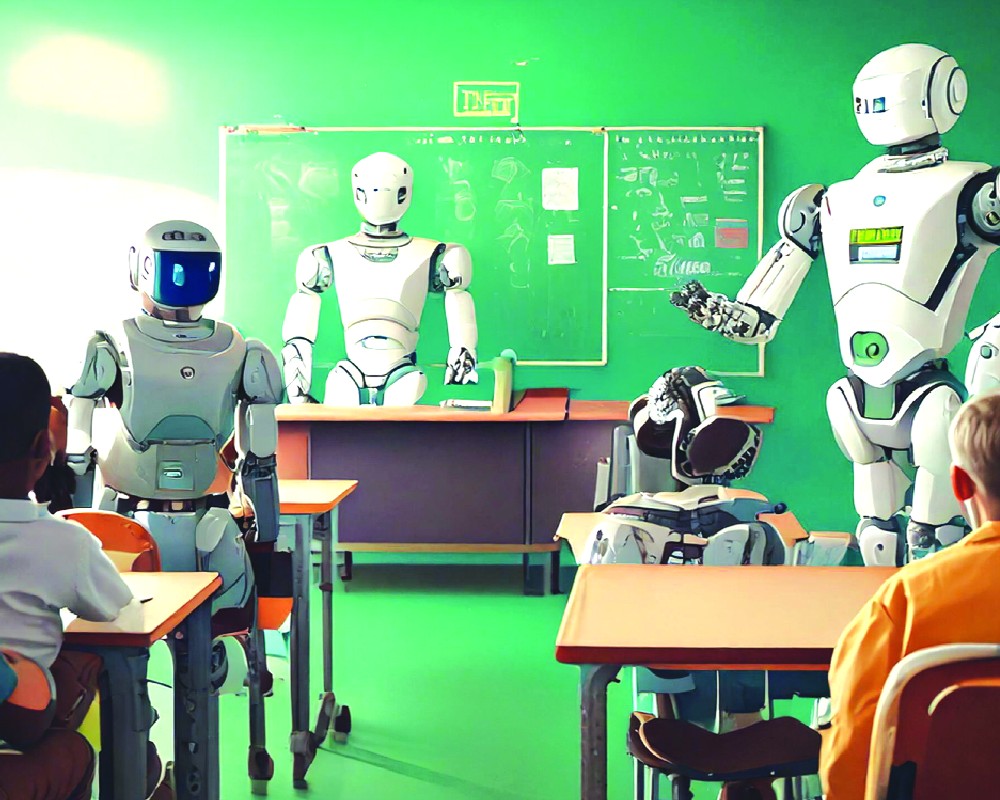
Artificial intelligence didn’t storm into education. There was no grand moment when classrooms suddenly changed. Instead, AI arrived slowly — through shortcuts during late-night study sessions, through apps that explained equations more patiently than tutors, through quick rewrites before a deadline. Over time, these small interactions added up. What once felt novel became routine. For many students today, AI is simply part of how thinking happens.
A final-year engineering student in Delhi said something recently that captured this shift perfectly: “Sometimes I’m not sure where my thinking ends and where the AI’s suggestion begins.” She wasn’t admitting guilt. She was trying to describe a new intellectual experience — the sense that the boundary between her own reasoning and digital assistance is fading.
The numbers across India and globally show just how quickly this shift has taken root. In the US, surveys of teens show that one in four now uses generative AI for schoolwork, double the number from 2023.
Adults, too, are interacting with AI at unprecedented rates, with more than 60 per cent saying they use it several times a week. In India, AI adoption in schools and colleges is accelerating even faster. A national survey reported that over 70 per cent of Indian teachers already use AI tools for creating lesson plans or automating administrative work, with the figure even higher among experienced teachers.
In higher education, more than half of Indian universities now permit students to use AI tools and many institutions are incorporating generative AI into curriculum design and learning materials.
The Indian market shows this momentum. AI in education here was valued at roughly $196 million in 2024 and is projected to cross $1.1 billion by 2030 — a compound annual growth rate of more than 30 per cent. That growth is driven by scale: India has over 40 million higher-education students and one of the world’s largest school systems, with 260 million schoolchildren and more than 8.5 million teachers. When a technology touches this system, even quietly, the effects ripple widely. But numbers only tell part of the story. What matters more is what AI is doing to the inner life of education — the process of thinking itself.
For centuries, education relied on a simple assumption: the work that mattered happened inside the student. The essay or the problem set was just evidence of that internal struggle. Learning meant grappling with ideas, wrestling with confusion, taking wrong turns and correcting course. It was slow, often frustrating work, but it built the kind of understanding that stays with a person for life.
AI scrambles this logic. It can produce clean, fluent, confident answers instantly. A student need only provide the prompt.
Studies from leading universities have found that AI-generated essays now match or outperform undergraduate writing in structure, clarity, and argumentation. Students who use AI to improve their essays often submit stronger
work— but when asked to explain the same ideas orally, their understanding is noticeably weaker. The surface looks polished, but the depth is missing.
Students feel the difference. Surveys in India and abroad show increasing anxiety: many students worry that AI is dulling their ability to think independently. A large majority say they often cannot tell how much of their work reflects their own reasoning. And this isn’t
laziness; it’s human psychology. When a system gives a smooth, immediate answer, it’s difficult to resist trusting it, especially under academic pressure. The trouble is that AI is not always correct. Large language models still generate fabricated information — so-called “hallucinations” — with surprising confidence. Depending on the question, error rates can range from a few percent to nearly a quarter. But students rarely have the time or context to verify every detail. When uncertainties are wrapped in fluent language, they blend into the student’s mental model without detection.
This challenge is magnified in countries like India, where access to high-quality teaching remains uneven. UNESCO reports that hundreds of millions of students globally
lack regular access to trained teachers and India alone faces a massive shortfall at multiple levels. In such environments, AI sometimes becomes a substitute for human instruction.
That can be a powerful equaliser — AI can deliver explanations anytime, in multiple languages, tailored to a student’s pace. But it also carries risks. When students rely on AI without the conceptual framework to evaluate it, they may absorb inaccuracies that weaken their foundations. This creates a new kind of inequality. In well-resourced institutions — elite engineering colleges, private universities, top public universities — students often use AI thoughtfully.
They test ideas, refine drafts, or explore alternative approaches. In under-resourced settings, students may use AI as a primary teacher. The difference is not access; it is epistemic resilience — the ability to question the information a system gives you.
Meanwhile, universities are struggling to respond. Some tried banning AI, but detection tools remain unreliable and risk penalising honest students. Other institutions welcomed AI but did not rethink how assignments are designed, even though many traditional tasks no longer measure what they once did. If a machine can produce a persuasive answer in seconds, what does an essay or a problem set really test?
International organisations have begun sounding alarms. Analysts warn that without assessment reform, countries could see a decline in deep literacy, reasoning skills, and independent thinking. These warnings apply strongly to India, where millions of students will interact with AI daily long before institutions fully adapt.
So what would meaningful change look like?
First, we need to redesign assessments so that they capture reasoning, not just results. Oral exams, in-class analytical tasks, multi-stage assignments with required reflections and reasoning logs bring the cognitive process back into view. These practices won’t eliminate AI use, but they make it harder for AI to replace thinking.
Second, we must teach AI literacy—not coding, but understanding. Students need to know how these systems work, why they sometimes make things up, how bias enters training data, and how to check whether an answer is reliable.
India’s linguistic diversity adds another dimension: tools trained mostly on English content may behave differently when asked questions in regional languages, and students need to be aware of that.
Third, transparency must become a norm. Academic journals already require authors to disclose how AI tools were used. Students could do the same. This simple practice restores agency and keeps the relationship between human thinking and digital assistance honest.
Fourth, India needs standards for the AI tools that enter classrooms, especially in rural and low-resource contexts. If AI will act as a teacher or tutor for millions, even informally, then accuracy, fairness, and reliability cannot be optional.
The stakes go beyond education. If societies produce graduates who sound articulate but lack the ability to evaluate information, democracy becomes fragile. A recent study found that people exposed to large amounts of AI-generated content were significantly more likely to believe misinformation, even when they thought of themselves as strong critical thinkers. When everything sounds polished, it becomes harder to know what to trust.
And yet, this is not a pessimistic story. Many students are using AI in thoughtful and creative ways: testing their understanding, checking assumptions, and pushing themselves to explore ideas they would not otherwise have considered. AI can sharpen thinking when used deliberately. The task before us is to build the structures that help students use it well.
AI is reshaping education through countless ordinary moments—the midnight rewriting of a paragraph, the instant solution to a problem set, the quiet doubt about whether an idea is truly one’s own. None of these feel dramatic. But together, they mark one of the most significant shifts in how knowledge is created, validated, and passed on.
We cannot reverse this transformation. But we can choose how to shape it.The future of education will not depend on whether AI exists in the classroom. It already does. The future will depend on whether students learn to use AI without losing trust in their own minds.
Author is a theoretical physicist at the University of North Carolina, United States; views are personal