




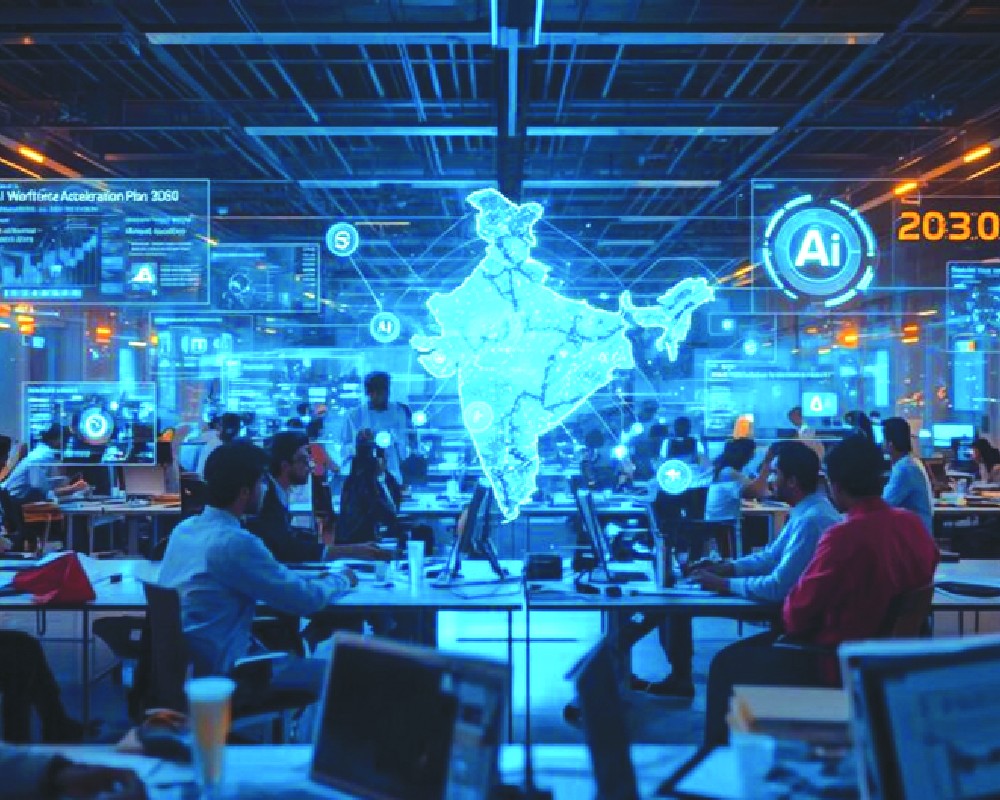
India has entered a period in which human resource management is no longer characterised by paperwork, checklists or rigid administrative routines. Instead, it is increasingly shaped by intelligent systems—machines that can interpret context, generate insights, collaborate with humans and increasingly operate with a level of autonomy once unimaginable.
As companies seek to retain competitiveness in a technology-driven economy, HR is quietly moving through its most significant shift since economic liberalisation. What once functioned as a support department is evolving into a digitally amplified and strategically influential system — built on Generative AI (GenAI), emerging Artificial General Intelligence (AGI) capabilities, agentic AI frameworks, Retrieval-Augmented Generation (RAG), the Model Context Protocol (MCP) and early signals from quantum innovation.
This transformation aligns closely with India’s current policy ecosystem. Initiatives such as Digital India, the IndiaAI Mission from MeitY, the National Quantum Mission and the Ministry of Labour and Employment’s Labour Codes are collectively steering the country toward a labour environment where digital infrastructure and public policy reinforce one another. Research from global advisory firms describes this moment as a move from traditional workforce administration to an environment where human capability is enhanced and scaled by intelligent systems.
The earliest wave of change was driven by Generative AI. Its significance for HR is not limited to drafting documents or automating communication. Instead, GenAI brings analytical and creative
intelligence into routine decision-making. Indian organisations are learning that GenAI can model
cultural attributes, forecast talent gaps, design multilingual learning pathways and adapt communication to diverse regional contexts. For the first time, creativity, analytics and cultural understanding are fused — transforming HR from a repository of forms into an adaptive talent engine.
Beyond this, the early contours of AGI are becoming noticeable. While true AGI remains in research territory, emerging systems that can reason, interpret uncertain human inputs, and offer higher-order insights hint at what is to come. Within HR, such intelligence could one day integrate economic indicators, workforce sentiment, external skill-market data and internal performance patterns to propose future organisational designs. Instead of responding to what employees do, these systems could analyse the motivations behind behaviour — enabling proactive workforce shaping grounded in advanced reasoning.
As India’s economy becomes increasingly knowledge-centric, AGI may guide everything from leadership pipelines to nationwide skill strategies.Agentic AI takes this transformation further. Unlike rule-based chatbots, agentic systems combine planning, memory, reasoning and autonomous execution. These agents can independently run multi-step HR processes — from talent sourcing and compensation benchmarking to employee experience monitoring and workflow coordination. They behave less like software tools and more like operational partners. Indian public-sector enterprises and large corporates can leverage such agents to continuously scan labour markets, manage hiring cycles, identify learning
trajectories or oversee organisational health with minimal manual intervention. This mirrors global predictions that autonomous AI systems will become deeply embedded in business operations within the decade.
Accuracy and contextual relevance in these systems are rooted in RAG, which grounds AI in an organisation’s internal knowledge base — policies, compliance records, case archives, labour advisories, audits, and skill frameworks. This is crucial in India, where labour regulations differ across states and HR must adhere to directives from entities such as MoLE, EPFO, ESIC, and SEZ authorities. When RAG indexes these sources, HR gains something akin to a highly precise institutional memory always accessible and free from interpretive ambiguity.
The Model Context Protocol (MCP) extends this intelligence into real-world action by connecting AI with HR and enterprise platforms such as HRIS, ERP, payroll, compliance tools, and IT systems. MCP enables automated onboarding, adaptive role changes, workload balancing and seamless internal mobility. It effectively closes the gap between insight generation and operational execution, turning HR into an always-engaged, intelligence-driven system rather than a reactive service unit.
Another emerging dimension is “vibe coding” — the effort to develop AI systems capable of understanding emotional tone, cultural nuance and collective organisational mood. Unlike conventional sentiment analysis, vibe coding uses multimodal AI to recognise psychological patterns across interactions. In a country as diverse as India — with its broad linguistic, cultural, and interpersonal variations—emotionally aware AI systems can provide leadership with a clearer view of organisational wellbeing. In an era of hybrid work and digital overload, such systems could become essential tools for empathetic, people-centric management.
Quantum computing represents the next frontier. Supported by India’s National Quantum Mission, the country is positioning itself among global contenders preparing for quantum capabilities. Quantum technology will not simply speed up HR tasks; it will address optimisation problems that classical computers struggle with — scenarios involving vast combinations of variables. HR planning fits precisely into this category. With qubits that can store multiple states simultaneously, quantum systems can evaluate millions of workforce arrangements at once. Quantum entanglement could allow these systems to quickly identify relationships between employee attributes, performance outcomes, cultural alignment and future skill potential. This could revolutionise team design, long-term workforce planning, capability forecasting, pay structuring and even diversity modelling. Quantum-driven HR tools may eventually allow Indian enterprises to simulate entire organisational futures—something beyond the limits of today’s analytics.
This technological shift coincides with a historic redesign of India’s labour ecosystem. The new Labour Codes — covering wages, industrial relations, social security and workplace safety — signal India’s most comprehensive labour reforms since Independence. These codes emphasise consistency,
digitisation and transparency. Organisations will need HR systems that can interpret regulatory changes in real time and adapt instantly. AI-driven HR environments become essential here. Autonomous systems can track compliance exposure, interpret state-level variations and align company policies with evolving Government notifications. Complementing this is India’s developing Labour Stack — a digital public infrastructure envisioned to create portable worker identities, authenticated skill records, digital career histories and integrated social security data. When combined with AI, this infrastructure could enable frictionless talent movement across industries, employers and regions — unlocking India’s demographic potential more efficiently than traditional reforms alone.
The convergence of AI, agentic intelligence, RAG-enhanced accuracy, MCP-enabled execution, and advancing quantum computing is steering HR toward a role far more strategic than administrative. With India’s digital-policy foundation and the scale of its enterprises, the country is uniquely positioned to adopt these technologies at national scale. The future of HR in India will belong not to organisations that simply automate tasks, but to those that design intelligent systems capable of continuous learning, reasoning and workforce orchestration. As India prepares for the next phase of economic growth, this augmented HR function could emerge as one of the most influential engines of institutional and national transformation.
The author is PGCIL, Director (Personnel) and a seasoned HR strategist with 35+ years of enabling business growth through change management, digital HR re-engineering and future-of-work readiness. A multi-award-winning professional and IIT Roorkee engineer, he continues to steer transformative people excellence and innovation in India’s power sector.; views are personal