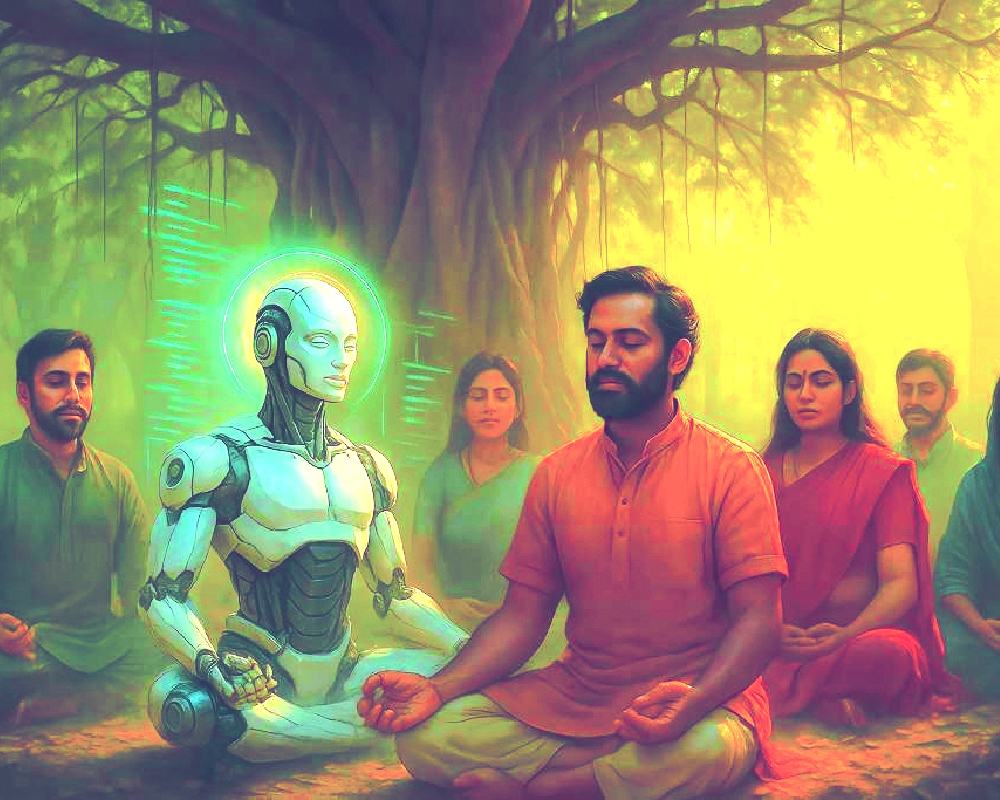
Artificial intelligence appears weightless — just code in the cloud, thinking at the speed of light. Yet behind that digital mist lies a heavy, physical world built from metal, electricity and heat. Every chat with an AI, every generated image, burns real power, releases real heat and depends on minerals pulled from the earth. India’s AI revolution is accelerating fast, but it rests on two fragile foundations — energy and elements. Without them, even the brightest algorithms fall silent.
The Hidden Fire Behind
the Cloud The “cloud” isn’t made of mist. It’s made of machines. Each data centre — the physical heart of artificial intelligence — is a warehouse the size of a football stadium, packed wall-to-wall with servers that hum, blink and never sleep. Together, they draw electricity on the scale of a small town.
Each chip inside them performs billions of calculations every second, and every calculation releases heat — enough to make these buildings feel like giant furnaces of intelligence. To prevent those servers from overheating, they must be cooled constantly. Not once a day. Not once a week. Every second, every minute, all year round. Cooling is what keeps the “cloud” alive.
But cooling comes at a cost. A single one-megawatt data centre and that’s considered small today — gulps down about 25 million litres of water a year just to keep its servers from melting. Now imagine dozens of such centres sprouting across Bengaluru, Chennai, and Mumbai — cities already gasping for water in summer. In places where residents line up for tanker deliveries, machines may soon compete with people for the same supply. And electricity? The numbers are just as staggering. According to the Institute for Energy Economics and Financial Analysis (IEEFA), India’s data-centre capacity will surge from 1 GW today to nearly 9 GW by 2030. Feeding that growth could consume 3 percent of India’s total power generation — roughly the same amount used by the entire state of Himachal Pradesh.
Cooling demand is exploding too. Mordor Intelligence projects that the water used for Indian data centres will climb from 150 billion litres in 2025 to 358 billion litres by 2030 — an increase of almost 19 Per cent every year. That’s more than all of Mumbai’s reservoirs combined. This is the unseen fire of the digital age: a network of vast engines that convert electricity into intelligence and heat. In the old industrial revolution, factories belched smoke; in this one, the emissions are invisible — measured in megawatts and degrees Celsius. The smarter our machines become, the hotter they run. And in a warming country like India, that’s an ecological paradox: intelligence that risks overheating its own environment.
The mineral side of intelligence:
The other side of AI’s hunger isn’t thermal — it’s elemental. Each chip that powers a large-language model depends on a complex chain of materials: lithium for batteries, cobalt and nickel for circuits, copper for conductors, silicon for processors, and rare — earth elements for cooling magnets and sensors. India imports nearly all of these.
The Government recently listed 30 critical minerals essential for advanced technologies and launched the National Critical Minerals Mission to reduce dependence. But building AI without securing materials is like trying to launch rockets without rocket fuel. If a single export ban or supply-chain shock hits — say, a shortage of rare-earth magnets or high-purity copper — India’s “intelligence factories” could slow to a crawl.
Globally, control over these minerals is becoming strategic. China processes about 60 Per cent of the world’s rare-earths and over 70 Per cent of lithium-ion battery components. The US and Europe are racing to diversify. For India, this isn’t just a trade issue — it’s a question of technological sovereignty.
When heat and minerals collide:
Now combine these two pressures — heat and minerals. Picture a data centre in coastal Chennai. It relies on imported chillers and high-grade copper cooling systems. A heatwave drives up temperatures, a water shortage limits cooling and a global supply delay stalls replacement parts.
Suddenly, servers must throttle their workload to avoid overheating. The smartest machines in the world begin to slow — not because of algorithms, but because of physics. That’s the uncomfortable truth: AI doesn’t fail in theory; it fails in thermodynamics. And without material resilience, even great software nations can become compute-poor.
The world has started noticing this new dependency. The International Energy Agency (IEA) estimates that global data-centre electricity use — largely driven by AI — could more than double by 2030 to 945 terawatt-hours, roughly equal to Japan’s current power demand. The United States is pairing new AI clusters with nuclear micro-reactors.
China has built hyperscale data parks powered by hydropower from Sichuan. The Gulf states are building AI centres near solar farms to offset cooling costs.
India can’t afford to simply follow. If our data centres keep clustering in crowded metros, we’ll drain grids and water sources before we scale AI itself.
A different blueprint for India:
The solution is simple and within reach. India can build its AI future where energy is clean, land is open and heat becomes an asset, not a waste.
Shift compute inland: Rajasthan and Gujarat, rich in sunlight, could host renewable-powered AI corridors where solar farms feed data centres directly, cutting costs and emissions.
Reinvent cooling: Replace water-hungry systems with liquid-immersion technology that reduces water use by up to 90 Per cent. Recycle waste heat to power nearby industries or urban cooling networks.
Mine and recycle smarter: India generates over three million tonnes of electronic waste a year — enough to recover valuable copper, aluminium and rare-earths for AI hardware.
Link science with infrastructure: Engineers trained in both AI and energy can design data centres that balance power, cooling and computation in real time.
This isn’t utopian; it’s simply India applying physics and geography wisely — turning sunlight, heat and waste into intelligence.
In the first industrial revolution, nations competed on horsepower.
In this one, they’ll compete on efficiency — who can run the most intelligence with the least energy, water and minerals. Think of it as a new kind of equation: Intelligence = Compute Power ÷ Resource Waste. The smaller the denominator — the less waste — the more intelligent the system becomes. India’s edge lies precisely here.
We have the sunlight, the engineers and the will to build cleaner, cheaper, more efficient systems. If we connect them wisely, India could become the world’s hub for green AI — intelligence that doesn’t overheat the planet.
A grounded ending
Every great invention leaves a trace of fire behind. Steam engines filled the skies with soot. The internet devoured attention as fast as it shared knowledge. Now artificial intelligence — humanity’s brightest creation — is burning silently, feeding on electricity, water and rare elements to keep its circuits alive. We call it “the cloud,” but there’s nothing weightless about it. Its mind is metal. Its breath is electricity. Its heartbeat is powered by rivers and sunlight. The brilliance that promises to change the world also risks overheating it.
India has the chance to break that pattern — to build intelligence that gives back more than it takes. If we treat energy, water and minerals as part of AI’s design, not as its cost, we can create a model for the world: a system that thinks in electrons but lives in balance with the planet. That would be the true definition of progress — not machines that outsmart us, but machines that coexist with us. Because intelligence, at its highest form, isn’t just about thought — it’s about empathy
for the world that allows thought to exist. When we achieve that, we won’t just have built smarter machines; we’ll have built a wiser civilisation.
Author is a theoretical physicist at the University of North Carolina, United States