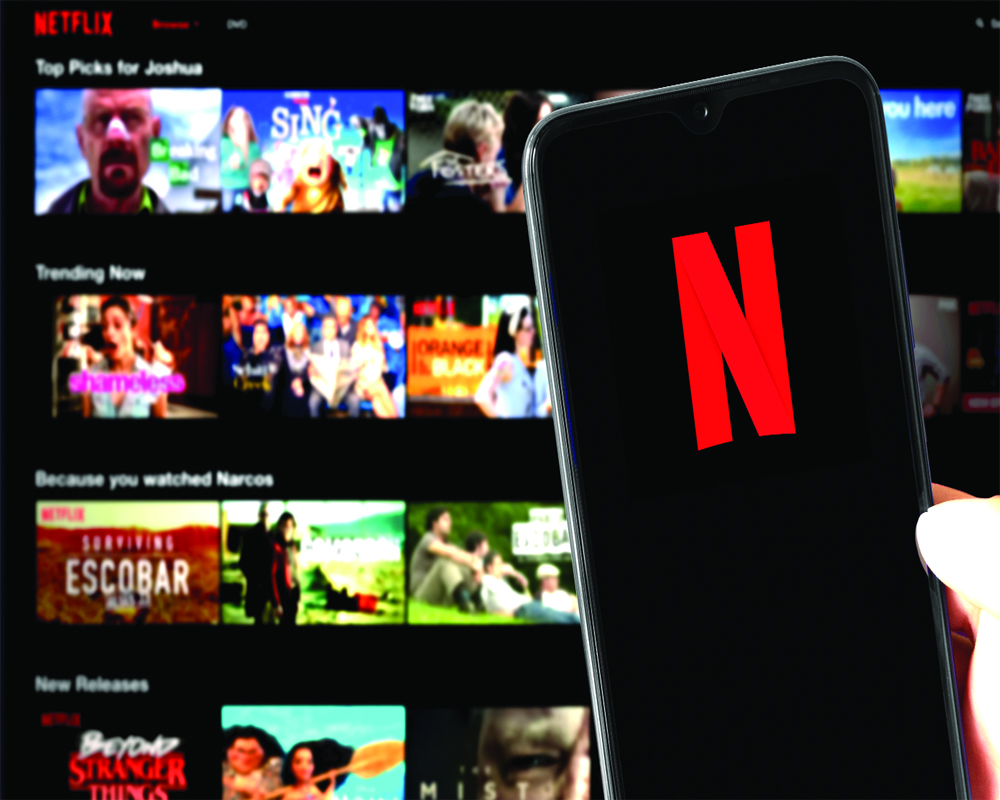
Netflix’s ascent from disruptor to dominator now balances precariously between boundless growth and the entropy of excess in an increasingly oversaturated attention economy
The year is 2015, Zayn Malik is leaving One Direction, bitcoin tops the currency charts, the Apple Watch promises to track your every calorie and Hotline Bling memes flood the internet. Meanwhile, with bated breath, viewers await the moment Kevin Spacey is crowned Best Actor at the Golden Globes for the House of Cards. In what was a high stakes $100 million gamble, House of Cards, Netflix’s inaugural in-house production, proved a resounding success, signaling that a once unassuming streaming service could truly rival television heavyweights. Having amassed 26 Oscars, Netflix has since legitimised its position as part distributor, part studio and definitive poster child of the great media migration.
In an age of proliferation and insatiability, few companies have come close to capitalising on the voracious appetite it generates more effectively than Netflix. With an operating margin of 34.1 per cent, a steady increase from earlier periods, it continues to ascend the greasy pole of entertainment with remarkable ease. The company’s latest posted earnings show a second quarter revenue growth of 16 per cent, reaching $11.08 billion, exceeding Wall Street’s projections. Fairly insulated from the ongoing trade war and swirling macroeconomic imbalances, it maintains vertiginous growth, a trend only complemented further by the weakened dollar.
Surging by nearly half in less than a year and pushing its market capitalisation beyond $500 billion as per Bloomberg, more than twice that of its rival Disney, Netflix’s stock prices are exceeding even bullish expectations.
Pandemic driven tailwinds have further propelled these valuations, delivering unmatched returns and resulting in “expectations hav(ing) gotten to thepoint that any disappointment would be a risk,” as observed by Michael Smith, head of Growth Equity and Senior Portfolio Manager at Allspring Global Investments. But even with shares trading steadily at a rough 10 per cent over average targets, a sign that much of the upside may already be priced in, investor scruples remain eased, underscoring the ironclad belief in the company’s market authority.
However, there’s no such thing as a free lunch. Netflix must inevitably contend with the malaise brought on by its closest and long — deemed suboptimal, competitor: YouTube.
With an expanding user base, especially in Asia-Pacific as per S and P Global Market Intelligence, which unsettles its market shares, YouTube, a pastiche spanning the absurd to the sublime, remains the go-to platform for effectively all kinds of content, a primacy terribly difficult to subvert. Its success in popularising short — form videos, particularly successful with younger audiences, has enabled the confiscation of a sizeable chunk of viewing time, chipping away at Netflix’s numbers.
As both vie for the same audience, Netflix sees a need for greater agility. With the past two years showing an almost 50 per cent average increase in operating incomes, its pivot to greater ad- supported services to sustain lucrative market growth reflects this need, unlocking unrealised revenue.
One can make the case for Prime Video, another streaming giant displaying vigorous subscriber growth and sustaining a premium valuation which trails not far behind Netflix. Although Prime Video’s existence at the intersection of Amazon’s diverse and intricate ecosystem gives it greater stability, it makes murky the degree to which streaming exerts a decisive influence on the conglomerate’s overarching valuation.
Not tethered exclusively to subscriber growth, Prime derives a structural advantage from Amazon’s simultaneous retail and cloud operations, suffering less from the immediacy of profitability pressures. Further, the multiplicity of touch points across the ecosystem deepen user engagement, cultivating a more enduring loyalty. But Netflix’s focus on pure-play streaming affords it an upper hand. Evading regulatory headwinds, Netflix offers a lesser risk option for investors particularly interested in the entertainment industry and its accelerated growth, with the singularity of purpose offering a more transparent revenue model.
Moreover, with Amazon now under fire from the Federal Trade Commission, most recently compelled to pay a record $2.5 billion civil penalty for allegedly deploying “manipulative, coercive, or deceptive user-interface designs known as ‘dark patterns’ to trick consumers into enrolling in automatically-renewing Prime subscriptions” as alleged by the FTC, it invites further scrutiny into the drivers of its profitability.
Whilst the penalty leaves not so much as a dent on a company with a market cap of $2.4 trillion as per FT, its swift conclusion offers investors a fleeting reprieve ahead of the larger antitrust trial slated for February 2027, in which Amazon faces allegations of leveraging monopoly to stifle competition.
But Netflix’s efforts to broaden revenue streams are already amounting to costly distractions. In an attention economy growingly contested by overchoice, with each minute bid on by Google, Instagram, Facebook etc., focused intent may prove more valuable in retaining a competitive advantage than chasing Youtube’s reach, even if it means conceding ground. Even discounting Youtube’s lead in daily viewers, 7 million to Netflix’s 4.7 million, the latter trails the former as well as Paramount+ and Peacock, with its customer satisfaction score flatlining at 79, as measured by the American Customer Satisfaction Index (ACSI). Not merely vying for viewer attention, an increasingly elusive commodity in the age of the infinite scroll, but also for the more enduring metric of viewer satisfaction, Netflix could invest in restoring depth in original long-forms which once allowed it to upend linear television, or risk a catch-22 and dilute its appeal whilst attempting to outpace a competitor whose scale is inimitable.
Its foray into gaming, appealing given the industry’s near $200 billion market value, signals a further departure. However, yet to produce a game that has sustained public interest, few equate Netflix to gaming and the scale of the over $1 billion investment suggests a deliberate, if somewhat anxious, push for diversity. Leveraging breakout homegrown content like Squid Games and The Queen’s Gambit to create engaging gaming experiences is a promising premise but how long, and at what expense to its core business, can it afford to divert capital and chase relevance in a domain where it’s struggling to secure a foothold?
As we float ceaselessly in its simulacra, these questions cast doubt on the durability of Netflix’s oligarchic expansion. But if things continue as they are, with buoyant share prices and rampant growth compounding unabated, it is not fanciful to imagine Netflix soon hitting the $1 trillion market cap. Though engagement remains healthy and “things look generally stable,” according to Co-CEO Gregory Peters, the prudence of these choices remains uncertain.
The writer is journalist based in the United Kingdom