In a major revelation that undercuts Islamabad’s denials, a senior Lashkar-e-Tayyaba (LeT) commander has confirmed that India’s Operation Sindoor, launched on May 7, inflicted severe damage on the group’s Markaz-e-Taiba headquarters in Muridke, Pakistan. The admission follows similar remarks by Jaish-e-Mohammed (JeM) commander Ilyas Kashmiri, who acknowledged the destruction at JeM’s Bahawalpur base, including personal losses suffered by the family of terror chief Masood Azhar.
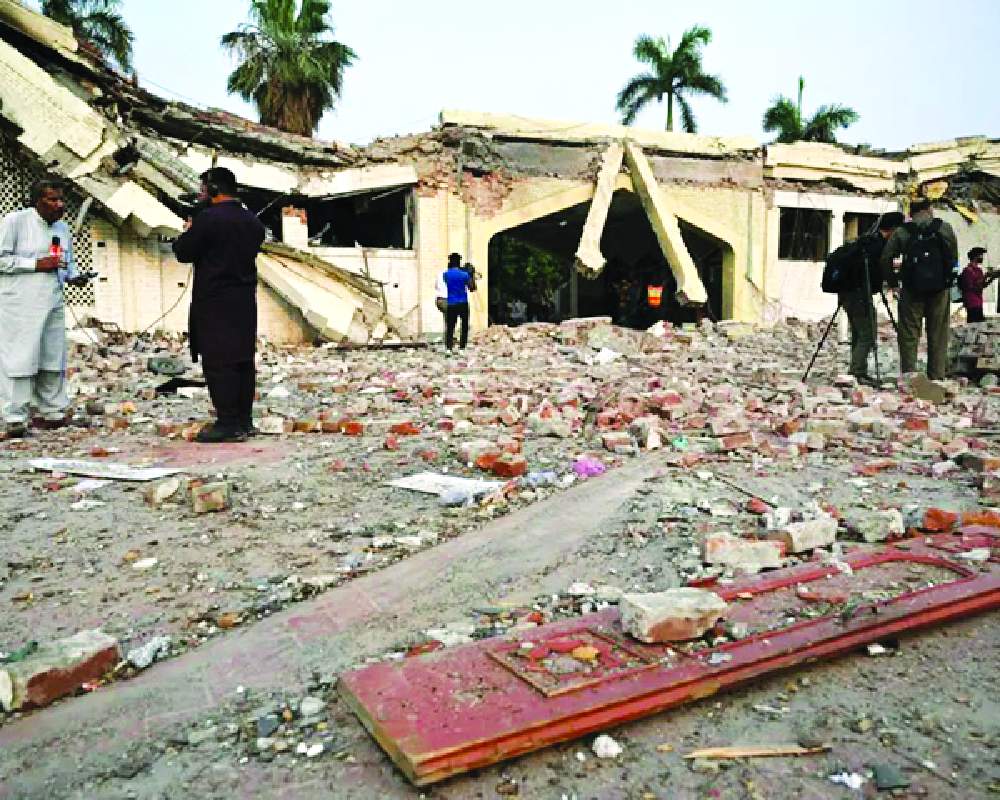
A video widely circulating on social media shows LeT commander Qasim standing amidst the rubble of the destroyed Markaz-e-Taiba complex. Addressing the camera, he openly admits the site’s significance as a long-time terror training centre and vows to rebuild it “even bigger.”
“I am standing in front of the Markaz-e-Taiba in Muridke. It was destroyed in the attack during Operation Sindoor. We will rebuild it and make it even bigger. From here, big names in Mujahideen got trained and achieved Faiz Victory,” Qasim declares.
The admission offers rare, on-the-record confirmation of the scale and impact of India’s retaliatory strike, which followed a deadly terror attack by LeT on April 22 in Baisaran Valley, Pahalgam, where 26 civilians — mostly tourists — were killed.
Markaz-e-Taiba, located in Nangal Sahdan, Muridke, in Pakistan’s Punjab province, has long been considered the operational heart of Lashkar-e-Tayyaba. Established in 2000, the site has served as a base for training, recruitment and ideological indoctrination. In another video, Qasim is seen encouraging young recruits to enroll in the Daura-e-Suffa program — a known terror training course that fuses religious extremism with combat drills.
Muridke terror camp destroyed in Operation Sindoor, says LeT The Indian Air Force strike targeted not just the training grounds, but also residential areas of top LeT leaders, including administrative offices used for planning terror attacks against India. According to sources, at least a dozen top operatives were killed in the coordinated strikes, including Yusuf Azhar, key conspirator of the IC-814 hijacking, Abu Jundal, LeT’s Muridke chief, and the son of the mastermind of the 2016 Nagrota attack.
Senior LeT commanders Maulana Abu Zar and Yunus Shah Bukhari are leading the reconstruction project, which is expected to be completed by February 2026. Intelligence inputs also suggest that LeT has a history of misusing humanitarian relief - notably after the 2005 earthquake - to redirect resources into terror infrastructure. Despite video proof and direct admissions by terror group leaders, Pakistan has denied that any such strikes or damage occurred. The visual evidence and statements by Qasim and Kashmiri, however, tell a different story - one that raises serious questions about Islamabad’s complicity and the ongoing presence of terror sanctuaries on Pakistani soil. The strikes mark a significant moment in India’s counter-terrorism posture, showcasing its capability to execute high-precision, cross-border operations deep within enemy territory.
As these revelations emerge, there is growing scrutiny of the international community’s response — or lack thereof — to the presence and rebuilding of globally designated terror outfits like LeT and JeM inside Pakistan. Public opinion polls have begun to reflect growing discontent. The Indian Air Force strike targeted not just the training grounds, but also residential areas of top LeT leaders, including administrative offices used for planning terror attacks against India. According to sources, at least a dozen top operatives were killed in the coordinated strikes, including Yusuf Azhar, key conspirator of the IC-814 hijacking, Abu Jundal, LeT’s Muridke chief, and the son of the mastermind of the 2016 Nagrota attack.
Senior LeT commanders Maulana Abu Zar and Yunus Shah Bukhari are leading the reconstruction project, which is expected to be completed by February 2026. Intelligence inputs also suggest that LeT has a history of misusing humanitarian relief - notably after the 2005 earthquake - to redirect resources into terror infrastructure. Despite video proof and direct admissions by terror group leaders, Pakistan has denied that any such strikes or damage occurred. The visual evidence and statements by Qasim and Kashmiri, however, tell a different story - one that raises serious questions about Islamabad’s complicity and the ongoing presence of terror sanctuaries on Pakistani soil.
The strikes mark a significant moment in India’s counter-terrorism posture, showcasing its capability to execute high-precision, cross-border operations deep within enemy territory. As these revelations emerge, there is growing scrutiny of the international community’s response — or lack thereof — to the presence and rebuilding of globally designated terror outfits like LeT and JeM inside Pakistan. Public opinion polls have begun to reflect growing discontent