Noida Airport begins operations with first IndiGo flight
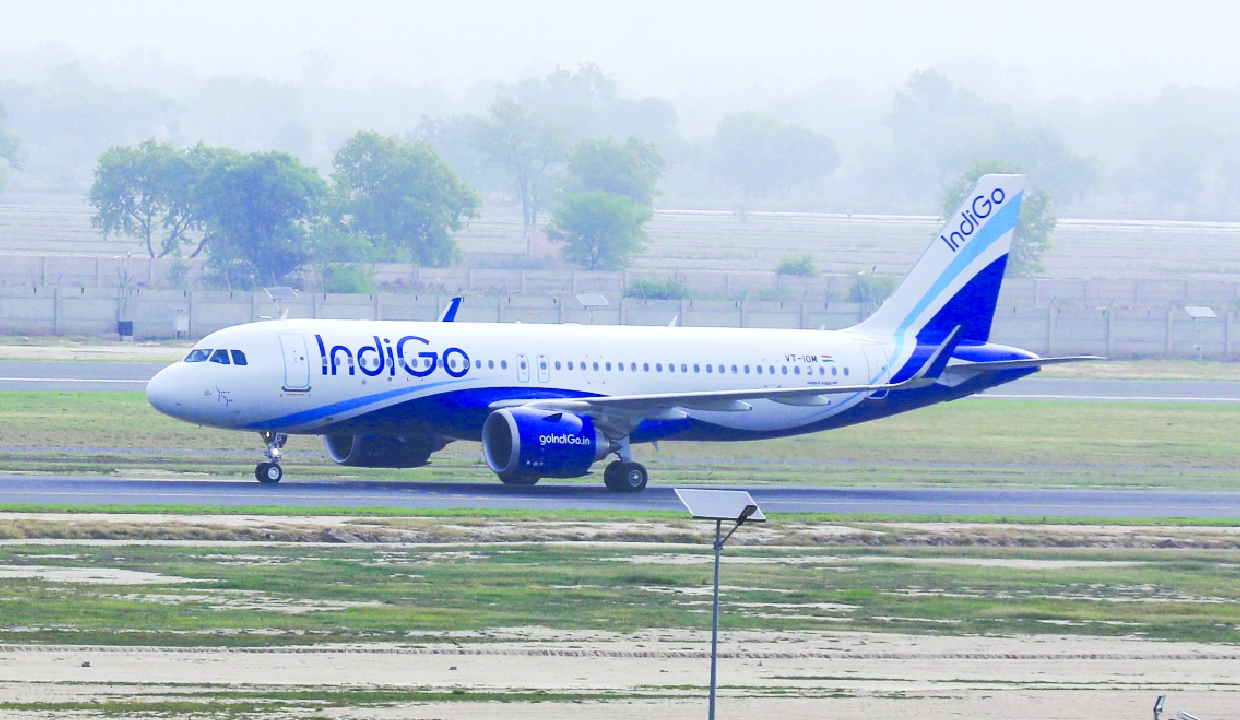
Noida International Airport at Jewar began commercial flight operations on Monday, with an IndiGo flight from Lucknow becoming the first commercial aircraft to land at the greenfield facility.
The event marked the operationalisation of the National Capital Region’s third airport nearly three months after Prime Minister Narendra Modi inaugurated it on March 28.
IndiGo flight 6E-2278 touched down on the NIA runway from Lucknow just before 8 am and was welcomed with a traditional water cannon salute. The same aircraft, registration VT-IOM, then operated the airport’s first commercial departure, taking off for Bengaluru shortly afterward.
Union Civil Aviation Minister Kinjarapu Ram Mohan Naidu, who attended the launch and interacted with passengers, framed the airport’s ambitions well beyond passenger transport.
“We want to see Noida International Airport grow not only as a transit hub or a transportation hub but also as an aerotropolis. We want multiple industries to come up around this area and create a strong economic base that caters not only to the country but also internationally,” Naidu said.
He described the vision as an integrated ecosystem where manufacturing, information technology, hospitality, cargo, MRO services, and agriculture would develop around the airport, generating employment across a region stretching from western Uttar Pradesh to Agra.
On the flight schedule, NIA will operate 12 daily domestic flights in June, rising to over 40 in July. IndiGo is starting with eight daily flights connecting NIA to Hyderabad, Amritsar, Bengaluru, and Jammu. From July, IndiGo will scale up to 28 daily departures and arrivals, adding destinations including Lucknow, Chandigarh, Dehradun, Bhopal, Jaipur, Jodhpur, Bareilly, Pantnagar, Kishangarh, and Dharamsala, with some routes operating multiple times a week rather than daily. IndiGo said this would connect NIA directly to over 16 destinations and enable one-stop connectivity between 14 city pairs.
Akasa Air begins operations on Tuesday with four daily flights connecting NIA to Bengaluru and Navi Mumbai. The Air India group is not operating from NIA for the present.
International operations are expected to begin by the end of the year, with short-haul flights to West Asia and Southeast Asia planned first. NIA Vice Chairman Christoph Schnellmann said both Indian and foreign carriers have shown interest, though the ongoing West Asia crisis has made some plans less predictable.
The airport’s cargo terminal, developed through Air India SATS Airport Services Pvt Ltd, has an initial annual handling capacity of 200,000 metric tonnes, with plans to expand to 1.5 million tonnes. A significant portion of this capacity is expected to serve the agricultural economy of western Uttar Pradesh.
NIA was designed and built by an arm of Zurich Airport International AG following a nearly two-year delay. Schnellmann recalled that the consortium won the bid at the end of 2019, just before the COVID-19 pandemic disrupted global aviation. “The years since have proven them and us right. We saw traffic in India rebound very quickly,” he said.
NIA is the third airport serving the NCR after Indira Gandhi International Airport and Hindon Airport. It sits along the Yamuna Expressway, roughly 80 km from central Delhi and 60 km from central Noida. Naidu said within a one-hour radius, crores of people will have access to the airport.
The proposed Delhi-Varanasi High-Speed Rail Corridor is expected to further strengthen connectivity once operational.
Unlike Mumbai’s Navi Mumbai International Airport, which is benefiting from saturation at Chhatrapati
Shivaji Maharaj International Airport, IGIA still has room to expand its current 105 million-passenger capacity toward 125 million.
Industry experts, therefore, expect NIA’s growth to be more gradual initially, with airlines likely using it to add peak-hour capacity, operate ultra-short-haul regional routes, and densify connections to tier II and III cities, before it eventually becomes a major driver of aviation growth in the NCR as IGIA approaches saturation in the coming years.