India, Russia, China: The New World Matrix Under Construction
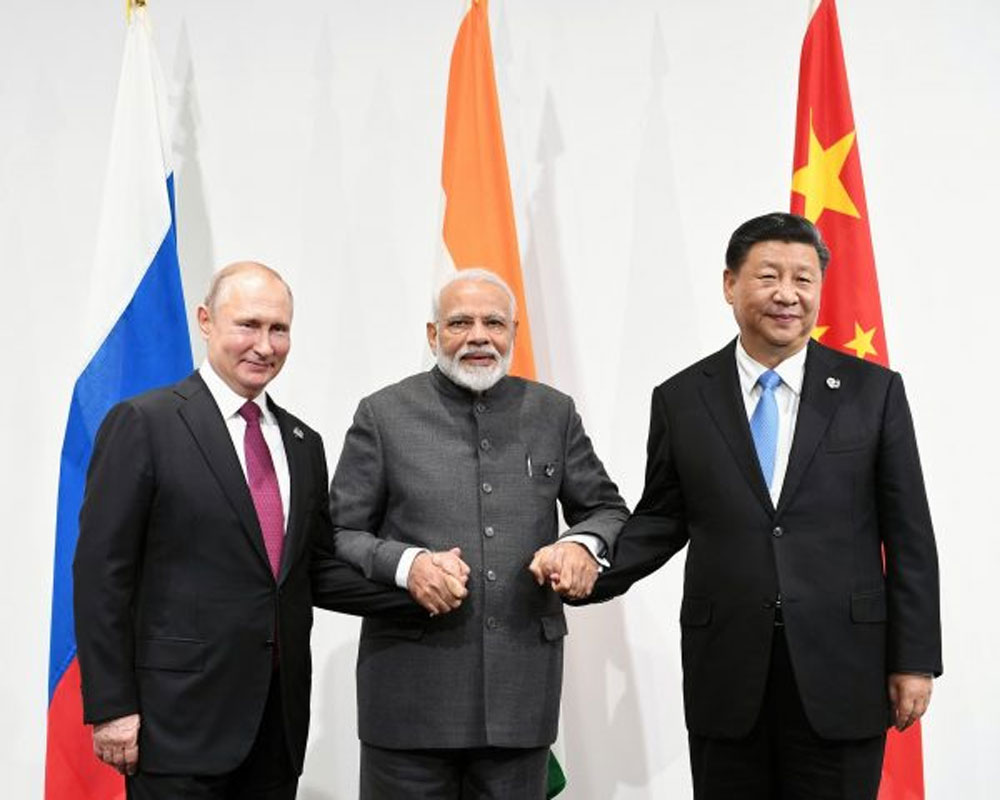
As the world navigates a period of intense geopolitical flux, two cataclysmic disruptions in the early 21st century have fundamentally reset the trajectory of global affairs: The COVID-19 pandemic, which paralysed systems and shook globalisation to its core, and the Russia-Ukraine conflict, which reintroduced large-scale war to Europe and has fractured long-standing alignments.
These twin shocks did not just disturb the old-world order — they triggered a systemic reset globally. What we are witnessing is more than a drift toward multipolarity or a Cold War redux. It marks the dawn of what I call the New-Muco Era-an era in which a New World Matrix is Under Construction.
This is a renovation — and — restart phase, where traditional institutions like the UN and WTO show signs of erosion, and sovereignty is reasserting itself over globalisation across sectors like semiconductors, AI, and energy. The dollar, though still dominant, is being cautiously counterbalanced. At the heart of this transition is a quieter revolution-optopolitics, or the battle of perceptions. In today’s world, influence flows as much through screens and algorithms as through treaties and tanks.
India’s Moment: From Participant to Architect
India now stands at a rare inflection point — not as a disruptor, but as a potential co-architect of the next global order. It is one of the few nations that enjoys credibility across both East and West, the trust of the Global South, and the civilisational depth to shape, not just survive — the new matrix.
Its G20 leadership, legacy of Gandhi, democratic institutions, and digital innovations like UPI and Aadhaar highlight India’s capacity to deliver at scale. But to seize the moment, India must shift from reactive diplomacy to proactive system design — helping construct new global frameworks across trade, finance, tech governance, and people-to-people exchange across cultures.
Five areas demand immediate focus:
- Creating digital currency corridors with trusted partners to reduce dollar dependence.
- Co-authoring tech standards in AI, quantum, and data governance.
- Leading South-South cooperation in climate, health, and education.
- Embedding itself in resilient, diversified supply chains.
- Building narrative capital — global storytelling that projects India’s values and vision.
India must also scale up its optopolitics and strategic imagination — by investing in think tanks, knowledge diplomacy, and intellectual capital that can shape international discourse from a position of confidence.
China: Builder and Rival
China is not merely reforming the global order-it is constructing parallel architectures. From the Belt and Road Initiative to the Digital Yuan, to its agenda — setting in the SCO and BRICS, Beijing is creating a system with Chinese characteristics, challenging existing frameworks on its own terms.
For India, China is both a strategic competitor and a necessary counterpart. Long-standing tensions remain, particularly over Himalayan border disputes, Indo-Pacific dominance, and tech rivalry in AI and telecommunications. At the same time, both countries share tactical space in platforms like BRICS, the SCO, and the G20. Moreover, China remains one of India’s largest trading partners, reflecting mutual interdependence. Navigating this duality demands clarity and composure. India must resist China’s hegemonic templates while asserting its own vision — not by isolation, but through constructive engagement and regional leadership.
Russia: A Strategic Lever
Post-Ukraine, Russia has pivoted eastward, deepening ties across Asia, Africa, and Latin America. It is actively promoting de-dollarisation through mechanisms like SPFS and MIR, positioning itself as a disruptor with enduring ambitions, even if diminished as a classical superpower.
For India, Russia remains a vital-and historically trusted-partner. The Indo-Soviet relationship during the Cold War was foundational to India’s industrial, strategic, and diplomatic evolution. That legacy still resonates.
Today, the partnership continues to offer India:
- Energy security - via long-term oil, gas, and nuclear agreements.
- Defense and space collaboration - including the S-400 system and joint production of submarines and aircraft.
- Strategic flexibility - serving as a buffer against binary global alignments.
However, Russia’s increasing dependence on China introduces new complexities. India must engage Moscow with calibrated realism - preserving historical ties, but ensuring the relationship remains independent of China’s growing shadow.
The United States: Partner, Not Patron
The U.S. remains the most powerful global actor, but its posture has shifted from building the global order to defending it, and to promoting an America-centric, Western dominated world. Its strategic focus is now also on containing China’s rise - militarily, technologically, and economically.
For India, this presents both opportunity and risk. The United States remains a vital partner - in defense cooperation, advanced technology ecosystems, and strategic alignment across the Indo-Pacific, particularly through the Quad. However, rising trade tensions and shifting U.S. priorities could strain medium- to long-term bilateral relations. India must tread with strategic care: deepening collaboration where interests align, while firmly resisting any role as a junior partner in a containment strategy that could compromise its autonomy or strain relations with other key global actors.
Instead, India should position itself as a sovereign peer - advancing shared interests while preserving autonomy in areas like digital regulation, trade policy, and South-South diplomacy. The partnership must evolve from one of alignment to one of co-authorship - allowing space for constructive disagreement and mutual respect.
India: From Balancer to Builder
India’s strategic identity must now transcend the role of “balancer” among great powers. It must become a builder - one that offers frameworks, ideas, and institutions rooted in sovereignty, pluralism, and pragmatic modernity.
This means:
- Engaging seriously with forums like BRICS, SCO, the G20, and the still-notional “IRC” (India-Russia-China) trilateral - a term India can champion to shift the narrative center and avoid being a silent participant in the older “RIC” nomenclature.
- Driving global conversations on future tech, climate equity, and inclusive development.
- Investing in institutional innovation and global education.
- Asserting narrative leadership that reflects India’s ethos and ambitions.
The world is not waiting. The scaffolding of a new global matrix is already rising. In this New-Muco Era, India’s task is clear: not just to rise - but to help the world rise with it.
Robinder Sachdev is the president of The Imagindia Institute, and author of Trumpotopia: A Guidebook to Decode Donald Trump-and the Culture of America-With Tips for World Leaders (July 2025).