India’s AI boom comes with a power bill
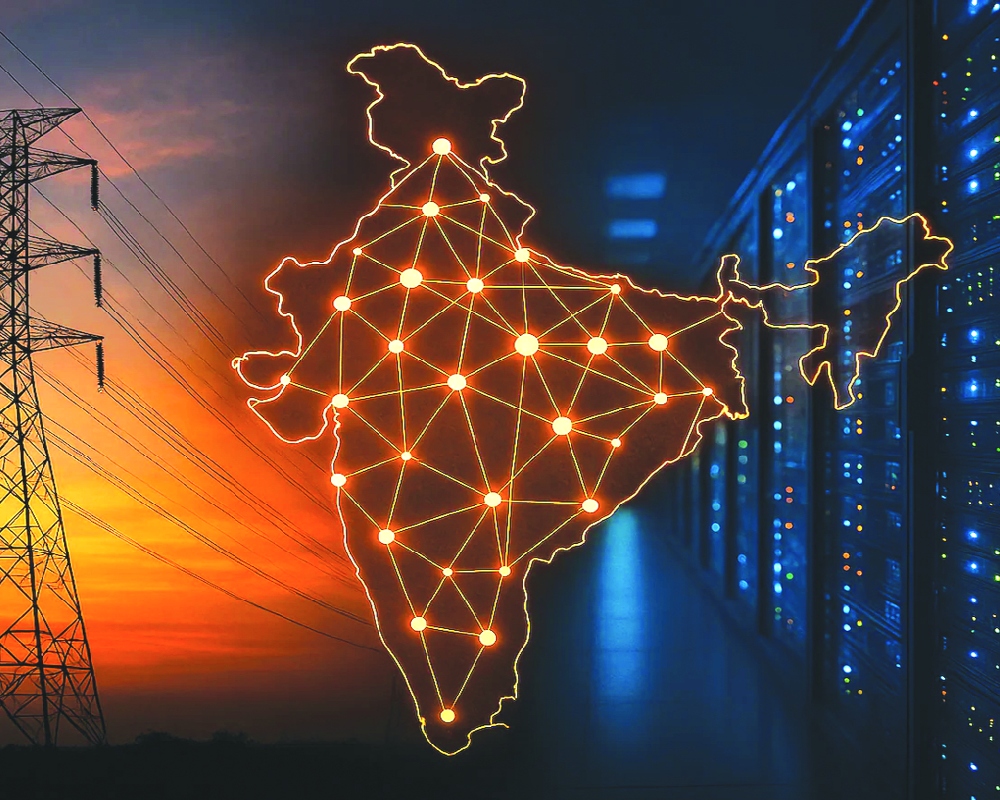
Every question we often ask an AI system carries a hidden cost. Behind the digital magic of chatbots, image generators and predictive models, a quiet physical process unfolds — one that consumes vast amounts of energy and produces enormous heat. In the age
of artificial intelligence, thinking is no longer a metaphor. It’s thermodynamics and it matters a lot.
When we say that AI ‘’learns,’’ what we mean is that billions of processors are performing mathematical operations, each powered by electricity. Those chips run hot. They must be cooled constantly. Every bit of information processed generates heat — a direct result of physics, not inefficiency.
According to the International Energy Agency (IEA), global data centres consumed about 460 terawatt-hours (TWh) of electricity in 2022 — roughly the same as France’s total annual consumption. By 2026, that figure could double, largely because of AI workloads. One estimate suggests that training a single large model such as GPT-4 consumes more power than 500 average Indian households use in a year. Now, as India’s own AI and digital infrastructure expands, this energy story is becoming our story too.
India’s growing energy appetite:
India’s data-centre power capacity stands at about 1.4 gigawatts (GW) today and is expected to grow to nearly 9 GW by 2030, according to the Institute for Energy Economics and Financial Analysis (IEEFA). That’s more than a six-fold jump in less than a decade.
The growth isn’t just about space. A recent Deloitte report estimates that India may need an additional 40–45 TWh of electricity annually by 2030 just to support AI-linked data centres — equivalent to the yearly power use of Denmark. At present, data centres account for under 1 Per cent of India’s total electricity demand. By 2030, it could reach 3 Per cent. That’s a massive jump in a country where electricity generation is still dominated by coal.
The thermal consequence is simple: more energy means more heat. Data centres rely heavily on cooling systems — typically air-conditioning or water-based cooling — which themselves consume large amounts of power. The U.S. tech giants know this problem well. Microsoft recently reported a 34 Per cent increase in its global water consumption in a single year because of AI workloads. In India, similar trends are already visible in regions hosting new data-centre clusters.
The physics of intelligence:
All of this is not just an engineering issue; it’s a law of nature. Physicist Rolf Landauer proved that erasing a single bit of information releases a small but measurable amount of heat. Every time an AI system deletes redundant data or rewrites memory, energy is transformed into thermal noise.
That principle — known as Landauer’s limit — defines the ultimate energy cost of information processing. Your brain obeys the same law, though much more efficiently. It runs on about 20 watts, roughly the power of a dim bulb.
A single Nvidia H100 chip, used in many AI servers, draws about 700 watts. Multiply that by thousands of chips per data centre, and the comparison becomes staggering. Artificial intelligence may be faster than biological intelligence, but it is nowhere near as energy-efficient.
India’s renewable advantage:
This is where India can turn a challenge into a strategic edge. The country is rapidly expanding renewable capacity, with a national goal of 500 GW of non-fossil power by 2030. That includes solar, wind, hydro and nuclear.
As of mid-2025, India’s renewable power output is growing at its fastest pace in three years. If India powers its AI revolution with clean electricity, it could become the world’s first low-carbon AI hub. Green data centres — designed with renewable energy sources, high-efficiency cooling and waste-heat recovery — already represent a $1.6 billion industry in India and are projected to reach $7.6 billion by 2032, according to Credence Research. The state of Tamil Nadu has become a key location for such projects, combining proximity to solar power parks and undersea cable networks. Maharashtra, Telangana and Gujarat are also investing heavily in green data infrastructure. India’s biggest advantage may be timing. Western nations built their AI infrastructure in the fossil era; India can build in the renewable era. It’s the same leapfrog pattern seen in mobile payments and solar adoption.
The coming heat economy:
But this opportunity comes with a warning. AI will soon compete with other sectors for electricity and water. Cooling data centres in India’s already hot climate requires reliable grids and freshwater — both under stress. Globally, data-centre electricity demand could approach 1,000 TWh by 2030 — about the same as all of Japan’s power consumption. Goldman Sachs predicts AI alone could account for 8 Per cent of global electricity use by then. If that growth is powered mostly by fossil fuels, the emissions gains of other sectors could be erased. In India, this creates a new kind of policy dilemma: the heat economy. How do we keep AI expanding without overheating the grid or the planet?
Some answers are emerging. Liquid cooling systems can cut energy use by up to
30 Per cent. Locating data centres near hydro or solar farms reduces transmission losses. Using the waste heat from servers for industrial or residential heating — already tested in Europe — could close the thermal loop.
Cooler intelligence and The road ahead :
The future of AI won’t depend on bigger models alone; it will depend on cooler ones. Quantum computers, for example, operate near absolute zero — just a few millikelvin above the coldest possible temperature. At that scale, resistance and energy loss vanish. Cryogenic computing and optical chips may reduce the thermal footprint of intelligence itself. But until such technologies mature, efficiency will be the new intelligence. Every joule saved per computation will matter more than every new parameter added to a model.
If India aligns its AI ambition with its renewable push, it can export not just software but sustainable intelligence — a model for a world trying to balance data growth with decarbonisation. The task now is to build an ecosystem where cloud companies, policymakers and power producers collaborate on one goal: energy-aware intelligence.In the end, temperature may become the real measure of progress. A smart civilisation isn’t the one that computes the fastest; it’s the one that learns to stay cool while doing so.