Eat till you drop: Delhi’s mango festival is back
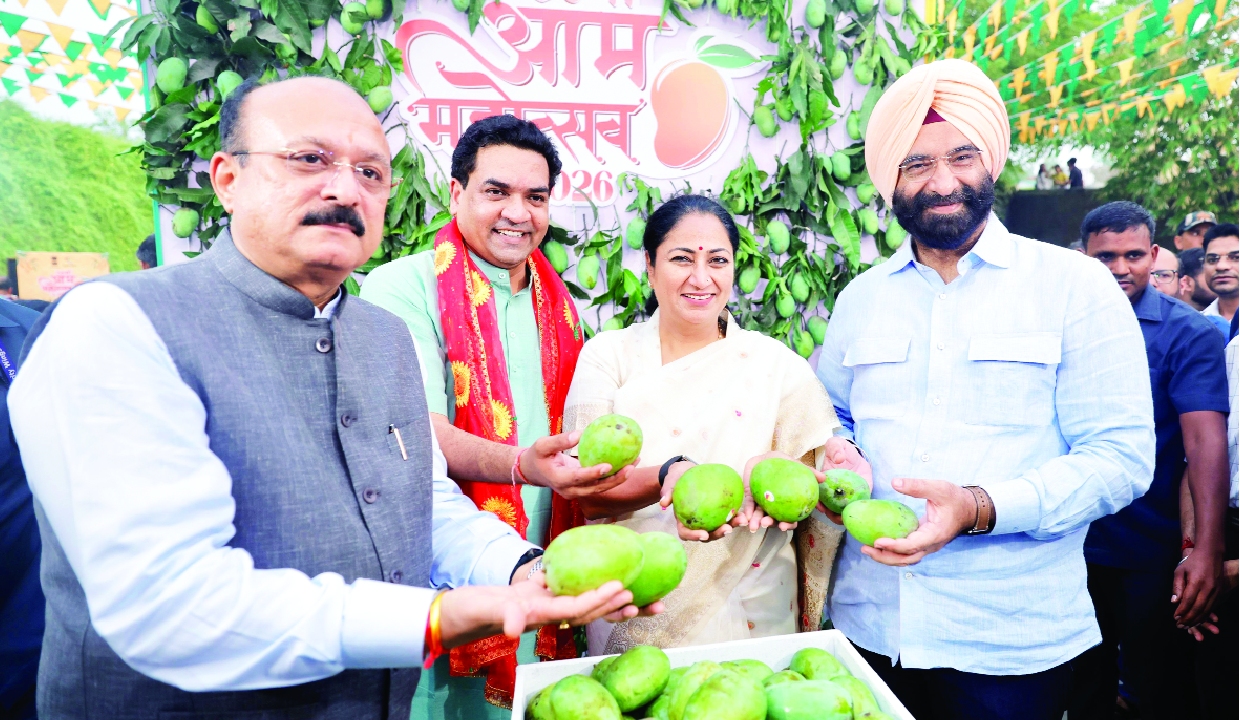
Every summer, for a single afternoon, Dilli Haat in Janakpuri becomes the most democratic place in Delhi. You pay Rs 100. You sit down. And then you eat mangoes, as many as you want, for as long as you can. Men on one side, women on the other, and somewhere in between, the quiet, sticky, entirely serious business of eating India’s most beloved fruit until you cannot eat any more. The 35th Annual Mango Festival 2026, inaugurated by Chief Minister Rekha Gupta on Friday, is many things. But the eating competition is the soul of the thing.
The festival runs at Dilli Haat, Janakpuri, from noon to 9 pm daily until July 5, and it is organised by the Delhi Tourism Department with a scale that the numbers alone cannot fully convey. More than 400 varieties of mangoes have been brought from across the country and arranged under one roof. Some are as small as grapes. Some are as large as papayas. There are Husnara, Rataul, Ramkela, Kesar, Mallika, Amrapali, Fazli, and Hathi Jhool, among dozens of others that most visitors have never seen in a market and possibly never will again outside this festival.
Mango growers from multiple states have made the journey, as have some of India’s most important agricultural institutions: ICAR-Indian Agricultural Research Institute at Pusa, ICAR-Central Institute for Subtropical Horticulture in Lucknow, Govind Ballabh Pant University of Agriculture and Technology in Pantnagar, Bihar Agricultural University, and the Directorate of Horticulture in Saharanpur. Individual growers, including Tariq Mustafa, Rambir, Akhlaq Ali, Mohammad Shahid, and Mohammad Junaid, have brought their finest produce.
Many of the varieties on display are the result of decades of careful grafting, selection, and experimentation by farming families who have spent their lives in orchards. The festival is, among other things, a living archive of what Indian agriculture is capable of growing. Cabinet Ministers Kapil Mishra, Ashish Sood, and Manjinder Singh Sirsa were present at the inauguration alongside the Chief Minister.
The Chief Minister described the mango as an emotional symbol connected with Indian culture, family memories, and childhood in a way that no other fruit manages. She noted that Indian mangoes have become a tool of soft power internationally, with what she called Mango Diplomacy giving a new dimension to India’s cultural and diplomatic relationships abroad.
India produces nearly half of the world’s mangoes, holds close to 1,000 of the approximately 1,500 known varieties globally, and has been cultivating the fruit for nearly 4,000 years. All of that history comes to a single park in west Delhi for three days every July. Tourism Minister Kapil Mishra said the festival is part of a broader effort to reposition Delhi as a cultural destination rather than simply a transit city.