India’s private space era takes off with Mission Aagaman
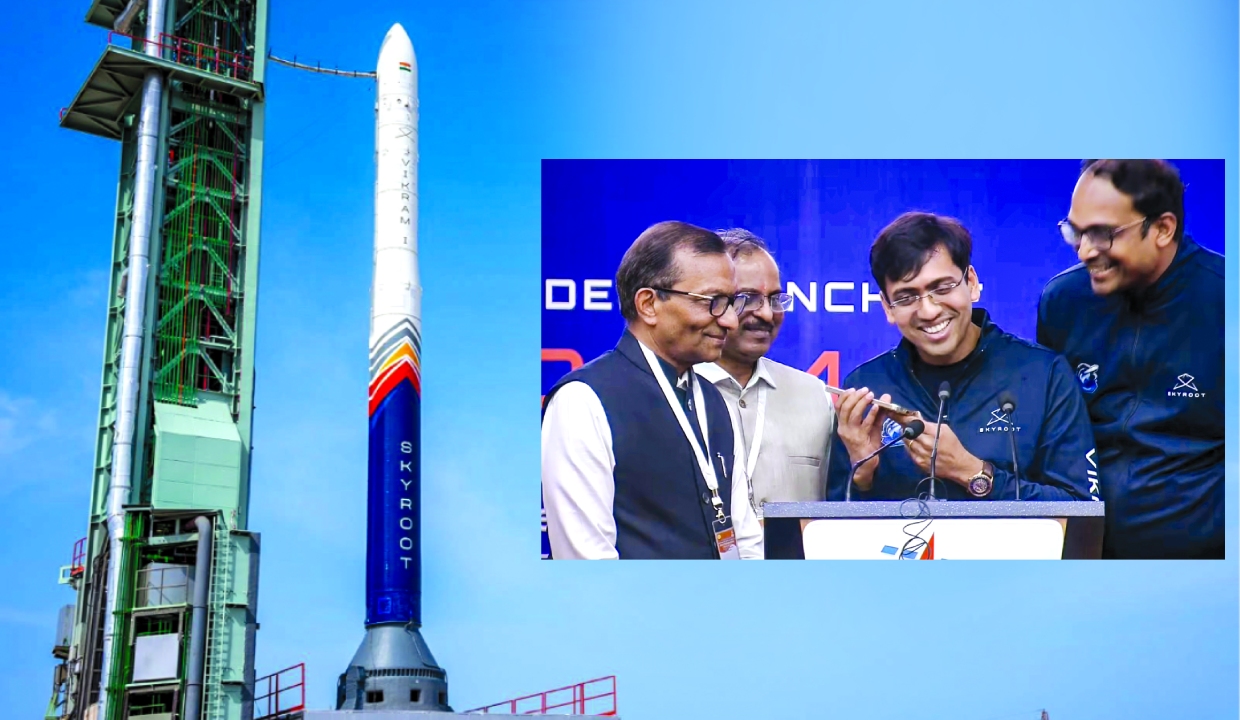
- India third country in world to achieve private orbital launch capability
- Vikram-1 carried several symbolic payloads, including an 18-karat gold miniature rocket, an artistic laboratory-grown diamond, and handwritten postcard by PM bearing message “Vande Mataram”
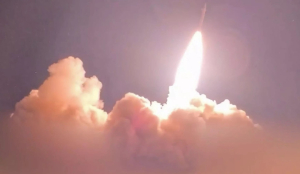
India scripted a historic chapter in its space programme on Saturday as Hyderabad-based startup Skyroot Aerospace successfully launched Vikram-1, the country’s first privately developed orbital launch vehicle, placing multiple technology demonstration payloads into a 450-km low Earth orbit (LEO).
The achievement makes India only the third country in the world, after the United States and China, to demonstrate private-sector orbital launch capability, marking a significant milestone in the country’s rapidly expanding commercial space ecosystem.
The four-stage Vikram-1 lifted off at 12.05 pm from the first launch pad at the Satish Dhawan Space Centre in Sriharikota, Andhra Pradesh, after a brief planned hold owing to a navigation-related issue. As the seven-storey launch vehicle soared, leaving behind a trail of orange smoke, jubilant scenes unfolded inside Mission Control, where scientists, engineers and officials celebrated what has been dubbed “Mission Aagaman,” signalling the arrival of India’s private space industry into the orbital launch market.
The maiden mission successfully deployed all its primary payloads, including technology demonstrators from Grahaa Space, Cosmoserve, German company DCubed and Skyroot’s in-house SCOPE satellite, validating the launch vehicle’s performance in its first orbital flight. During the conversation, Chandana informed the Prime Minister that the average age of Skyroot’s team was just 28 years, prompting Prime Minister Modi to describe the feat as an example of India’s young scientific talent.
Soon after the successful mission, Prime Minister Narendra Modi personally called Skyroot Aerospace co-founders Pawan Kumar Chandana and Naga Bharath Daka, congratulating the team for achieving a landmark in India’s private space journey.
The Hyderabad-based company, which carries the slogan — “Redefining access to space. Your fast track to orbit. On-demand launch vehicle for rapid, precise, and customisable small satellite deployments” — on its website, described Saturday’s mission ‘Aagaman’ (arrival) as a “grand success”.
According to the company, Vikram-1 also carried several symbolic payloads, including an 18-karat gold miniature rocket, an artistic laboratory-grown diamond, postcards from engineers and astronauts, and a handwritten postcard by the Prime Minister bearing the message “Vande Mataram.” A micro-art payload featuring miniature sculptures of Vikram Sarabhai, Sir CV Raman and former President APJ Abdul Kalam was also placed in orbit as a tribute to the pioneers of India’s scientific and space programmes.
Speaking to the founders over the phone, Modi described the mission as proof that India could become truly Atmanirbhar in advanced technologies. “The growing participation of our private sector is opening new frontiers and accelerating innovation. This achievement will encourage countless youngsters to dream bigger and innovate fearlessly,” the Prime Minister said.
For Skyroot Aerospace, the successful mission represents a leap from its earlier achievement in 2022, when it launched Vikram-S, India’s first privately built suborbital rocket. Saturday’s mission validated several advanced technologies, including an all-carbon composite rocket structure and 3D-printed engines, both of which the company says are first-of-their-kind developments for an Indian orbital launcher.
The engineering data gathered during the mission will now be analysed to validate the rocket’s guidance, navigation and control systems before future commercial satellite launches.
The payloads onboard also showcased emerging technologies. Grahaa Space’s Solaras mission demonstrated new capabilities in low Earth orbit, while Cosmoserve’s Embrace tested robotic arms designed for future space debris removal missions. Skyroot’s SCOPE satellite carried experimental technologies for upcoming launches, while German firm DCubed flew deployable space hardware aboard the vehicle.
Both Chandana and Daka, former ISRO scientists, were present at Mission Control along with ISRO Chairman V. Narayanan. Former ISRO chiefs, astronaut Shubhanshu Shukla and Andhra Pradesh Minister Nara Lokesh also witnessed the launch.
Calling the achievement a direct outcome of India’s space sector reforms, ISRO Chairman Narayanan credited the government’s decision in 2020 to open the sector to private players and establish the Indian National Space Promotion and Authorisation Centre (IN-SPACe).
“Within six years of the reforms, a startup has successfully placed satellites into orbit on its very first attempt. It is a truly satisfying moment,” he said, while also praising the youthful Skyroot team.
Chandana said the mission reflected what Indian startups could accomplish when given the opportunity. “We are very proud that the government enabled private participation. Today we stand as India’s first private company to launch a rocket into orbit with a fully Indian team and a vehicle built 100 per cent in India,” he said.
His co-founder, Daka, noted that the mission placed India alongside the United States and China in demonstrating private orbital launch capability. Beyond its technological significance, Vikram-1 is expected to strengthen India’s position in the fast-growing global market for launching small satellites. The mission is widely seen as validation of the country’s efforts to build a vibrant commercial space ecosystem, where private companies work alongside ISRO to expand India’s footprint in the global space economy.
Several chief ministers and leaders across the political spectrum congratulated the private company on its achievement.
The payloads that piggybacked on Vikram-1 include Cosmoserve Space’s Embrace (mission name), an in-orbit demonstration of robotic arms capable of removing space debris, and Solaras by Grahaa Space, which is a compact satellite mission developed to demonstrate new capabilities in LEO. German test payload uD3PP and mD3RN by Dcubed also reached space on Saturday.
Spoke to the team of Skyroot Aerospace and congratulated them on the successful launch of Vikram-1. This is a defining moment in India’s space journey —Prime Minister Narendra Modi
lauded the young team — having an average age of 28 years — for achieving a successful orbital mission in their very first attempt and contributes to the “Bharat 2047” vision - ISRO Chief V Narayanan
We are very proud that the government has enabled us and opened up the sector to private players. All from India with a fully, fully Indian team, 100 per cent built in India - Skyroot Aerospace CEO Pawan Kumar Chandana