Skyroot’s moment, ISRO’s test
While private participation has broadened India’s space ecosystem, the country must ensure that ISRO does not lose talent to emerging ventures
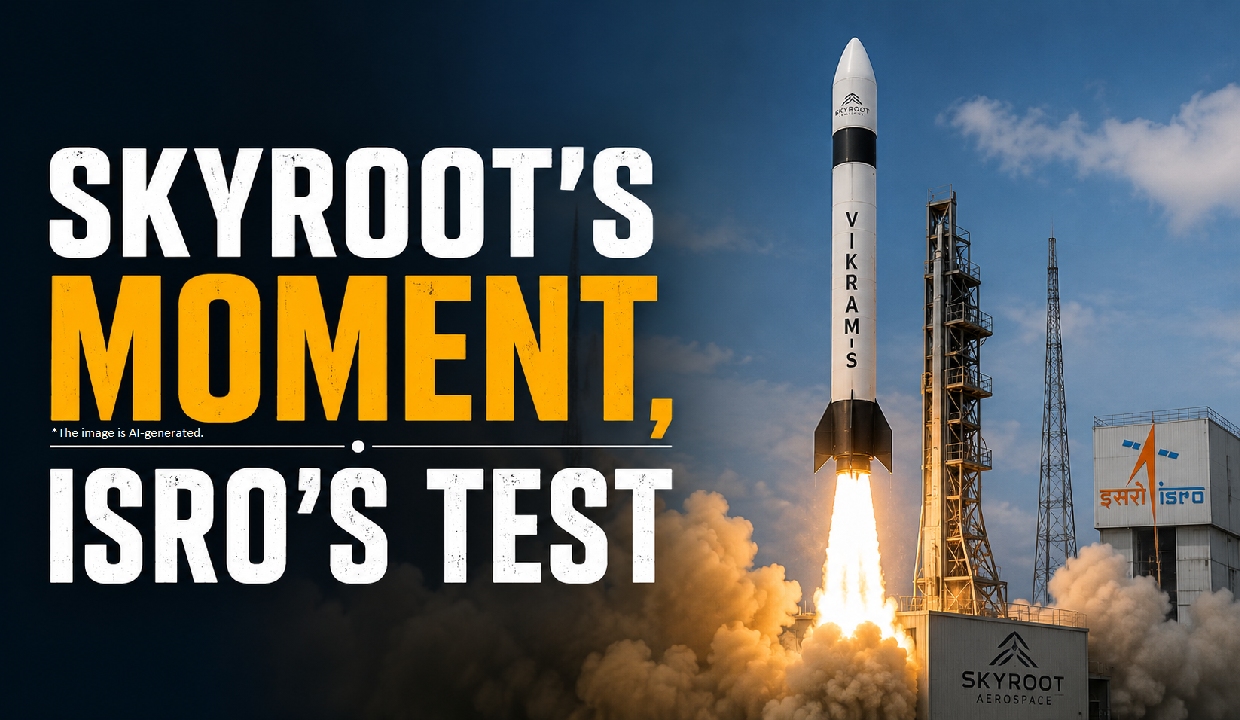
On July 18, a rocket that owed nothing to the Indian Space Research Organisation raced through the sky over Sriharikota and did what no Indian company had ever done: it reached orbit. Skyroot Aerospace’s Vikram-1, flying under the mission name Aagaman — Sanskrit for “arrival” — made India only the third country after the United States and China to host a privately built orbital launch vehicle.
It is a genuine milestone. It also lands amid the loudest talent crisis ISRO has faced in years, and the timing is not a coincidence. The scale of Saturday’s achievement is easy to understate. For six decades, reaching orbit from Indian soil has meant one thing: ISRO. Vikram-1 breaks that monopoly, built by a company founded only eight years ago by two former ISRO engineers who started with a team of ten in Hyderabad and first touched space with a smaller suborbital rocket back in 2022. That the rocket flew customer payloads on its very first attempt, rather than merely proving instruments, suggests Skyroot is not just demonstrating a capability but opening for business. That matters because it validates a bet New Delhi placed in 2020, when it opened spaceflight to private capital after decades of treating it as an exclusively sovereign function.
The reasoning was that ISRO, superb at frugal science missions, was never built to chase the fast-growing small-satellite launch market. Vikram-1 is the first hard proof that reasoning held: India can now offer commercial customers a private alternative to the PSLV and GSLV, edging toward the model in which NASA shares American skies with SpaceX and Rocket Lab rather than flying every mission itself. But the same fortnight that proved the private-space bet also exposed its price. More than a hundred ISRO scientists have resigned or taken voluntary retirement in recent months — enough that the Department of Space, just four days before Vikram-1 lifted off, moved to block routine exits of scientists working on Gaganyaan and other flagship missions.
The pull is not mysterious: start-ups founded largely by ISRO alumni offer two to three times government pay, equity, flat hierarchies, and freedom from layered bureaucracy. Those leaving are not junior hires; many carry specialised experience from missions such as Chandrayaan-3 and SpaDeX, and they are exiting a public agency already facing missed deadlines on some of its own flagship launches — for a private sector that, not incidentally, just launched India’s first private orbital rocket. Optimists call this redistribution rather than drain, likening it to how engineers cycle between NASA and SpaceX in a maturing market. That comparison could prove right — but only if India’s space ecosystem grows large enough to absorb the churn, keeping ISRO staffed for the missions only a state agency can run even as it keeps seeding the companies extending India’s reach commercially. Vikram-1 shows what that ecosystem is capable of when it works. Whether ISRO stays intact enough to keep supplying it, mission after mission, decade after decade, is now the harder question hanging over India’s space programme.