The hidden cost of India’s AI boom
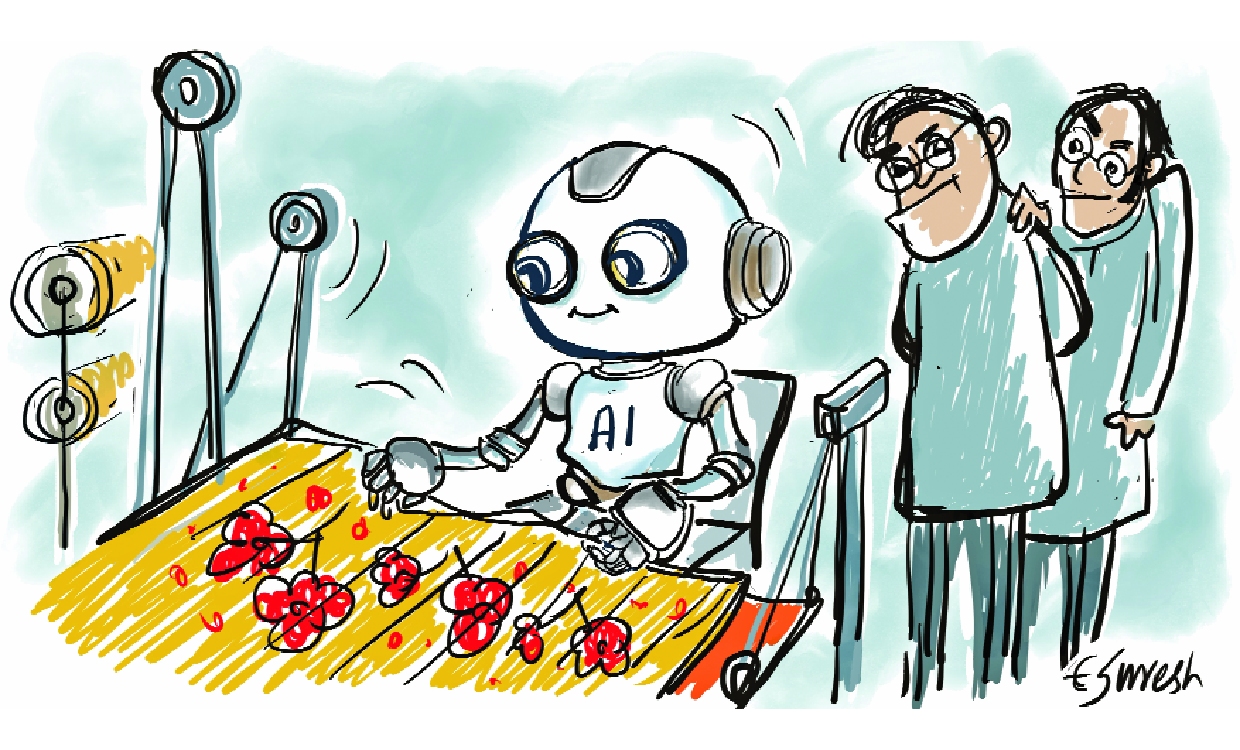
A recent news story highlighted how machine technicians in a textile factory in Nagpur have been strapped with small recording devices during working hours to track their every action. At another textile factory in Tamil Nadu, several women workers wear smart glasses that record their hand movements as they neatly pack items into plastic covers. Many Chinese and US-based AI data solutions and robotics companies have been heavily outsourcing egocentric data collection to India's vast network of factory workers and gig labourers to equip the next generation of humanoid robots and physical AI systems. Another news story underlined that, for the tenth consecutive year, the number of newborns fell in Japan, and that the world's fourth-largest economy faces one of the world's lowest birth rates and an ageing population.
As major industrial economies encountered the challenges of shrinking workforces, as a potential solution to compensate for the 'missing workers', they moved towards automation, from specialised industrial robots for repetitive factory tasks to humanoid robots(HRs), adaptable to human-centric environments. Globally, there are about 4.66 million industrial robots in operational use, and manufacturing sectors have been integrating at a record pace of 162 robots per 10,000 employees worldwide(IFR). While global research projections for HRs indicate that from 2035 onwards they will be in massive use in highly unstructured working environments, such as in households or elderly services. By 2060, the total units in ownership (UIO) for HRs are expected to reach three billion, replace 20 per cent of the workforce in the industrial sector, and 50 per cent of the workforce in the service sector(Bank of America, 2025).
However the commercial scaling up of industrial robots and its fallout on the labour dynamics caused concern among the development economists. A 2017 study by McKinsey Global Institute warned that up to 800 million jobs globally could be lost to automation by 2030. Notwithstanding, a study on 'productivity, employment and jobs' asserted that 'if used effectively, robots enable companies to increase productivity and competitiveness, particularly in the SMEs'. A 2020 global study assessed that the 'rise in industrial robot density of one percent boosts 0.8 per cent of productivity (Select USA,Dept. of commerce, International Trade Association). Further, a 2023 study, based on data from the Chinese Annual Survey of Industrial Firms, compared the labour demands of robot adopters with non-adopters, and found that 'deployment of robots enhanced human labour, especially the active hiring of female employees'. While studies project that in a robot-driven world, increased productivity is likely to boost in GDP growth by 10 per cent in the next decade, and up to 1.4per cent annually over the next 50 years(IFR).
Nevertheless, many social scientists opined that 'such a transformative technology may apparently enhance various aspects of human lives, but can also deepen inequalities and further concentrate economic power (Korinek and Stiglitz, 2021).
The 'winner-takes-all dynamics' advantage the technology giants and favoured the owners of capital at the expense of labour, leading to greater concentration of wealth (Acemoglu and Restrepo, 2019; Korinek et al., 2021). While the developing countries are likely to lose out on the benefits of 'demographic dividend' and 'low-cost labour'. The trend of multinationals 'restoring' factories closer to their primary consumer markets is already visible.
The GE brands have recently brought back a manufacturing line to the USA, and are managing operations with the help of cameras, robotic arms, artificial intelligence and autonomous mobile robots. However, the counter view goes that automation will push developing nations into high-export powerhouses, as happened in many East Asian economies where the reduction in production costs triggered massive export booms, and an increase in local employment to handle the scaled-up logistics and management.
India, as a data-gathering destination, is expected to be in the global AI and machine learning supply chain. Industry experts predict that India's data annotation sector could exceed $7 billion by 2030 and employ over a million annotators (NASSCOM Publication). While the currently operating about 500 AI-specific global capability centres (GCCs) that are managing robotics data pipelines for MNCs, can turn India into a major intellectual property (IP) factory for physical automation. The local deep-tech companies like Humyn AI and Objectways, having access to highly synchronised data sets, could also help build up affordable humanoids.
A recent study disclosed that India's advantages of low assembly costs and skilled local engineering talent could enable it to manufacture humanoids at $16,500 per unit, representing a massive 73 per cent cost reduction compared to US alternatives. However, on the flip side, the World Bank reports suggest that 69 per cent of existing jobs in India are under threat of being lost to automation as Indian labourers are essentially 'training themselves out of a job' by mapping their precise physical movements into datasets for foreign robotics labs, which could directly affect India's 490 million informal workers.
Many also believe that even if India becomes the owner of the actual robotic hardware and patents, it risks losing long-term employment in manufacturing and logistics to the very humanoids it helped to enrich.
Now, when the global integration of AI and robotics is reshaping geopolitics, economies, and societies worldwide and no longer remains only in the realm of purely corporate tech competition, the AI Summit 2025 rightly pointed out the need for international guidelines that promote AI as a public good. While the UN's Global Digital Compact (GDC) 2024, has spelt out the first multilateral roadmap for inclusive digital cooperation and global AI governance. Adhering to the UNGDC is essential for all nations to bridge the global technology divide, especially tech-rich countries that hold the majority of resources.