The human thread
Across rural India, master artisans are fighting to save centuries of Heritage from industrial extinction
Real people shoulder the heavy weight of this fragile history. How many of us would actually dare to walk away from a secure, parent-approved future?
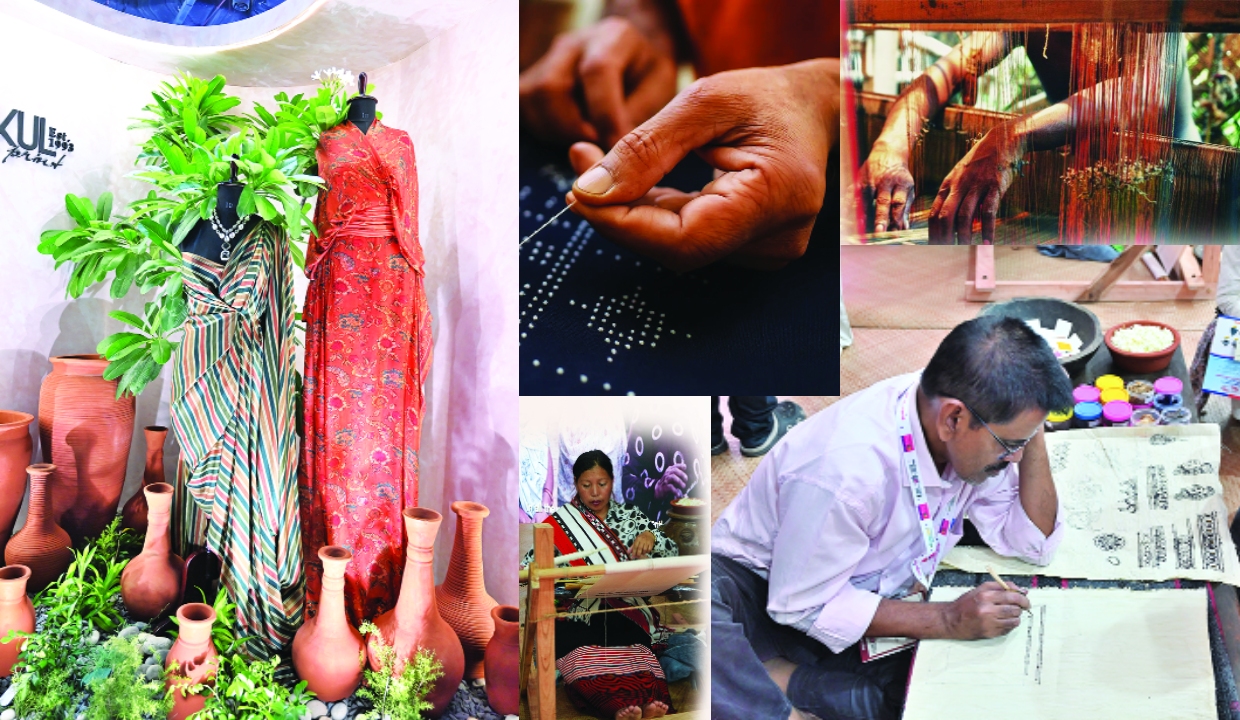
Every wooden loom carries the deep soul of an entire community. As loud factory machines take over the market, the true masters of our traditional arts face a terrible forced silence. These incredibly gifted creators now have almost zero stage left to stand on. Walking through Bharat Tex 26 feels like watching centuries of heritage fight for survival. From Nalbari’s heavy silks spun along the Brahmaputra to the sacred Khandua drapes of Maniabandha created for Lord Jagannath, every textile tells a story of cultural resistance.
Down in Gopalpur, a tradition spanning five hundred years and shaped by the Bhakti movement transforms ordinary cotton into art. These are tangible memories, sustained by families who surrender their days to the heavy wooden loom. Can a factory machine ever replicate the human spirit stitched into a handmade garment?
Real people shoulder the heavy weight of this fragile history. How many of us would actually dare to walk away from a secure, parent-approved future? Down in Srikalahasti, Andhra Pradesh, fifty-four-year-old B Chiranjeevi Krishna knows exactly what that sacrifice costs. While his father desperately pushed him to chase a respected medical degree, Krishna made a much harder choice, trading a safe career to keep a fading local heritage alive. The young boy had other plans entirely and happily traded the absolute safety of a stethoscope for a simple carved bamboo stick. He found himself completely captivated by the ancient temple art of Kalamkari. Today, he commits to an exhausting fourteen-stage routine. His raw materials sound almost mythical, relying on fermented palm jaggery, rusted iron, and buffalo milk. He washes his painted fabrics in a local river, letting the natural sand and harsh sunlight slowly bleach the cloth. Choosing this demanding life required immense courage, yielding four decades of loyalty to a childhood calling.
However, raw passion cannot halt the march of mass production. Akula Charan Nandi from Odisha highlights a brutal reality for today’s weavers. His village spends weeks making complex weft ikat fabrics, a painstakingly slow technique shared between men and women. Now, cheap power loom prints flood local markets, copying their sacred patterns and confusing buyers about the true worth of handmade goods. A lifeline finally emerged through the Antaran initiative by Tata Trusts, which taught his community about modern marketing and design. Using this knowledge, he launched Tri Ratna Handicraft, stepping up as an independent business owner rather than a daily wage worker.
The fight to survive pushes families toward brilliant innovation. Pramod Kumar Sur, a Tussar silk master from Gopalpur, works in a circle with his state award-winning father, his mother-in-law, and his young daughter. Handcrafting one single saree consumes forty-five days of their collective lives. To outsmart cheap imitations, the family must constantly invent fresh designs. Their incredible patience finds a true reward when their entire stock clears out just as Ganesh Puja begins.
These artists possess rare magic but often lack access to the right audiences. As Mridula Tangirala of Tata Trusts observes, the survival of Indian handlooms depends entirely on helping rural artisans build sustainable companies. The goal is to see creators own their brands and control their destinies. Showcases like Bharat Tex offer that critical bridge, turning hidden rural talent into global opportunity so the voices of these masters will never face a forced silence.
The fight to survive pushes families toward brilliant innovation
Gujarat's Tangaliya Weave: The 700-Year-Old Dot Makes a Comeback
By Gyaneshwar Dayal
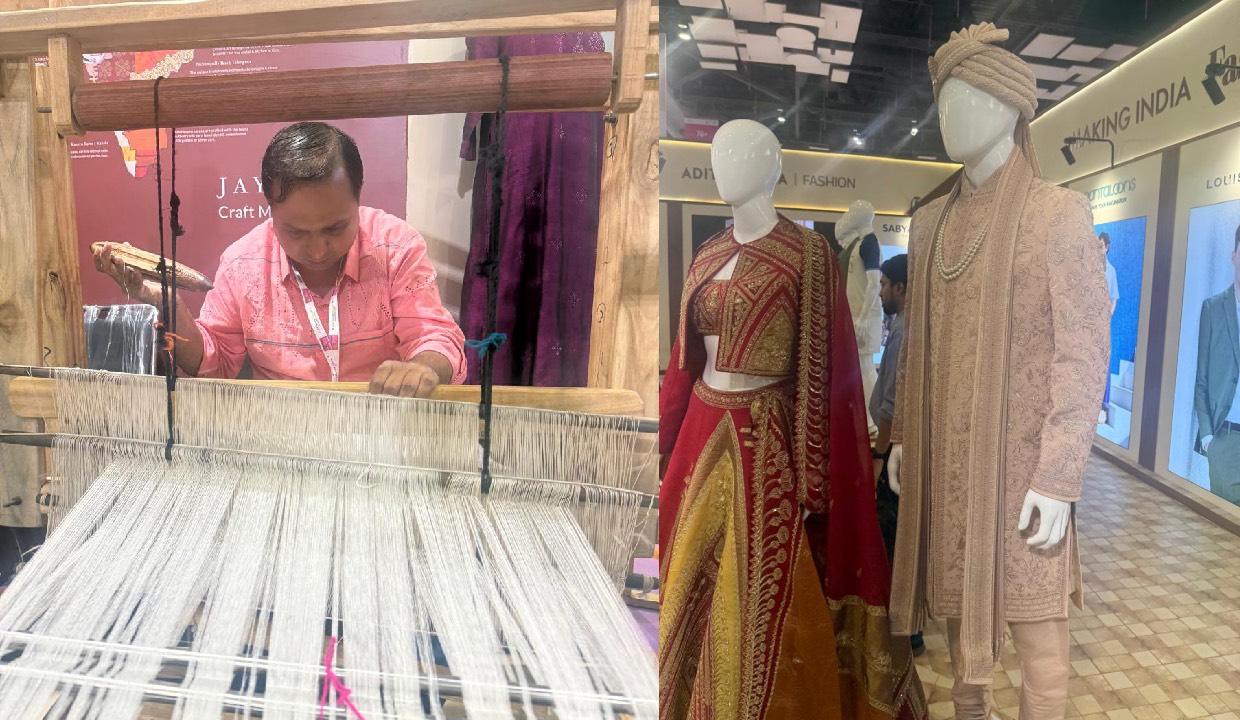
When Bharat Tex 2026 wrapped up its four-day run at Bharat Mandapam in New Delhi this week, one of the smaller stalls amid India's largest textile fair carried an outsized story: Tangaliya, the 700-year-old dot-weave craft of Gujarat's Surendranagar district, on display alongside the country's biggest textile houses and global buyers.
Tangaliya is unlike anything else on India's handloom map. Practised almost exclusively by the Dangasia community of the Saurashtra region, the technique involves twisting contrasting yarn by hand around two or three warp threads to raise tiny bead-like knots — locally called "dana" — that form geometric patterns visible identically on both sides of the fabric. There are no stencils or printed guides; the weaver counts every thread from memory, and a single miscalculation ruins the design. It carries a Geographical Indication tag, one of the few crafts in the world practised by only one community.
Originally, Tangaliya shawls and wraparound skirts were woven for the Bharwad shepherd community using wool from their own flocks. Today the same technique appears on dupattas, stoles, sarees — and, increasingly, contemporary fashion.
Three things explain why Tangaliya is having a moment in 2026. First, government backing: the Vibrant Gujarat Regional Conference in December cited the craft as a model for connecting rural weaving clusters to global investors, part of the Centre's broader push to move handloom traditions from village workshops onto international markets. Second, and more unusually, Hollywood: actor Brad Pitt was seen wearing an indigo Tangaliya shirt in last year's film "F1," instantly multiplying the craft's visibility well beyond India's design circuit. Third, sustained fashion-industry collaboration — the label 11.11/eleven eleven has worked with Surendranagar's weavers for over five years, turning a shepherd community's utility textile into a wardrobe staple for global buyers.
The weaver behind that Hollywood shirt is Baldev Mohanbhai Rathod, a National Award-winning artisan from Dedadara village, who learned the craft from his father Mohanbhai and has since taught it to his own sons — the fourth generation of his family to keep the loom running. Tangaliya's presence at a platform like Bharat Tex, where handloom clusters from across India compete for buyer attention alongside industrial-scale exporters, reflects exactly the kind of exposure artisans like Rathod have said they need most.
Rathod has been candid about what that exposure meant in practical terms. The yarn work behind the shirt Pitt wore on screen earned him around Rs 8,500 — a modest sum set against a Hollywood production, but what followed mattered more: a wave of inquiries from designers and buyers that, by his own account, arrived faster than his loom could keep up. For a craft that was fading a generation ago, as shepherd customers dwindled and fewer young weavers took up the trade, that kind of demand is not just validation — it is survival.
That, ultimately, is Tangaliya's real story in 2026: a craft that has stayed unchanged in method — no templates, only memory and hand — while finding entirely new markets to sell into. Rathod's sons are learning the same way he did, by watching rather than by drawing patterns on paper. Bharat Tex gave the weave another hall to be seen in. Whether that visibility keeps the looms of Surendranagar threaded for a fifth generation is the question the Ministry, the buyers and the weavers are now answering together.