










The world needs 50 per cent emissions cut by 2030 to stay below the +1.50C limit. But that does not seem to be working out at all. So what now?
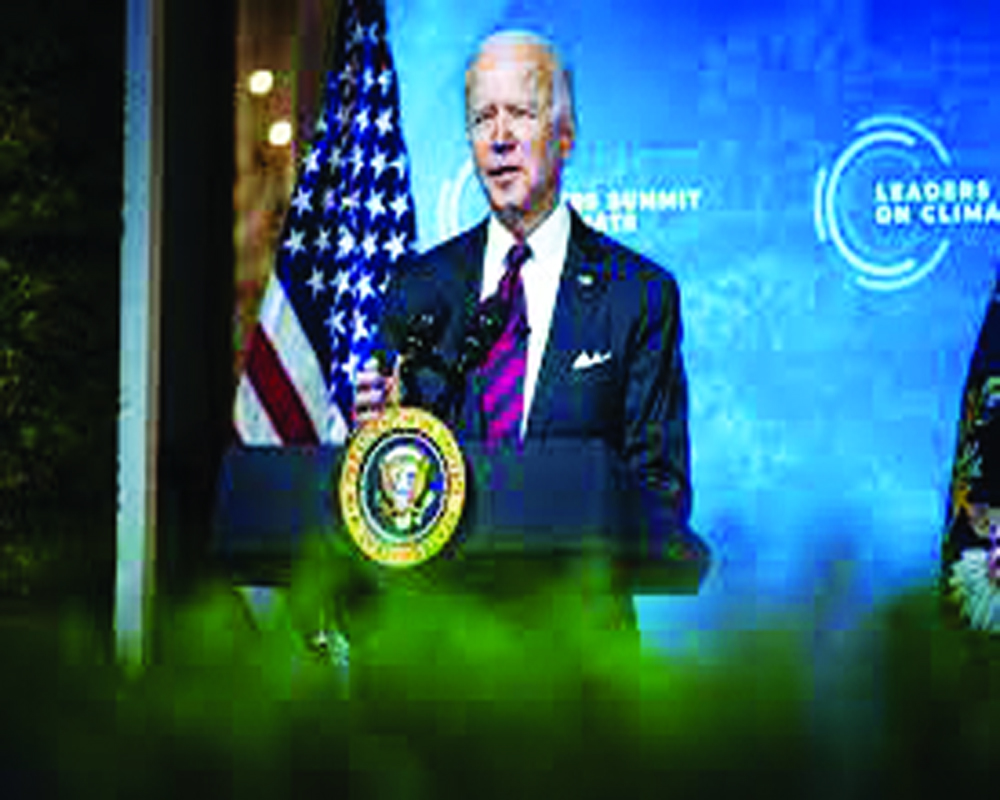
You can tuck your head between your knees and kiss your target of “not more than 1.5° Celsius warming†goodbye. The maverick US President Donald Trump is out and sensible Joe Biden is in the White House. And you will hear a lot of talk about meeting that never-exceed +1.5° Celsius limit. The blather that began on April 22, when the US president convened his virtual ‘Leaders Summit on Climate’, will end in November in Glasgow with Conference of the Parties (COP)-26, the five-yearly United Nations climate meeting where the commitments actually get made.
However, it is already clear that the Glasgow meeting cannot keep the warming under +1.5° Celsius. That target was close to impossible when they adopted it at the last big climate summit in Paris in 2015, and that train has now left the station.
This is not a licence for despair. Cutting greenhouse gas emissions is still important and urgent, but the issue is now also how to deal with much more dangerous warming. We will need new strategies and new technologies to contain the damage, but first — how can we know for sure that we will go through +1.5° Celsius by 2035, or possibly even by 2030?
By the numbers. The scientific consensus is that 430-435 parts per million (ppm) of carbon dioxide in the atmosphere will commit us to +1.5° Celsius. We are now at 415 ppm, and in an average year we put about another 2.5 ppm into the atmosphere. So we have at the most 20 ppm left to play with before we commit to +1.5° Celsius, and we will cover that distance by 2029. Or rather, we’ll get there by then if we don’t cut our emissions very fast.
In fact, we have to cut them by half in 2030 if we want to be safe. But even in the plague year of 2020 we only cut our emissions by seven per cent. Most years we don’t cut them at all.
It’s the Nationally Determined Contributions (NDCs) that tell the tale. NDCs were an innovation of the Paris Climate Summit in 2015, designed to break the deadlock that had paralysed previous summits.
Instead of arguing endlessly about how much emissions each country should cut, every nation was just asked how much it was willing to reduce. They’d presumably be too embarrassed to say “nothingâ€, so at least that way we’ll get something done.
By the way, this was why Donald Trump looked so foolish when he demanded to renegotiate the US emission cuts that his predecessor Barack Obama had promised. There was no negotiation in 2015. Each country’s obligation was whatever it offered. The only person Trump could have renegotiated with was Obama, and only if he had a time machine.
Anyway, here we are in 2021, and theory was that at this summit (originally scheduled for 2020) every country would raise its target for emissions cuts. We need 50 per cent emissions cuts by 2030 to stay below the +1.5° Celsius limit. How’s that working out?
Russia and the UK are the stars among the major countries, offering 70 per cent and 68 per cent cuts in their emissions respectively compared to 1990 (but that’s only because they massively de-industrialised in the 1990s). The whole European Union (EU) will make 55 per cent cuts compared to 1990. If everybody else did the same, we’d be home and dry by 2030. The US says 50-52 per cent cuts and Canada says 40-45 per cent cuts, but only compared to 2005. (They moved the goalposts.)
Japan says 46 per cent cuts, but only compared to 2013. Mexico and Australia are in the mid-20s, India and Indonesia won’t set a number at all but New Delhi did announce an ‘India-US Climate and Clean Energy Agenda, 2030 Partnership’. India also reiterated its promise to install 450 gigawatts of renewable energy capacity by 2030. China says it will try to “peak†its emissions by 2030 (i.e. they will continue to grow every year until 2030).
In other words, the countries responsible for more than half the world’s emissions are making no promises (their NDCs contain no numbers). Some, like China and India, will still be raising their emissions throughout this decade. Even if those who make promises actually keep them, we will end up in 2030 with a global cut of 30 per cent at best. So wave good-bye to “no more than 1.5° Celsius of warming.†What do we do now? Starting with COP-26, we start developing ways to get carbon dioxide back out of the atmosphere i.e. Carbon Dioxide Removal (CDR), and to hold the heat down while we work on that through Solar Radiation Management (SRM). And we work as fast as we can to get our emissions down, because the other stuff is just short-term techno-fixes.
CDR and SRM were both discussed at the 2015 summit, but now we need to start spending serious money on them. We’re going to need them in the 2030s, and neither the science nor the technology will be ready overnight. Ten years might be enough. It had better be enough.
Gwynne Dyer’s new book is ‘Growing Pains: The Future of Democracy and Work.’ The views expressed are personal.



