










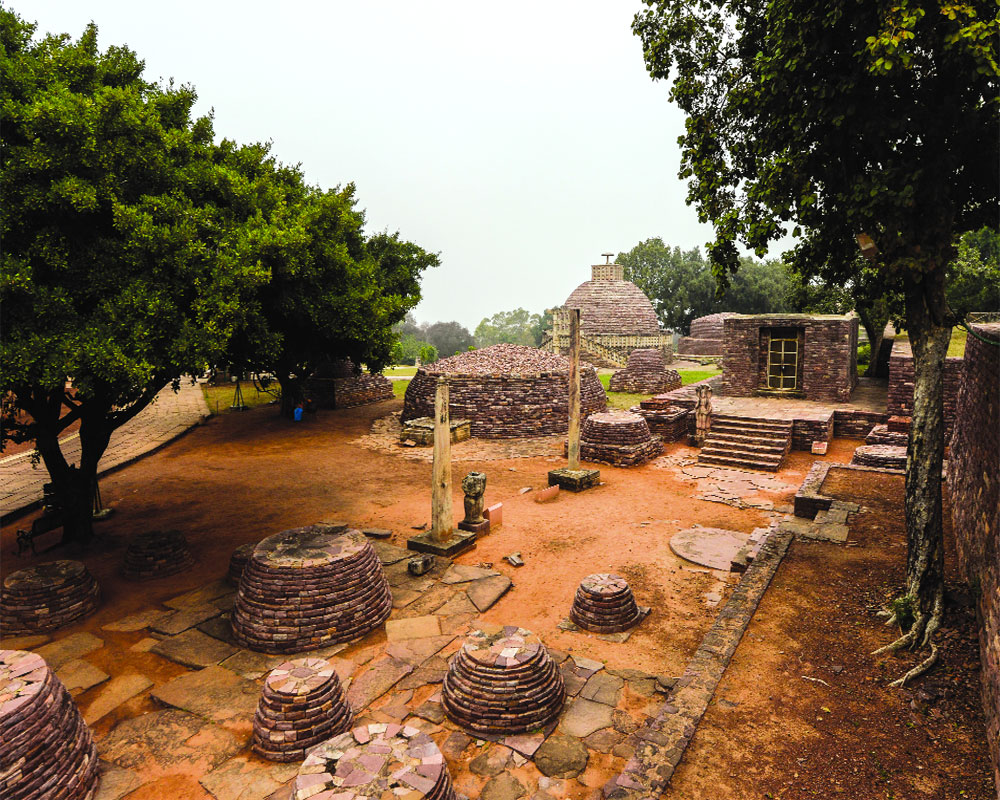
Kushan Mitra explores one of the few remaining sites in Central India with a direct connection to ancient India’s greatest emperor
Sanchi is a ‘blink and you’ll miss it’ sort of town, much like thousands of other small towns on India’s highways. Located on the Bhopal to Vidisha state highway, you’d never quite believe one of India’s most famous historical sites is located on a hill on the edge of the town if it weren’t for the tens of boards that the state tourism board has stuck at various places, all but the last vital turn. On the way to the site from Bhopal, you do cross a little curiosity, a marking for the ‘Tropic of Cancer’, an imaginary line which if you remember your middle-school geography is the northernmost declination of the sun relative to the earth, a point reached at the summer solstice. Odd that there are remarkably few markings of this line in India and it was a pleasant surprise to find it out here.
If you take a look inside your wallet and find a Rs 200 note, you’ll see the image of the Great Stupa of Sanchi on the obverse, and its importance in Indian history is mainly because of the fact that it is one of the largest archaeological remains from Mauryan times. The Great Stupa, or ‘Stupa Number 1’ as it is called dates back to the reign of Ashoka and construction was begun by him. This stupa is a part of a major complex of Buddhist sites across the region. Ashoka considered the region dear to him as his first wife Devi hailed from the nearby town of Vidisha. She was the mother of Ashoka’s son, Mahinda and daughter, Sanghamitra, who spread the tenets of Buddhism to Sri Lanka from where other monks spread it far and wide.
As you turn off the highway to drive to the Stupa, you first pass the Archaeological Museum. Though small, it is a place that you must stop and visit. The ‘Lion Capital’ from the Ashokan pillar found at the Stupa has pride of place at this museum. This capital which is extremely similar to the one found at Sarnath that most Indians today know as our national symbol is remarkably well-preserved as are many other relics mainly from the site and other nearby Buddhist and Hindu sites. It recalls the stellar work of Sir John Marshall in restoring the site and saving it from his fellow colonialists.
The story of saving the Stupa is one that does deserve to be told and the Sanchi Museum has a treasure trove of photographs dating back to 1881 when the British finally put an end to the ravaging of the site by military treasure hunters and amateur archaeologists. Sir Marshall, more famous for his work in excavating the sites at Harappa and Mohenjodaro, played a vital role in saving Indian historical sites as the Director-General of the Archaeological Survey of India (ASI). His stellar role in shepherding the ASI for a quarter-century till 1928 is a major reason that so many sites across India survive to this day. Marshall’s role at Sanchi is so venerated by the ASI that they’ve kept his worktable and some notes at the museum and, rather curiously, his silver cutlery as well. The stupas and the old Buddhist monasteries and schools at Sanchi had been ravaged by time and treasure hunters, the worst of which were the final colonialists who broke into the great stupa in the hope of finding a buried treasure. India owes a great debt to Sir John Marshall.
A winding drive up the hillside takes you to the site where on the way is a small levelled out field where the local children have an ongoing tennis-ball cricket match while the town elders sit on the roadside wall drinking tea and bemoaning the pandemic and the loss of income the town has suffered. Sanchi is the most important site in the central Indian ‘Buddhist Circuit’ and is particularly popular with Sri Lankans, so much so that many signs inside the complex are written in Sinhala. Once you get to the rather empty parking lot, the Giant Stupa looms large in front of you. And you also get a sense of the vastness of the complex, Sanchi was a major site of Buddhist learning for centuries and several additions to the complex were made even after Mauryan times. Indeed, there is a belief by some scholars that the post-Mauryan Shunga dynasty destroyed the original stupa and rebuilt it later.
At its peak, there were probably thousands of monks, scholars and students at the site, the ruins of the monastery and smaller stupas under which prominent monks had been buried.
You enter the site walking to the northern gateway and its impressive ‘Torana’, these gateways have rich sculptures where stories of the Buddha and great kings, including Ashoka have in relief. The remains of the polished sandstone Ashokan pillar are located near the southern gateway from where a staircase leads up to the deambulatory walkway. Scholars believe that the Great Stupa as we see it today was built by the Shunga dynasty that followed the Mauryan empire, the covering of stone, the balustrades and even the intricate sculptures on the gateways are from that period. What you see on the 200-rupee note is the Western gateway.
Much like the 100-rupee note that features Rani Ki Vav, the famous stepwell near Patan in Gujarat, the image on the note does not do justice to the site. The sculptures on the gateways are tremendous and the different gateways all have different stories. Some depict tales from the life of Gautam Buddha and others tell the story of Ashoka the Great. You also see the vastness of the site that you never really learn about in your history textbooks in school. This again comes back to the fact that India has the richest amount of history of any nation. A site like Sanchi could be as prominent as the Taj Mahal in other nations, in India, while undoubtedly a popular site, primarily due to its importance as a site of Buddhist pilgrimage, but it should also be remembered, much like Sarnath outside Benaras as one of the few remaining sites with a direct connection to ancient India’s greatest emperor.



