










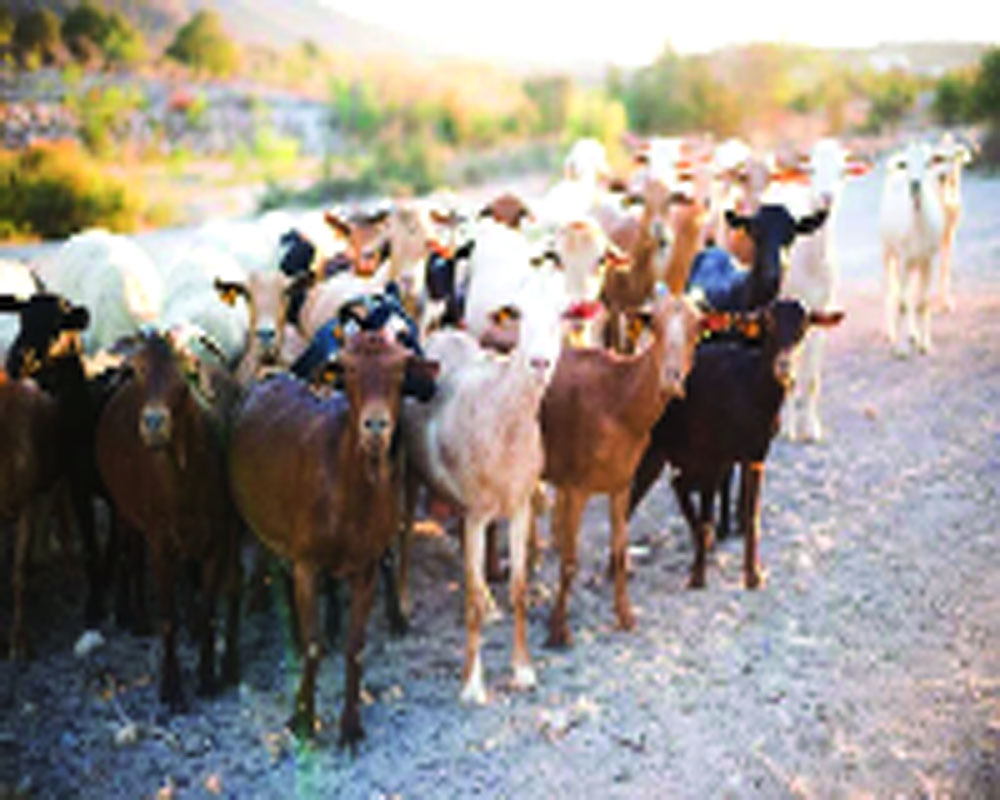
To provide livelihood, the government should provide adequate training and information to landless, marginal farmers about the goat farming schemes
Anita Devi, a 40-year-old resident of Hussainpur village, located about 65 kilometres from the Muzaffarpur district in Bihar, lost her husband two years ago. Left with no means to support her family of seven, including four daughters and two sons, she started goat farming to earn a livelihood. She faced criticism when she began rearing goats as a woman farmer. However, Anita resisted because her motivation to provide for her family kept her going. She had started with just two goats. Today, she has eight adult goats and 20 young ones. Goat rearing enabled her to protect her family and improve her financial status.
Alongside manual labour, agriculture-based employment like cattle, poultry, ducks, and goat farming is a crucial source of income, especially for economically disadvantaged individuals like landless, small-scale farmers, agricultural labourers, and socially oppressed individuals. According to the latest 2019 Livestock census, India has a population of 150 million goats, the second largest in the world. In around half a million remote villages, 70 million farmers are involved In the goat farming business. The primary income from Goat farming comes from milk, which has a production of about 42000 Kgs and meat production, which stands at 8500 Kgs.
Like Anita Devi, Goat farming is an excellent means of self-employment for many rural women. Around rural areas in Muzaffarpur, many women earn their livelihoods through goat farming, becoming breadwinners for their families. 35-year-old Champa Devi, resident of the same village as Aninta, also supports her three daughters and two sons by raising goats.
In other instances, older women in the village claim that their sons and daughters-in-law have stopped providing for them in their old age. These women have, therefore, started rearing 2-4 goats to earn a living. These women leave for the fields in the morning to graze their goats and only return in the evening.
Goat farming is a hard job, especially during the monsoons. It can be a challenge to find adequate fodder for the goats. The farmers rely on bananas, bamboo, and Banyan leaves to keep the cattle alive. People invest their capital into it. Even after that, we see an increasing number of women who raise goats in the village. It has become a source of livelihood for many families.
Various non-governmental and government organisations run programs to strengthen the village economy through agriculture-based employment like cattle, poultry, ducks, and goat farming. The Bihar government provides subsidies up to 60% for promoting goat farming. Under the Integrated Goat and Sheep Scheme, there is a provision for subsidising ten goats plus one buck, and 40 goats and two bucks. The government also provides financial aid to disadvantaged communities like Scheduled Caste/Schedule Tribe and Other Backward Classes. These continuously disadvantaged groups get up to 60% subsidy, while the rest get 50%.
In addition, the capital investment required for raising 20 goats with one buck is about two lakhs, and farmers can take a loan from the bank for this purpose. This process of approving loans goes through the Department of Animal Husbandry in consultation with the bank. After that, subsidies get deposited into the beneficiaries' bank accounts in two instalments. However, because of a lack of awareness, many rural families do not know these schemes, leading women farmers like Anita and Champa to take loans with high interest rates to start goat farming. On top of that, due to their lack of training,
It is difficult for farmers to acquire high-quality breeds.
To promote livelihoods, the government should provide adequate training and information to landless, marginal farmers, and labourers about the goat farming schemes. Details about these schemes should be available in the Panchayat office or Gram Sabha. Ward members should be responsible for disseminating information about these programs to goat farmers. Only then women in vulnerable situations will be able to continue goat farming as a career and give themselves and their families a better future.
(The writers is a student from ruralBihar; views expressed are personal)



