











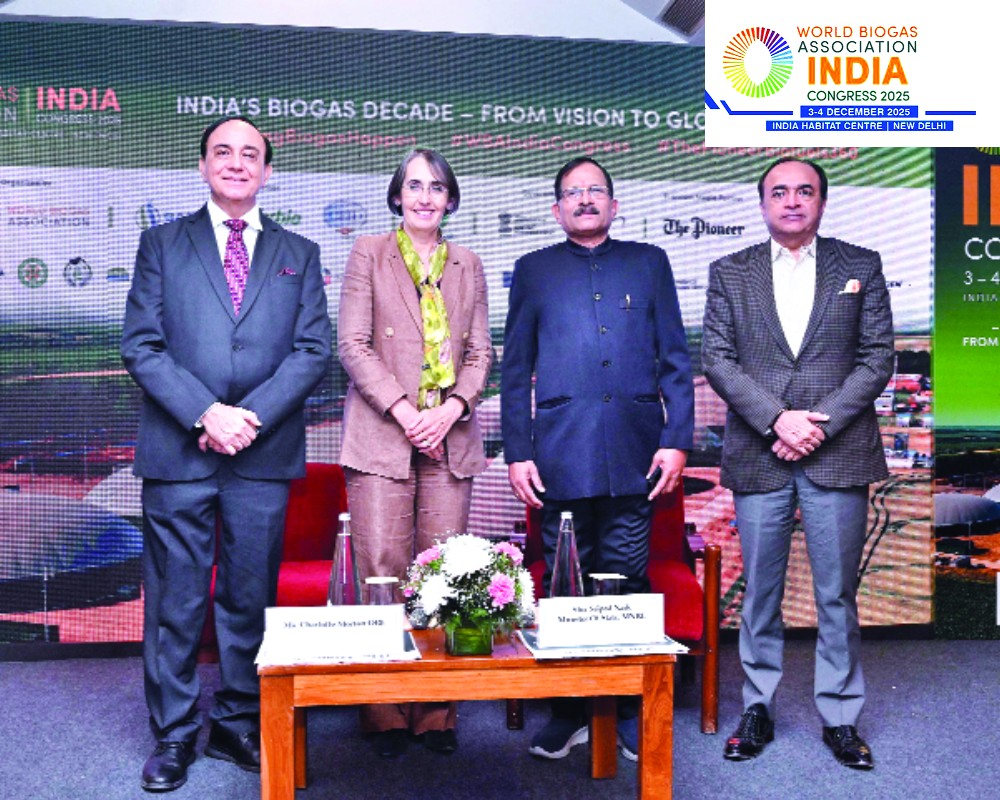
Setting an ambitious tone for global collaboration in biogas, Union Minister Sripad Yesso Naik on Thursday said India is on the threshold of what we proudly call the Decade of Biogas. “Our goal is clear and consistent: from a national vision to global leadership. We aim to position India as the world’s hub for Biogas policy innovation, investment, and scalable business solutions,” said Naik, addressing the gathering on the concluding day of India Congress 2025, organised by World Biogas Association in the national Capital.
Naik, who holds the Ministry of Power and Ministry of New and Renewable Energy portfolio as Minister of State, also emphasised that Biogas is becoming essential for India’s clean energy transition, energy security, waste management, and industrial decarbonisation. He noted that it “sits exactly at this intersection” of national priorities and that India is “already aligned and advancing on both fronts” through accelerated programmes and global partnerships.
Naik highlighted that Biogas and Biomethane are transforming agricultural residues, municipal waste, and industrial effluents into clean energy, organic fertiliser, and green jobs, calling it “the circular economy in action.”
He expressed that village-level and community Biogas systems strengthen waste management, increase access to clean cooking, and enhance local energy security, describing the transition as “a rural development revolution” and “a pathway to a resilient local economy”. He praised the NDDB-WBA MoU for promoting global standards, training, and operational excellence in India.
The day advanced into parallel policy and technical tracks like Biogas Beyond Borders: Global Dialogue; Strategic Vision for Biogas & Biomethane — Margin to Mainstream; Small and Medium Scale Biogas Plants — Challenges and Opportunities.
The day wrapped up with a rich set of discussions that brought global and Indian perspectives together. Speakers shared how international cooperation can speed up Biogas growth, while MNRE outlined a clear vision for taking the sector mainstream. Sessions explored the role of small and mid-scale plants, the promise of Biomethane for transport, fresh avenues for private financing, policies to tap industrial organic waste, and India’s push to scale Biogas from early pilots to a nationwide, socially inclusive, job-creating ecosystem.
The second day of the WBA event saw industry leaders, policymakers, and technology experts discussing how to tackle the roadblocks, or how boldly the targets to be met and that India cannot unlock its Biogas potential unless it solves how biomass is collected, stored, priced, and delivered.
The gap between policy ambition and ground-level reality also surfaced. While the government’s SATAT scheme promises up to 50 per cent financial aid for new plants and assures off-take through oil marketing companies, the physical challenge of connecting these plants to consumers remains stiff.
Technology experts pointed to another silent risk: plant safety and design quality. Flávio Ascenco of the World Biogas Association said mistakes in basic engineering could trigger catastrophic failures. “A small error like closing a breather valve and creating negative pressure can collapse a digester three times,” he warned. He stressed the need for proper HAZOP studies and stronger automation, pointing to European sites that run with a single worker monitored by safety systems adapted from the oil and gas industry.
NTPC’s Amit Kulshrestha outlined how digestate can be turned into biochar using torrefaction. He said Biogas could also support electricity during peak hours if NCR’s biopulp is used to produce CBG and injected into existing pipelines. IndianOil Adani Venture CEO Atul Kharate spoke about the early challenge of convincing customers to switch from LPG and liquid fuels to CBG, requiring pressure-flow modifications and new firing mechanisms.
Others focused on the long-term environmental case. Kevin Houston of Carbon Masters called CBG one of India’s strongest climate solutions because it produces both clean fuel and soil-restoring fertiliser. “The soil carbon issue is huge. If we don’t fix it in the next 20 years, India will end up with just dirt,” he said.



