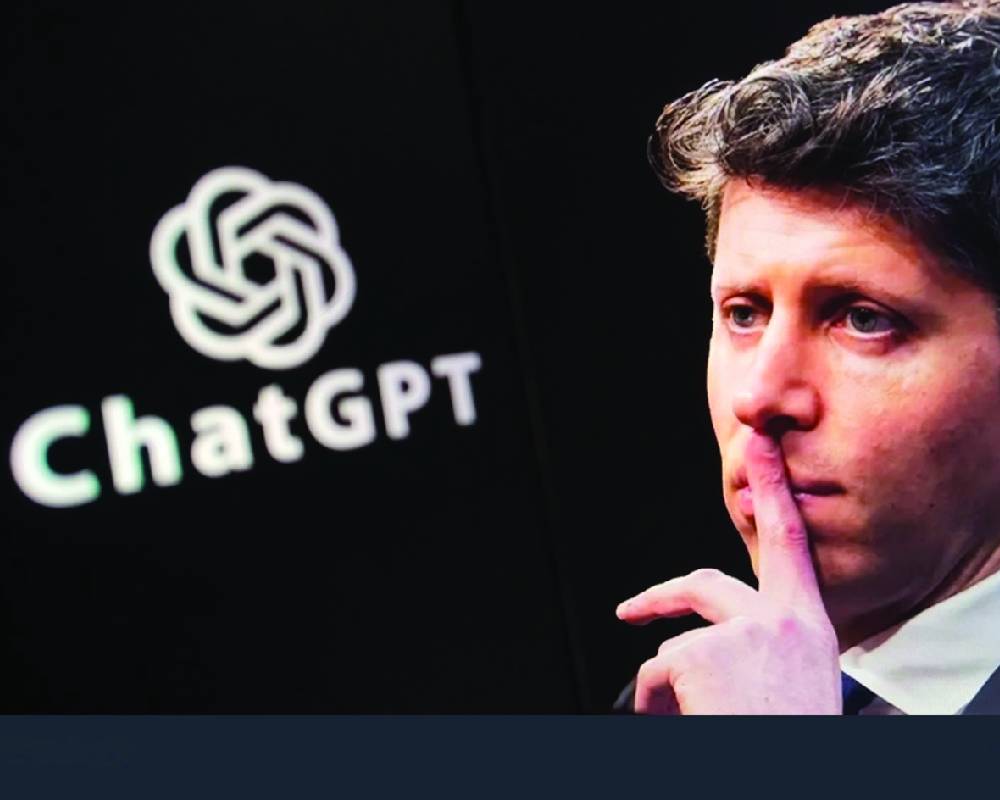
OpenAI’s “Go” tier is free for a year for the Indian users. The announcement created a ripple. Despite zero cost, the plan offers “10× more messages and image uploads,” and access to an advanced model, whose features were behind paywalls. It is a Rs4,788 freebie. According to TechCrunch, OpenAI’s ChatGPT app recorded more than 29 million downloads over the past quarter in India, but in-app purchases were a mere $3.5 million. The gap between adoption and monetisation is palpable. Hence, through the free plan, OpenAI aims to convert usage-curiosity into paying-loyalty.
Like Reliance Jio’s free voice and data offer in 2016, which rewired the mobile usage economics, OpenAI’s gambit is about creating a market at the expense of immediate profit. The latter hopes that zero entry barrier will result in habitual paying-users. Monetisation can happen through upgrades, enterprise bundles, or API integrations. If 5 per cent of the free downloaders start paying after a year, revenues will be significant. One million users can bring in Rs5 billion a year, or nearly $60 million. Ten million will make India one of OpenAI’s largest national revenue pools outside the US.
History cautions us against such assumptions. Large user bases do not automatically convert into healthy margins. Netflix’s mobile-only plans led to large sign-ups. But the OTT firm struggled to lift average revenue per user (ARPU) beyond Rs 200 a month. India’s digital economy thrives on low ARPUs, with high engagements. This forces companies to seek monetisation through advertisements, data partnerships, and enterprise tiers. Since ‘compute’ dominates costs, a large base is an asset and a liability. If the users do not pay, they are a powerful source of data but drain expensive GPU hours.
Like Netflix, OpenAI uses price as a lever to build habits. Both treat India as a market that demands accessibility first, and loyalty later. For Netflix, this implied a mobile-only plan, and free weekends. For OpenAI, it means a year of the usage of advanced tools at zero cost. The calculations are identical. The more the users who join the ecosystem early, the higher the odds of long-term retention later.
The difference lies in what counts as value. For Netflix, value is the time spent watching. For OpenAI, it is data, prompts, and behaviour feedback to refine its language models. For the AI tool, the free plan is an investment for the future, not a marketing expense. Each new prompt expands the model’s understanding of multilingual syntax, regional vocabulary, and mixed-language expressions. The result is a loop where users during the free period train the product, make it more efficient, and enable the firm to monetise usage later.
Netflix’s experience may provide lessons for OpenAI. The former’s surge and lurch showed how quickly free access could dilute the paying intent once the novelty wore off. When Netflix enforced payments, price sensitivity kicked in. OpenAI may face similar challenges, which is a dilemma that is eerily familiar to the Telcos too, apart from OTTs. Yet, India cannot be left behind.
“India is our second-largest market after the US, and it may well become our largest,” OpenAI’s chief executive Sam Altman said earlier this year. “The excitement, the embrace of AI in India, and the ability for Indian people to use AI to leap-frog into the future is really quite remarkable.” Rivals know this, and are ahead of the game. Perplexity AI tied up with Telco Bharti Airtel to offer a year’s plan at zero cost. It pitched its product as an “AI search companion,” not a chatbot. Google, through Gemini Pro integration with Reliance Jio, extended complimentary access to millions of Android users.
India is embroiled in a new price war, where bandwidth is replaced by ‘compute,’ and user acquisition is measured not by call-minutes but prompts per day. Analysts estimate that OpenAI’s global usage exceeds 2.5 billion prompts daily. If India contributes even a tenth of additional traffic in 12 months, it will represent one of the largest single-market usage surges in modern software history. What happens after the one-year period is another story.
Jio eventually introduced data caps, and pricing tiers; Netflix moved from free trials to ad-supported plans. Both confronted consumer expectations conditioned by zero costs. In addition, as both learnt from experience, the game plays out against a backdrop of shifting regulatory policies. India is vocal about indigenous language models through the IndiaAI Mission and BharatGen. The finance ministry has advised civil servants to avoid foreign AI tools like ChatGPT due to concerns related to privacy and data localisation.
Free tier that democratises access may invite scrutiny over how data is stored, processed, and used for model training. The government’s forthcoming AI governance framework is expected to include guardrails on cross-border data flows, and algorithmic transparency. OpenAI may gain by getting embedded deeply in India’s digital routines before the regulatory walls rise. It may secure market familiarity and user dependency. By the time local LLMs mature, millions will be hooked to workflows around ChatGPT.
The outcome will be instructive. India will witness an explosion of usage. Over 2-3 years, monetisation, taxation, and data ethics will dominate conversations. Finally, the model that sustains may shape how the developing world engages with AI. If OpenAI can profit from India’s high-volume, low-ARPU market, it will validate the thesis that AI can scale up like a platform rather than a luxury service.