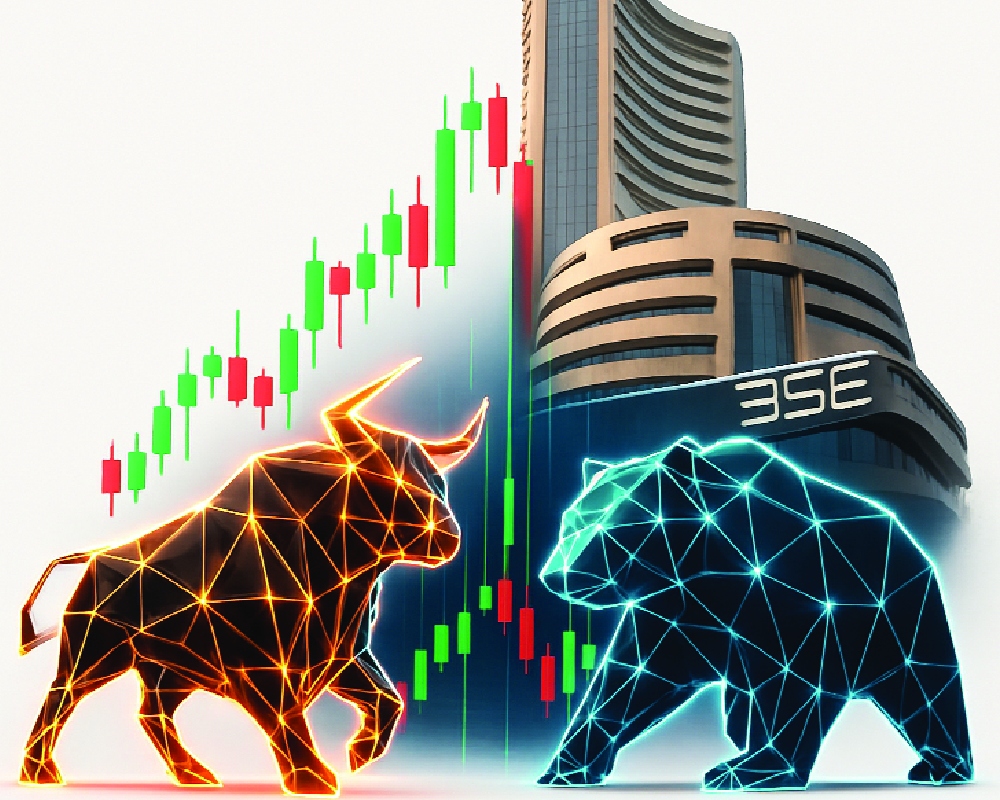
Over the past one week, Sensex, the market index for the Bombay Stock Exchange (BSE), has lost 1,500 points. It is ironic that over the past one month, it gained almost 1,700 points, or 2 per cent. Yesterday, the index was down more than 500 points and, according to media reports, investors “lost more than Rs 2,00,000 crore on Tuesday as the cumulative market capitalisation of firms listed on the BSE dropped to below Rs 4,70,00,000 crore.” Several reasons can explain yesterday’s crash, as also the decline over the past few trading sessions. One of the main reasons is global cues. Recently, the US Federal Reserve announced that what many had assumed to be an automatic interest rate cut in December 2025 was not a foregone conclusion. The Fed wants to wait for concrete data, which is not available due to the Government shutdown, before making its decision. This dented sentiments across the world.
In addition, several global experts have begun to chatter, and debate about the valuations in the mega tech stocks, especially Artificial Intelligence (AI) firms. Discussions have ensued around the theme whether AI is now in a bubble, which can burst any moment, or are the valuations sustainable despite lack of revenues and profits. Some compare the current worth to those of the tech stocks in 2000, and conclude that there are no reasons to be worried today. Others look at the values in isolation, and highlight that there are inherent problems. In fact, there are contradictory views on whether AI can be a gamechanger. Yet again, some say that the productivity gains may be as high as 30 per cent over the next few years. The naysayers feel that AI can maximum add 1 per cent each to the GDPs of advanced economies. Employers too are not sure about the benefits.
On Tuesday, both the losses among individual stocks and sector-specific indices were dismal. Of the Nifty 50 stocks, only eight ended in the black, and most were in the red. Some of the stocks fell by as much as 3 per cent each. Among the few winners, some of the stocks went up 1-2 per cent. But the story was vastly different among the sectors. Apart from Nifty Consumer Durables, the other sector indices were down. The worst affected included metals and IT, as well as auto, and bank and financial services. Obviously, consumer durables have a good story going due to the recent GST rate cuts. There is good news from the auto sector, but disturbing one from the metals. IT is caught in a bind: Some stocks have done well due to their emphasis on AI, but others have not. There is huge uncertainty about the future of the sector over the next few quarters.
Huge hikes in H-1B visa fees are a problem. It restricts the movement of labour from India to the US. More importantly, Indian firms will need to churn the visa holders who are already present in America, which will increase their demand and, hence, salaries. If the US junks the existing lottery system, and opts for pay-linked entry via H-1Bs, Indian employers will need to send more expensive people abroad, which will cut into their profits, as will the fees. According to Raghuram Rajan, the former head of the Reserve Bank of India, Indian firms need to be more worried about the HIRE Act, which seeks to impose a tax on outsourcing. The outsourcing equations, and returns, will need to be re-calculated and re-calibrated. This can disrupt some of the existing business models.
When it comes to the BSE, out of the more than 4,300 stocks listed on the exchange, more than 1,600 advanced on Tuesday, and more than 2,500 went southwards. Yet, 140 stocks hit a 52-week high, and only 90 hit a 52-week low. More than 10 stocks jumped over 15 per cent on the BSE yesterday. The most active stocks on the National Stock Exchange (NSE) were the ones that were in the news in the recent past. Vodafone Idea got a reprieve from the Supreme Court to pay its dues to the Government, although the latter is yet to decide the modalities. Suzlon Energy sizzled with multiple increases in profits in the second quarter this year. Recently, YES Bank hogged newspaper headlines when the State Bank of India (SBI), its main promoter after the former bank went down under, sold a part of its stake to a Japanese bank at a huge profit. The stake sale helped SBI to increase its profit in the second quarter of this fiscal.
Nifty’s technical outlook, as voiced by chartists and experts, indicates that at a current level of 25,600 points, it stands on a weak and stocky wicket. If the index remains below 25,700, the weak sentiments may persist, with a downside of another 200 points. However, if it stutters over 25,700, the upside may be 200 points too. At a macro level, news from the US on inflation, jobs, and growth will determine the fate of the global indices. Until now, the American economy has withstood the trade-tariff disruptions, with a few job losses, and mild price rise. If the negative trends escalate, as data pours in later, the investors are in for trouble. If the data is positive, or even remains unchanged, stocks may rebound.