










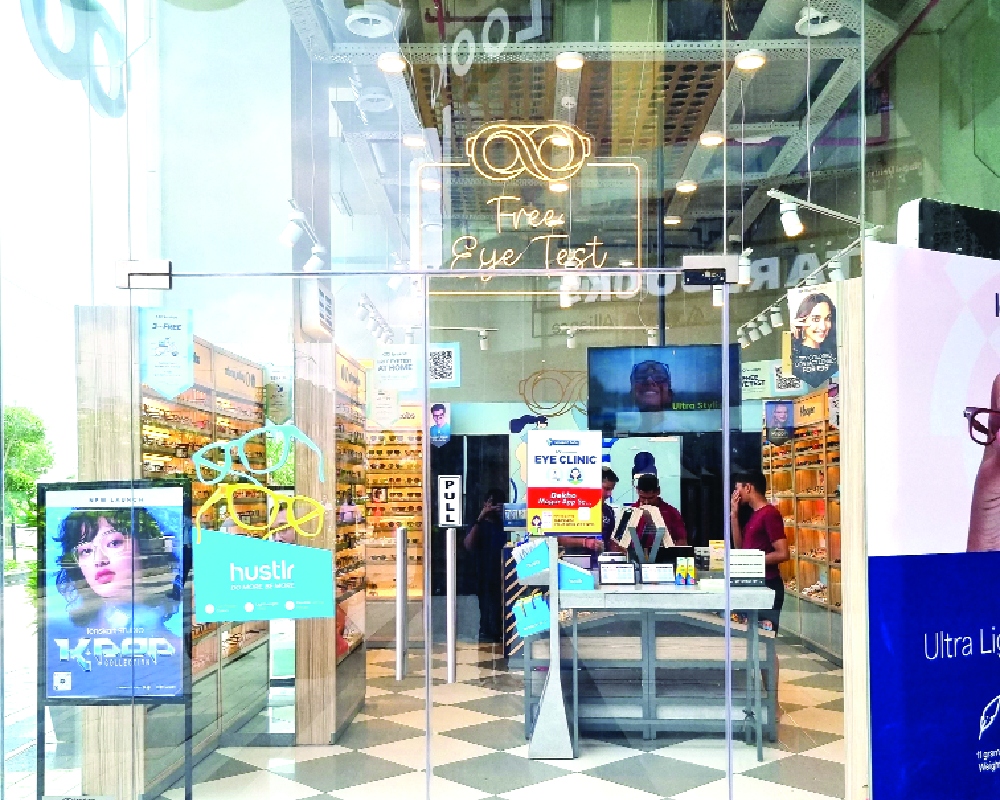
It is one of the most-viewed, and highly-crazed companies that will be listed this week on the exchanges after its IPO (Initial Public Offering). As expected, the listing gains were minimal, as Lenskart’s stock opened on the National Stock Exchange (NSE) at a nearly two per cent discount, and closed a rupee above its offer price, or 0.25 per cent higher. During the day, after co-founder Peyush Bansal feverishly waited for the bell, the share price dived to below Rs363 on the NSE, or a drop of nearly Rs40, or 10 per cent, within two minutes. It recovered fast, ruled above the offer price for almost four hours, dipped down, and stayed afloat above the issue price.
Before the listing, in the grey market, the price was quoted at Rs390, or more than Rs10 below the offer price. Ambit Capital, a brokerage house, gave a ‘Sell’ rating, and estimated a target price of Rs337, which indicated a potential downside of 16 per cent. According to the brokerage, Lenskart’s was a capital-intensive model, with “limited free cash flow generation, and modest return on capital employed (RoCE) of around nine per cent,” which made its “lofty valuation hard to justify.” The institutional investors were bullish. “The business is great. The runway is great. The lead over the rivals is very good,” Kunal Shroff, managing partner, ChrysCapital, told a website.
For weeks before the IPO, and during the period till the listing, there was a debate on Lenskart’s valuation. Some analysts said that the company’s worth, based on the offer price, was highly-stretched. Questions were asked about IPOs to SEBI officials, who wavered between allowing the market to decide the worth of new shares, and a view that valuations need to be fair and genuine. Other experts said that the eyewear company, which is now into smart AI-driven glasses, has a huge future potential, and the investors are paying for it. Despite the so-called high price, the issue was oversubscribed by more than 28 times, with the institutional figure being 45 times.
Bansal, the co-founder, said that he had no idea about a listing bell when he launched the company with others, but he realised that his vision was 20/20 from the reaction of one of his early customers. “She was a teacher who gave up reading notebooks because of her eyesight, and started crying when she wore our glasses. It reminded me that our business is not about eyesight, but dignity, pride, and possibilities,” he said at the listing event. Lenskart, according to him, transforms how people see, and wows customers.
Bansal’s business became an obsession even as the founders discussed building Indian institutions on the lines of Microsoft, and provide vision at global standards. Bansal said that they dreamt about a time when everyone in a crowded cricket stadium would wear their glasses. They were rattled when mall owners repeatedly said that the ground floor space was meant for the foreign brands, and Indian ones could go lower, or higher. They were heckled for owning a ’chasma ka company.’ Bansal had to convince his co-founder’s prospective father-in-law that it was fine to marry his daughter to his partner. “Profit is oxygen, but purpose is breath for us. Every customer we serve is like an IPO, as the stock market rings the bell once, and customers ring it every day,” he added.
On the first day, the expert views, as we mentioned earlier, remained mixed. Shivani Nyati of Swastika Investmart maintained a ‘Neutral’ view, and cited “stretched valuations even though the company's business fundamentals remain solid.” Another analyst, Siddharth Maurya of Vibhavangal Anukulakara felt that with a “potential valuation of around Rs70,000 crore, Lenskart’s omni-channel presence, and aggressive international expansion stand out as key differentiators.” But he wanted the investors to do their due diligence, and look at the sustainability of margins. According to NSE data, on the first day, more than 131 million shares were traded, with a value of Rs522 million, and a market cap of Rs70,184 crore.
According to a media report, “The eyewear platform entered the market with a valuation of around Rs70,000 crore. Yet, just before its listing, its grey market premium slid from Rs108 at its peak to zero. The drop reflected a sharp pullback in appetite, suggesting investors were no longer willing to pay a premium even before the shares hit the exchange.” Several factors can explain it. The valuation metrics put Lenskart higher than competitors like Titan, Trent, and Nykaa. Brokerages stated that while revenue growth is robust, margins have not kept pace. The market mood changed in terms of valuation despite the huge and mighty response to the IPO.
Several analysts drew some positivity from the price trend. One of them said that the investors expected miracles. The fact that the listing price, and closing price did not waver too much from the offer price indicates that the IPO pricing was almost-perfect. In such a scenario, even a great company can disappoint a little. Future share price will be determined less by sentiments, and listing expectations, and more by performance. If Lenskart can deliver on the promises, and show financial results, the price will go up. If not, it will be one of those momentary sparks, and go down the way of other IPOs, which were either issued at aggressive prices, showed awesome listing gains, and then fizzled out to quote at huge discounts.
This explains why a few analysts advise patience to the shareholders, and potential buyers. The ones who have the shares do not need to rush to sell. Ones who do not do not need to rush to buy. Existing investors can hold-and-wait for things to happen. The same is true for the buyers-in-waiting. The next few quarters, says an analyst, will prove to be the key to understanding what to do. The company, which has spread its looks in the Middle East and Asia, now seeks to zoom in on Europe. The international presence, and the growing share in India will help. Margins, though, will be a challenge.
According to another report, Lenskart is an oddity in the booming IPO space. Its weak debut can be contrasted with other high-profile ones that rewarded investors on listing days. LG Electronics, for instance, gained 50 per cent, which was one of the strongest debuts. Anthem Biosciences shot up by 27 per cent, and National Securities Depository opened 10 per cent above the issue price. The IPO market will continue to sizzle with several known companies hitting the market to raise massive sums. But Lenskart may provide a new valuation lens to decide a company’s worth. Investors too will check their vision through new non-tinted glasses, hopefully.



