










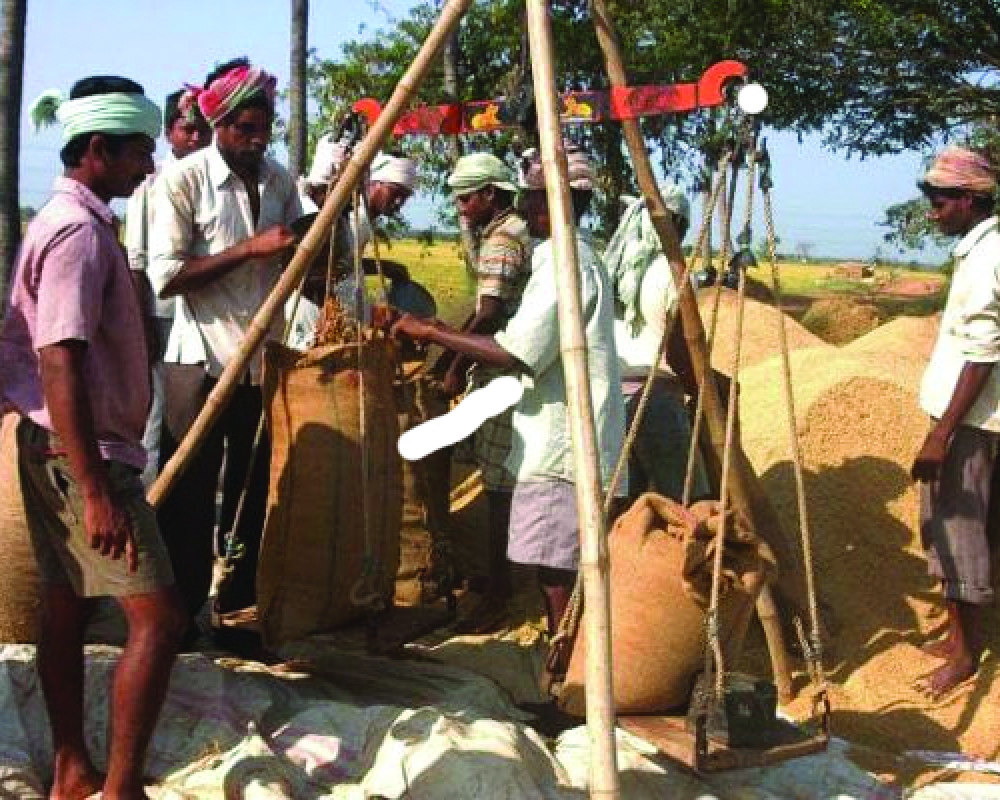
Some of the farmers in North India are crossing state borders to ‘illegally’ sell their Kharif produce. Apart from better prices in terms of the government-decided MSPs (Minimum Support Prices), the growers are lured by reliable procurement, better policies, and efficient infrastructure across the borders. What this implies, and what evidence proves, is that the cultivators get as much as a third less than MSPs in their own states. Thus, at present, as the Kharif produce hits the market, both the trends are in play.
It is akin to a game of Chinese Checkers, as the farmers from Uttar Pradesh and Rajasthan allegedly enter the adjoining districts in Haryana and Punjab to market their produce. However, unlike the board game we mention, the on-ground “adversaries” in the states where the crop is sold do not intend to enter the “intruder-farmers” areas. All that the former wish to do is to “defend” their incomes. “When the Rajasthan farmers tried to sell their crop in Punjab, the local authorities jailed them, and confiscated the produce,” alleges Thakur Guni Prakash of the Bharatiya Kisan Union (Mann).
The main reason why the growers need to resort to such cross-state sales is because their state governments are absent, inactive, or lackadaisical, or they are forced to sell at much-lower-than-MSP prices to the middlemen. Prakash is incensed that farmers take on other cultivators in this cross-border dispute. “What is disgraceful is that the so-called leaders of the farmer union in Punjab help the police to get their own people arrested,” he claimed.
Let us look at how the official paddy procurement (and sales) proceeded from mid-September till now in North India. Due to efficiencies or inefficiencies, different states follow different procurement schedules. During the period under question, due to the early arrival of the paddy crop, Punjab rolled out the official Kharif procurement on September 16, and Haryana commenced the MSP operations on September 22. In both cases, the dates were earlier than Uttar Pradesh, which started MSP-based buying on October 1 in the western districts, and November 1 in the eastern ones.
Generally, the rice-marketing of the Kharif crop in North India starts in October, and different states follow schedules based on the cropping patterns, monsoons, and other factors unique to their respective states. Farmers in Punjab and Haryana, as in the other states, structure growing patterns around crops that are backed by MSPs. Although the Centre offers such prices for 22 crops, the subsidy-incentive-protection system principally favours wheat and rice, which are the major crops sold to government agencies.
While the government buyers in Punjab and Haryana were ready to take the crops at MSPs earlier, Uttar Pradesh lagged. The actual procurement in the latter state took a few more days in certain districts due to the bureaucratic processes involved. Thus, due to the early arrival of the paddy, the farmers in Uttar Pradesh faced two choices: Either cross the border into Punjab to sell the crop, or dispose of it at below-MSP in their own state.
Reports from Lucknow indicate that some middlemen, and others, in Uttar Pradesh offered Rs1,600-1,800 per quintal, against the prescribed MSP of Rs2,369 (common paddy), or one-third lower. It was a no-brainer for the courageous and savvy growers among the sellers. They crossed the borders. Obviously, the Punjab farmers were peeved, and put up a stiff resistance against the ‘outsiders,’ who dared to intrude, and cut into their MSP pie. State governments have seasonal targets, and stop the purchases once these levels are reached. It is a first-come, first-bought regime.
The problem is not from the neighbouring states only. Growers from the adjoining areas, and with means (money, transport, and logistics) to carry the crop to the “mandis” (agricultural markets) in the border states to sell as quickly as they can. But the middlemen too play this game. Retailers and wholesalers from far-off Bihar allegedly carry crops to Punjab and Haryana during the procurement seasons despite the protests from the administration and local peasants.
“The condition of the farmers in Bihar remains the worst in the country. Their average household incomes are half of the national average, and one-fourth of the states like Punjab,” claims a recent statement from the Samyukt Kisan Morcha (SKM). The Morcha was formed as an umbrella agency to represent several farm unions, and protest jointly against the now-repealed three farm laws. In Bihar, the procurement is through the State Food and Civil Supplies Corporation, and there is no official mandi, which offers MSPs. Since most farmers cannot approach the Corporation’s warehouses, or purchase points, this provides an opportunity for the middlemen to buy cheaper, and later sell expensively in the market.
“In the last 10 years, only 25 per cent of the paddy produce was procured by the government. Wheat has averaged less than one per cent. Bihar farmers get 30 per cent less price than the MSP,” alleges SKM. “The percentage of farmers who can avail MSP comes to less than 10 per cent of the total,” says the organsation secretary of the RSS-affiliated Bharatiya Kisan Sangh (BKS), Dinesh Dattatraya Kulkarni. He points at the farmers’ apathy, and asks, “Do the brother-farmers in Assam, Odisha, and West Bengal, get anything?”
Bihar runs a State Crop Support Scheme, which supplements MSP, and provides additional financial security. However, limited infrastructure and logistical issues affect timely procurement, and not all the farmers are aware of it, or are able to access the stipulated digital registration systems. This game of Checkers is complex. The Centre cannot force the states on MSP since agriculture is a state subject under the Constitution, and the MSP implementation requires changes in the state-level laws and rules.
Since farm price control is in the concurrent list of the Constitution, the Centre can announce MSPs, and fund procurement through the agencies like the Food Corporation of India (FCI). But it cannot unilaterally enforce MSP compliance across states. This means the states have legislative and administrative control over agricultural markets, and procurement mechanisms. This explains why the farmers demand a central legal guarantee to ensure that no crop is sold below MSP, but this will require a new law that either overrides state laws, or mandates state compliance.
In addition, many states do not have the financial capacity, or political will to procure crops at MSP. A few oppose central mandates due to ideological and political differences, or concerns about market distortion and fiscal burden. The BKS contends that the issue is not about higher procurement, MSP, or the amount spent in purchases. The concern is about how many farmers access the benefit. While India protects the growers from foreign sellers, the former, especially the small and marginal ones, need to access a wider market.
(The author has more than three decades of experience across print, TV, and digital media); views are personal



