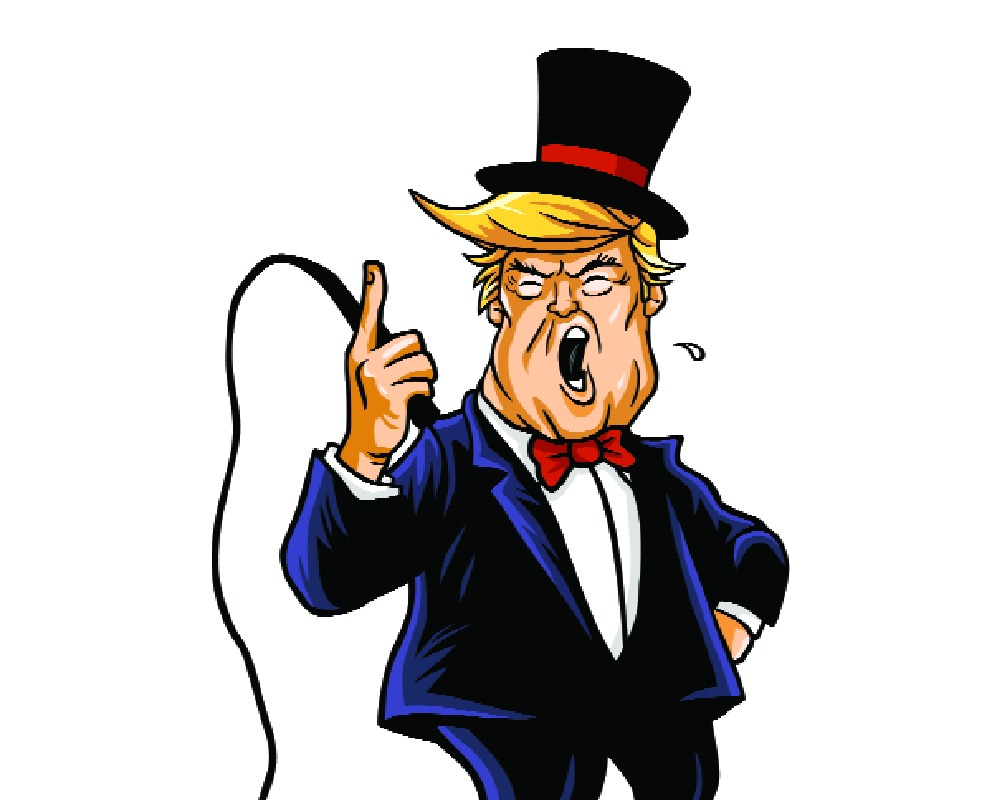
The circus in White House never ceases to entertain. The logic behind some of the major US’ decisions is so convoluted and mystifying that even if the economist John Maynard Keynes and physicist Albert Einstein had combined their brain powers, they would have failed to comprehend and decode the actions of the American President Donald Trump. There seems to be no method to his randomness and chaos. His gaze and attention shifts from one corner of the globe to another within hours and days.
Soon after he received congratulations and accolades from world leaders for the Gaza (Palestine) ceasefire, he announced that he would impose a 100 per cent punitive tariff on Chinese imports. Humourists, who mine Trump tantrums daily to extract good laughs, warned that the tariff axe would soon fall on Norway. Why? The Norway-based Nobel Peace Prize Selection Committee refused to bow down to Trump’s demand that he should receive the coveted prize. Instead, the former gave it to the Venezuelan opposition and pro-democracy leader who, ironic as it was, was supported by America. Trump unleashed his anger on China, not Norway.
This is not the first time that the US president has targeted a country to spite another. A few months ago, furious with Vladimir Putin, the Russian leader who refused to back out of the war with Ukraine, Trump ordered Europe, China, and India to stop buying Russian oil and gas. The latter refused. Trump singled out India for a punitive 50 per cent tariff on imports. China was conveniently left out because of economic and geopolitical compulsions. A trade deal was stuck with Europe, which agreed to several demands.
More than two months after the initial 25 per cent tariff, which was later hiked to 50 per cent, the impasse continues. Although Indian officials have expressed optimism that a bilateral trade deal may be inked before the end of this year, there is uncertainty. Trump’s loyalists in the administration, primarily his chief trade negotiator, Pete Navarro, and Howard Lutnick, commerce secretary, continue with their silly and ridiculous threats and allegations. Their ominous tones are reminiscent of Hollywood mafia movies.
Now, Trump, who loves to create daily headlines, has finally turned his attention to China. In his fantasy MAGA-land, the US president perhaps thinks that the Chinese leader, Xi Jinping, will cower into submission just like Japan or Europe did. Trump has threatened to “not meet him (Xi),” as if the latter is badly hankering for a meeting to sign a trade deal. Instead, China recently tightened the screws on exports of rare earth minerals, which America badly needs, and legal imports, and alleged smuggling, of American semiconductor chips.
Behind the bluff and bluster of Trump is the growing desperation of the local soybean and maize farmers. In 2024, the exports of farm products to China were valued at $13.5 billion. Soon after Trump threatened China with higher tariffs, and more sanctions, China switched gears, and ordered enormous quantities of soybean and maize from Brazilian suppliers. This left the hundreds of thousands of American farmer-exporters out in the cold.
Brazil, which is another victim of a 50 per cent tariff like India, happily obliged China. In effect, the Trump threat to impose a 100 per cent tariff on China, beginning November 1, looks more like a desperate gambit than a strong bargaining chip. What if China refuses to blink? Trump does not think so because he has seen others as powerful as China falling in line, or at least showing signs of least resistance. But if Xi does not show any signs of weakness, and counters bluster with bluster, and tariffs with curbs, where will that leave the circus at the White House, and its ringmaster?
Even erstwhile Trump supporters, who initially cheered when he announced that America will punish nations that take advantage of its so-called benign policies, are worried. The bull-in-the-China-shop antics ensures that the US economy remains on tenterhooks. As far as the ordinary middle-class American consumers and workers are concerned, the magical relief and prosperity promised by Trump remains a distant dream. Retail inflation in America is double that of India. Real wages are not going up. The promise of millions of new factory jobs looks more like fantasy, and unrealistic.
The economic uncertainties are reflected in policies, as the former may have adverse political implications. A few months ago, the president threatened Apple CEO Tim Cook with “consequences” if the company did not move iPhone production from nations like India to the US. Cook publicly agreed, cooked a hot-and-nice investment meal for Trump, and promised that his company would pump in hundreds of billions of dollars in the US. Trump was mollified.
Cook placated India that he would continue with the proposed $2 billion investment in the Indian plants. Apple continues to sell ‘Made-in-India’ phones in the US. This fiscal year, its Indian exports to the US may cross $22 billion. In the case of pharma tariffs, Trump indicated a 200 per cent on Indian drugs. This was set aside. In between, he imposed a 100 per cent tariff on imports of branded drugs. Today, there are no tariffs on either generic drugs, India’s mainstay, or patented drugs on nations with whom the US has trade deals, which excludes the main potential sufferer, Europe.
Belatedly, Trump realised that he could not afford the political costs of costly drugs in the local markets. Indian generics account for a sixth of American imports, and Europe’s branded medicines majority of the shipments. In the recent past, Trump thought that he had an exit option to escape the price push by allowing American importers to build a large inventory. But possibly the costs are formidable. New local and greenfield pharma ventures will take time. It was best to postpone the tariff decision, and look at it another time.
The fact remains that when Trump took charge for a second time, he felt that his trade-tariff-threat strategy would produce results within months, if not weeks. But three large consumers and suppliers, India, China, and Russia did not cave in. The midterm elections to the US Congress and Senate are scheduled in late 2026. If the Republicans do not win enough seats, or lose some, they will be on the back foot. As recent events indicate, the party could not force decisions in the Senate, which led to a government shutdown. Trump cannot afford a jolt by the voters next year. Maybe, this realisation may make him saner, and resort to common sense economics.
The author has worked for leading media houses, authored two books, and is now Executive Director, C Voter Foundation