










igest a few floating facts before we venture into the depths. More than four-fifths of the nations face income inequality, which covers 90 per cent of the world’s population. Wealth inequality is more serious than income inequality; in fact, income inequality fell since 2000, though largely because of China’s prosperity. When it comes to wealth, while the richest 1 per cent “captured” more than 40 per cent of the new wealth between 2000 and 2025, the bottom half had to contend with 1 per cent of the riches. What this means is that while the average wealth of the richest went up by $1.3 million, the figure for the poorest half was a mere $585. Essentially, the wealth of the poor remained the same over 25 years, despite poverty reductions.
These are some of the dramatic figures disclosed in the latest G20 report on global inequality. The committee, which prepared the report was concerned about the “global increase in incomes and wealth at the upper end of the scale, with those at the top getting an increasing share of national income and wealth, especially the very wealthiest (the top 0.01 per cent),” stated the report. It added that the top 10 per cent accounted for more than half the global incomes, and nearly three-quarters of the wealth. Some nations show an “evisceration” of middle-income groups, “which can have significant consequences for economic and political stability.” The ‘middle’ is saddled with insecure incomes, and precarious material lives.
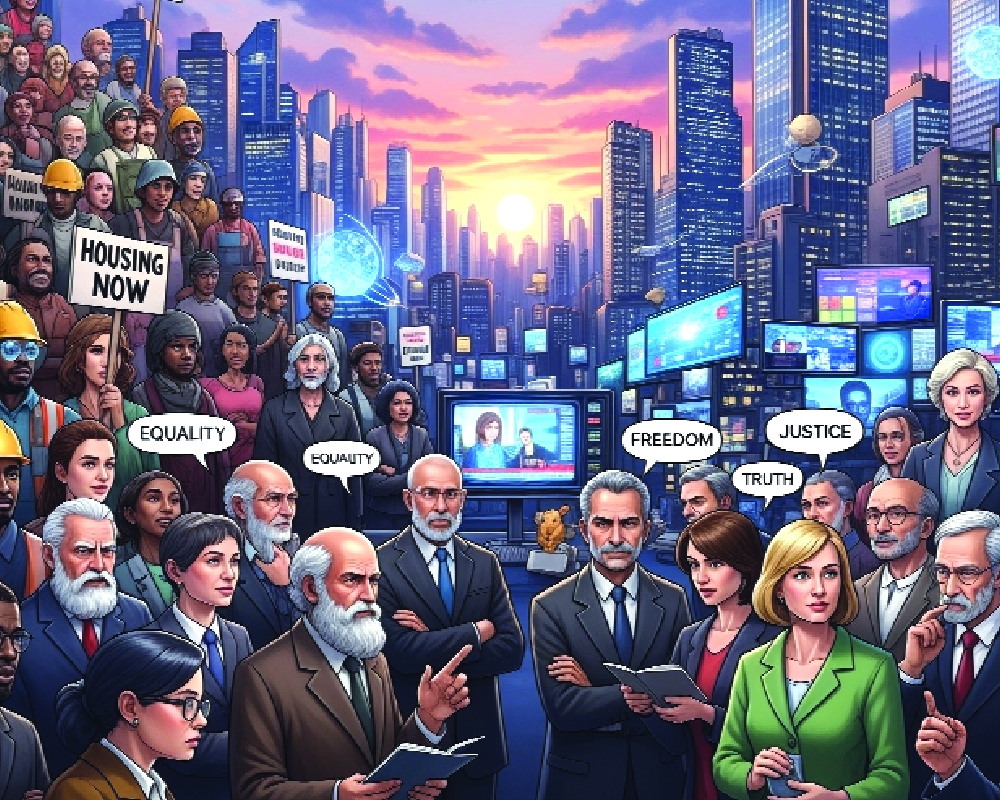
Economic inequality, stated the report, is strongly correlated with inequities in other areas such as health, education, jobs, housing, freedom, and access to justice. Within some nations, there are intersecting inequalities due to gender, class, race, and ethnicity. Location and migration generate “multiple deprivations,” and changes in multidimensional privileges and power. Of course, opportunities-related inequalities reflect in varying outcomes. There are large discrepancies between fact and perceptions. “For instance, while the United States is… described as a ‘land of opportunity,’ the evidence is that there is less mobility than in many other countries, and that the ‘American Dream’ is… a myth. Poverty traps… are part of the landscape in many… countries,” stated the report.
If one talks of India, the report found that the top 1 per cent grew their wealth by more than 60 per cent during the 25 years, which was higher than China (54 per cent), and way higher than the global average (41 per cent). If we look at the figures mentioned above, the top 1 per cent globally increased their average wealth by 2,655 times as much as the bottom half. The same, or rather higher, inequality may be embedded in India. The poor still constitute a quarter of the population, according to the World Bank’s benchmarks, and 2.5 per cent live in extreme poverty. The figures doled out by the Indian officials, and other studies, are more optimistic; some contend that the number of poor in India is 50 million or so.
Let us compare India and China with the US to get a handle on the context. “If China and India grow their per capita GDP by 2.5 times and 2.7 times faster than the US, respectively (based on their average annual growth rate over the past 10 years), China will catch up with the US per capita GDP in 24 years, and India in 54 years. Yet, for China, the absolute gap will continue to grow, and only start closing after seven years, while it takes India 28 years for the gap to stop growing, and start shrinking,” stated the end notes of the report. Clearly, the current growth rates, though impressive, are not enough. India needs to grow by leaps and bounds in the future.
According to the report, the drivers of inequality include long-term structural forces, and short-term forces (war, post-pandemic inflation, and trade disruptions). History matters as some nations took early advantage of technology before the others caught up. Policies matter, as equilibrating factors (access to education) conflict with the disequilibrating ones (monopoly power). “Much of the increase in inequality… can be attributed to the weakening of centripetal (equilibrating) forces, and strengthening of centrifugal (disequilibrating) forces,” stated the report. Of course, the absence, or dissonance, of strong public action perpetuates, and increases inequality. People with high incomes access health and education, which enables them to save more, and earn high returns on investments. These are passed on to the next generation.
Neoliberal policies, which are based on the idea that unregulated markets are the most efficient way of allocating resources, led to higher inequality. These policies helped in the expansion of financial wealth, and protected them during crises (through bailouts). Despite the fluctuations in financial wealth, the long-term trend was to increase asset values, which resulted in wealth inequality because “financial assets are very unevenly distributed.” The report added, “Both proponents and opponents of neoliberal policies generally agreed that they would increase inequality. The difference was that proponents thought it a price worth paying,” as growth would outweigh the income share of the top. This did not happen. In fact, growth “collapsed” in several developing regions that were required, or even forced, to implement the neoliberal policies.
Political drivers impact economics, incomes, and wealth. Elites ensure that economic resources are distributed unequally, as data from 136 nations suggests. Still, the links between economic and political inequality are complex and contested. Yet, the G20 committee felt that “in most jurisdictions, economic inequalities get translated into political inequalities, with inequalities in ‘voice’ related to economic inequalities influencing outcomes, particularly in matters affecting economics.” Obviously, when they have the influence, and opportunities, the rich elites push for actions that favour them. “It is estimated that at least one third of billionaire wealth is derived from crony connections to governments. Individuals and corporations lobby… for lower taxes on incomes and wealth, and other policies, and regulatory changes that benefit them. During the Covid-19 pandemic, drug corporations… sought to maximise shareholders profits by spending millions lobbying successfully against proposals to waive their monopoly rights,” stated the report.
However, the committee felt that inequality is not a given; it is manmade and can be undone. There needs to be a political and economic will to combat it. “Inequality results from policy choices that reflect ethical attitudes and morals, as well as economic trade-offs. It is not just a matter of concern for individual countries, but a global concern that should be on the international agenda, and therefore the G20,” summarised the report.



