











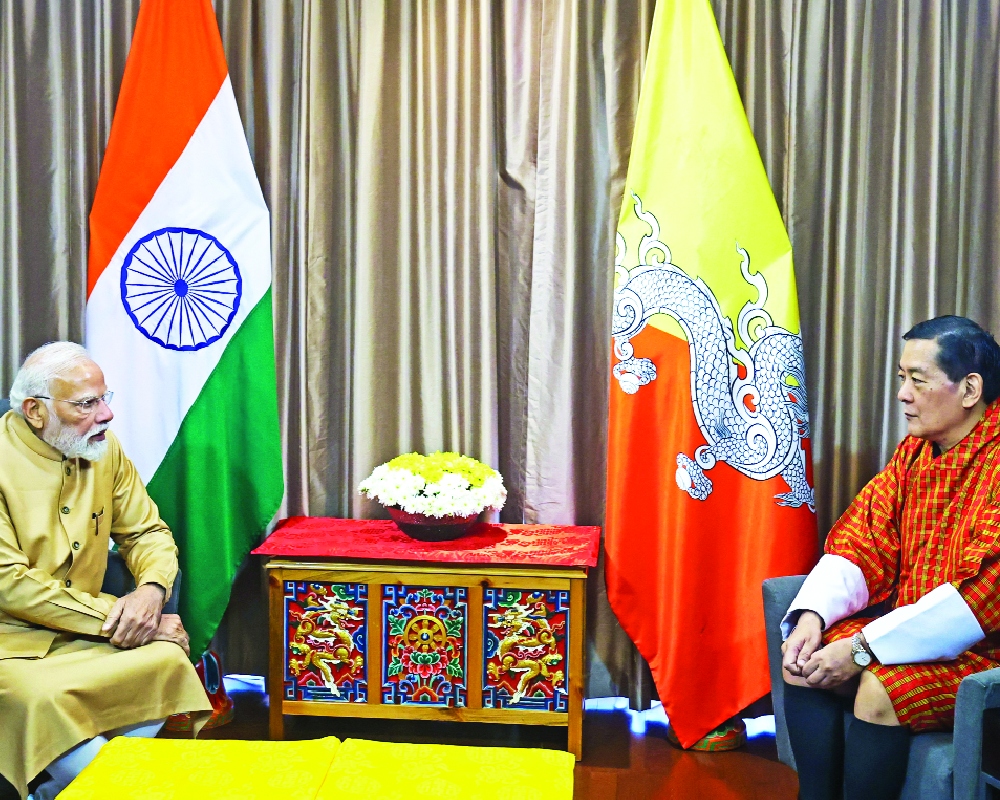
The former King of Bhutan, Jigme Singye Wangchuck — revered as K4, the Fourth Druk Gyalpo — turned 70 on November 11. In Bhutan, the Bodhisattva King, as he is fondly known, is remembered not merely as a monarch but as a visionary who transformed a secluded Himalayan kingdom into a modern, democratic, and contented nation. His reign from 1972 to 2006 marked an era of wisdom, self-reliance, and reform, blending tradition with progress in a way few leaders in history have achieved.
Prime Minister Narendra Modi’s visit to Thimphu to join the celebrations was far more than a ceremonial gesture. It was an affirmation of a relationship that has stood as a beacon of stability in a region marked by shifting loyalties and power rivalries. India and Bhutan have not simply coexisted — they have complemented each other, building a partnership rooted in trust, cultural affinity, and shared destiny.
K4 and the Modernisation of Bhutan
When K4 ascended the throne at the age of 17, Bhutan was still emerging from centuries of isolation. His father, King Jigme Dorji Wangchuck, had already launched Bhutan’s first Five-Year Plan with the support of Prime Minister Jawaharlal Nehru in 1961. The young king continued this developmental journey, deepening ties with India and strengthening institutions that would guide Bhutan into the 21st century.
As Chairman of Bhutan’s Planning Commission in 1971, K4 learned early that India’s partnership was not one of dependence but of shared growth. His 1974 decision to peg the Bhutanese Ngultrum to the Indian Rupee at a 1:1 exchange rate was a masterstroke of economic foresight, guaranteeing stability and seamless trade. He also invited India’s Border Roads Organisation (BRO) to construct and maintain Bhutan’s strategic road network under Project DANTAK, laying the foundation for economic transformation.
Today, Bhutanese firms have taken charge of their own infrastructure — an outcome K4 envisioned decades earlier.
Hydropower Diplomacy: The Energy of Friendship
Among the enduring legacies of India-Bhutan friendship is their hydropower cooperation — a pillar of mutual prosperity. The commissioning of the 336 MW Chukha project in the 1970s marked the beginning of a partnership that illuminated both nations. Subsequent ventures such as Tala, Kurichhu, and Mangdechhu deepened this bond, while the 1,020 MW Punatsangchhu-II project, to be jointly inaugurated by Prime Minister Modi and King Jigme Khesar Namgyel Wangchuck (K5), stands as a symbol of enduring collaboration.
Built on a grant-loan model, these projects have provided Bhutan with sustainable national income and India with clean energy.
As both sides look ahead, private-sector participation — from Tata Power to Adani Power — signals a new era of joint ventures extending beyond state-led models. India’s development partnership also spans infrastructure, health, education, and digital connectivity, including the Digital Drukyul initiative under Bhutan’s 13th Five-Year Plan (2024-29).
In December 2003, Bhutan demonstrated the true meaning of friendship. Militants from India’s North-East, including ULFA and NDFB, had established bases in Bhutan’s southern jungles. When diplomacy failed, K4 personally led Operation All Clear, directing the Royal Bhutan Army to eliminate the threat. Supported logistically by India, the operation was swift and decisive — marking Bhutan’s first modern military campaign and reaffirming its sovereignty. On the Indian side, security forces sealed the border to capture fleeing militants. The episode remains a textbook example of neighbourly trust and joint security.
K4’s deep understanding of India’s democratic ethos and his nuanced grasp of China’s strategic behaviour continue to shape Bhutan’s policies. Even today, his counsel guides King K5’s national security and foreign policy deliberations — especially amid evolving Bhutan-China negotiations.
Diplomacy, Democracy, and Mutual Respect
The 2007 India-Bhutan Treaty of Friendship, negotiated under K4’s guidance, redefined the partnership for a democratic era. It replaced the 1949 clause stating that Bhutan would be “guided by India” with the principle of sovereign equality and mutual respect. Since then, India has remained Bhutan’s largest trading partner and leading investor, with a duty-free transit regime through Indian ports — an arrangement unique in South Asia.
The upcoming Gelephu Mindfulness City — a visionary 2,500 sq. km zero-carbon, multi-sectoral development zone integrating spirituality, technology, and green energy — epitomises the shared aspiration for a sustainable and harmonious future.
Cultural and Spiritual Kinship
At its core, the India-Bhutan relationship is a civilisational partnership. The two nations are bound by a shared Buddhist heritage manifesting in pilgrimage, philosophy, and art. India’s loan of the Zhabdrung Ngawang Namgyal statue, the unifier of Bhutan, symbolised this timeless bond. Equally, the Transboundary Manas Conservation Area (TraMCA) linking Bhutan’s Royal Manas and India’s Manas Tiger Reserve reflects shared ecological stewardship. Bhutan’s Gross National Happiness aligns deeply with India’s Vasudhaiva Kutumbakam — the belief that the world is one family.
In Contrast to Asia’s Fractured Geopolitics
While Asia is witnessing increasing friction — from the South China Sea to the Himalayas — the India-Bhutan partnership remains a model of stability. Bhutan’s measured approach to China, guided by transparency with India, contrasts sharply with the opportunistic balancing often seen in other regional capitals.
For India, Bhutan is not merely a buffer but a trusted partner in ensuring that the Himalayas remain a zone of peace. For Bhutan, India is not a dominant neighbour but an anchor of security and an ally in development.
Navigating the China Challenge
As China tightens its grip on Tibet, Bhutan must balance sovereignty and strategic autonomy with quiet pragmatism. The first-ever Bhutanese Foreign Minister’s visit to China in 2023, coupled with China’s growing share of Bhutan’s trade and the 2021 Three-Step Roadmap for boundary resolution, underscores a cautious yet notable outreach.
Beijing’s invocation of the Five-Finger Policy — an apparent expansionist vision that views Tibet as the palm and Ladakh, Nepal, Sikkim, Bhutan, and Arunachal Pradesh as its fingers — adds to India’s unease, particularly concerning Doklam, overlooking the strategic Siliguri Corridor. For Bhutan, which maintains no formal diplomatic ties with China, this presents both opportunity and risk.
India’s continued engagement is therefore not sentimental but strategic — central to ensuring peace and stability in the eastern Himalayas. Despite occasional friction points, including insurgent activity and environmental hesitations over the BBIN Motor Vehicle Agreement, both nations continue to navigate differences with maturity and mutual respect.
A Celebration of Friendship and Faith
As Thimphu celebrates K4’s 70th birthday, it is not merely an occasion to honour a monarch — it is a celebration of a friendship that has matured through trust, sacrifice, and shared vision. Prime Minister Modi’s presence is both symbolic and substantive — a reaffirmation that India and Bhutan will continue to walk together, as equals and as family. In an increasingly fractured Asian neighbourhood, India and Bhutan stand as proof that geography need not breed rivalry - it can nurture harmony. Their partnership, built on faith rather than fear, remains South Asia’s most enduring example of Neighbourhood First in action. In the India-Bhutan story, friendship is not strategy — it is destiny.
Hemangi Sinha, Project Head, World Intellectual Foundation, and Pravin Kumar Singh, Senior Project Associate, World Intellectual Foundation; views are personal



