











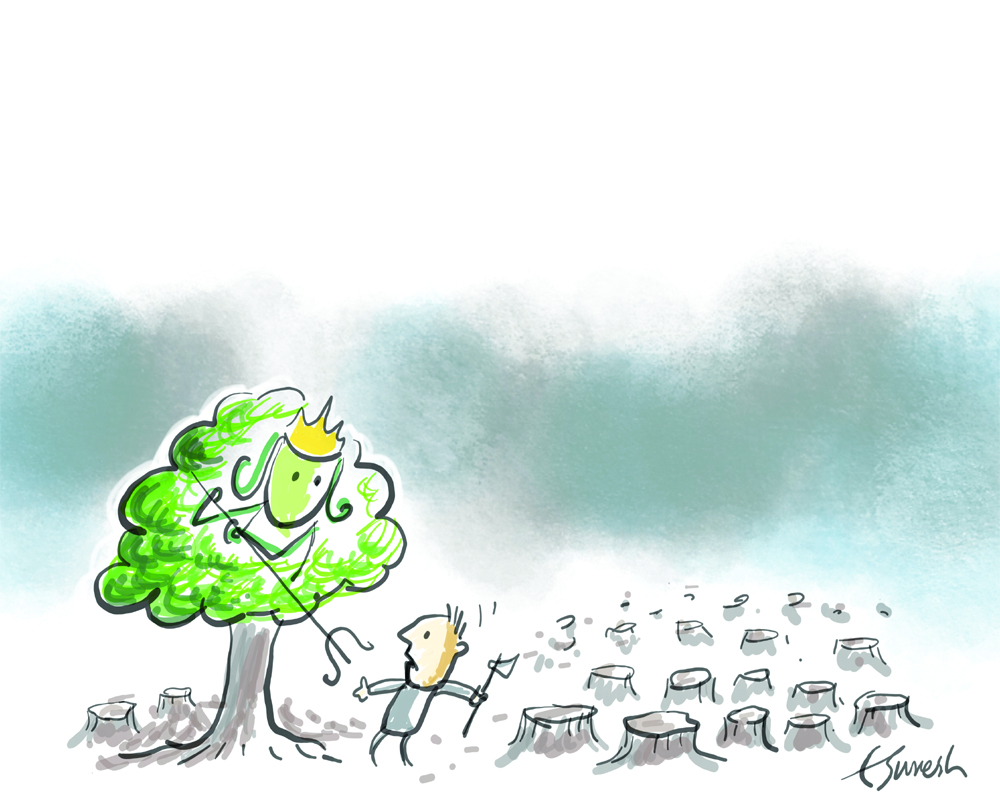
In a world where exploitation and greed mirror the demons of old, Navratri is a reminder that true worship, true sacrifice, and true restoration begin with reverence for nature — and the courage to confront the poison within ourselves
This Navratri, as the planet reels under record heatwaves, poisoned rivers, and collapsing forests, the hymn “Ya Devi Sarvabhuteshu…” takes on an urgent meaning. We are not only invoking a distant goddess. We are calling upon the very breath that keeps us alive: the rivers, the winds, the forests, the food on our plate. The Durga Saptashati’s third charitra says it without hesitation: when the demons Shumbh and Nishumbh were vanquished, rivers flowed clean, the air turned cool, and mountains and forests healed. The Goddess’s victory was the Earth’s restoration. The sages were not naïve. They saw that whenever adharma rises, an important casualty is nature. The health of rivers and the coolness of the wind are the truest measures of whether dharma or adharma rules. That is why the text ends its long battle not with the devas celebrating, but with the land itself breathing again.
After Mahishasura’s death, the devas had rejoiced, but their joy was short-lived. New demons rose, and again the gods lost their dominion. What do they do when defeated? They do not persist in arrogance. They remember the Mother. On the banks of the Ganga in the Himalaya, they bow and pray: “O Devi, you dwell as strength in all beings, as memory, as intelligence, as hunger, as satisfaction. Whatever we see, whatever we feel, it is you.”
This catalogue is deliberate. By naming hunger, memory, delusion, forgiveness, and even forgetfulness as Devi, the devas remind themselves: nothing here is outside prakriti. For us today, this is the forgotten lesson. The grain of rice, the sparrow, the soil, the monsoon, all are Devi. To forget this is to treat fragments of the world as independent, available for exploitation. To forget is to invite demons back into power.
Into this recognition comes the demon. Shumbh and Nishumbh, intoxicated with conquest, hear of a radiant woman wandering in the mountains. Their emissaries go to her with what they call a proposal. But the “proposal” is only a threat. If she will not come willingly, they will drag her by the hair. This is the heart of the rakshasa: to treat the sacred as an object of possession. No reverence, only appetite. This is no myth. We are the demons. We strip forests for contracts, divert rivers into pipelines, blast mountains for mining blocks. Shumbh and Nishumbh live wherever the earth is treated as property to be plundered rather than a mother to be revered.
The battle begins. A lesser demon is killed by the sound of Devi’s voice. Others follow: Chanda and Munda, and finally Raktabija. Raktabija is the most profound symbol. Every drop of his blood births another of his kind. Strike him, and he multiplies. Suppress him in one corner, and he rises in ten others. Is this not the story of our climate crisis? Burn one forest, and ten new wildfires break out. Melt one glacier, and whole chains of ice collapse. Release one pollutant, and it multiplies through soil, air, and ocean. Raktabija is the image of ecological feedback loops: problems that multiply when mishandled. This is why Raktabija has haunted the Indian imagination for centuries. At this moment, Kali emerges from Ambika. She does what no one else can: she drinks Raktabija’s blood before it touches the ground. By taking it in, she ends the chain of multiplication. This is not violence but the highest compassion. Usually, what is foul, we throw away. But then it festers elsewhere. True strength is not in rejection but in digesting and transforming. That is why the tradition places Kali beside Shiva, who holds the halahala in his throat. Both point to the same truth: greatness is the power to absorb poison without being poisoned.It is the highest image of restoration.
A toxin already spread in soil or water cannot be ignored; it must be neutralised. Anger or greed within, if only repressed, multiplies. It must be faced and made harmless. Kali drinking the blood is this lesson: what wounds the world can be healed only when it is fully taken in and rendered powerless.
Finally, Shumbh and Nishumbh fall. And what does the Saptashati say? Not that the devas held a festival. It says: the rivers cleared, the winds cooled, the mountains healed, the forests revived. Victory is not measured in thrones or flags. Victory is when prakriti is restored. When exploitation ends, nature returns to balance.
For our age, this is the test too. We will know the demon has fallen not when markets rise, but when the Yamuna runs clear, when North India’s skies are no longer poison, when Himalayan floods no longer wash away villages, when children can breathe without choking.
The third charitra also clarifies another confusion: the nature of bali or sacrifice. True sacrifice is not the killing of helpless animals. The Goddess never asked for that. The Saptashati shows seekers who gave up food and comfort, who reduced indulgence as their offering.The real bali is to surrender what you cling to most: your body’s indulgence, your ego’s pride. Today, that means offering our greed. Not goats on an altar, but our addiction to plastics, flights, and fossil fuels. To kill an innocent animal is cruelty; to kill your own craving is worship.
Navratri, then, is not a seasonal carnival. It is a rehearsal of truth. Shumbh and Nishumbh are not figures of the past; they are present tendencies. They live wherever there is exploitation without love. Raktabija walks wherever harm multiplies by being mishandled. To worship Devi is to recognise her everywhere: in water, in air, in the sparrow, in the grain of rice. To worship Devi is to oppose what violates her: the ritual that calls violence “sacrifice”, the appetite that calls plunder “progress”, the indulgence that calls itself love. To worship Devi is also to restore: to cleanse, to absorb, to make whole what has been wounded.
The Durga Saptashati closes with two seekers, a king and a merchant. The king asks for his lost kingdom; the merchant asks for freedom. To both, the Mother replies: “Whatever you ask, I grant. But know this — liberation comes only through knowledge.” Even Devi does not bypass this law. Bhakti, worship, sacrifice, all are meaningful only when they lead to clarity. Without right knowledge, the cycle of defeat and restoration repeats endlessly. With knowledge, the chain is broken. For our age too, this is the final lesson. The climate crisis is not of technology but of ignorance. We know how to plant trees and generate energy. What we do not know is how to restrain our greed. Without this knowledge, every solution becomes another problem, every cure another Raktabija.
Navratri is therefore not just about outer restoration. It is about inner illumination. Liberation is knowledge, and knowledge is restoration. Until man knows himself, no river will run clean, no forest will stand safe. To worship Devi is to end the demon within; only then will the earth be free.
Acharya Prashant, a philosopher and teacher of global wisdom literature, is the founder of the PrashantAdvait Foundation and a best-selling author who brings timeless wisdom to urgent modern questions



