Diplomacy through debate
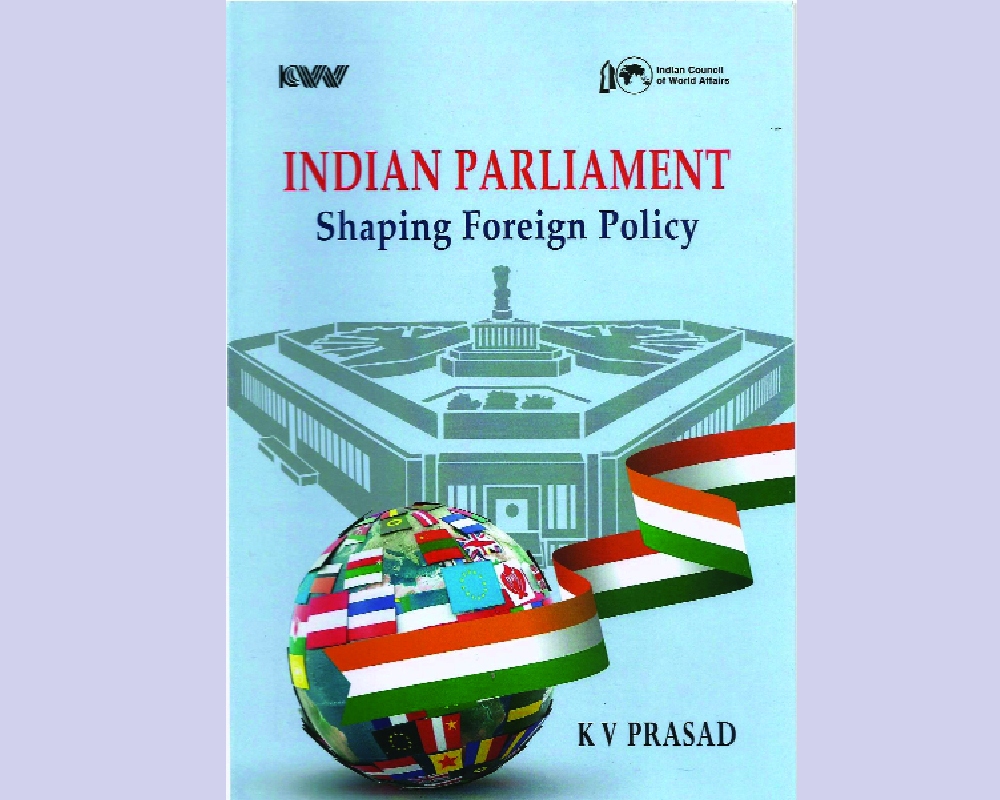
In this well-researched book, veteran journalist KV Prasad focuses on initiatives of the Indian Parliament. It is not merely a rumination on the author’s vast exposure and long journalistic journey; he painstakingly brings out how the apex legislative body played a prominent role in the framing and reinforcing of the foreign policy of the country since 1947. It offers deep insights into the vast arena of foreign policy, tracing the role of Parliament. Indeed, the book provides a rigorous account of how successive Governments and Prime Ministers navigated challenging times within Parliament. The introduction succinctly delineates the devices available to the Members and the parliamentary processes involved in shaping foreign policy and the elaborate committee set up. It provides a clear picture of what readers can expect from the book.
Written perceptively about how the executive plays a decisive role in foreign policy as provided by the Constitution, the author’s stress on the ‘minimalist’ role of Parliament is elaborated. This leitmotif is a recurring theme in the book. It demonstrates the evolution of debates and how MPs were taken into confidence by the executive, tracing the origins of foreign policy to 1921. Jawaharlal Nehru played a prominent part in steering the foreign policy and building consensus in Parliament until his death in 1964. He brought out a rather difficult debate, explained in a candid and simple way and observed: “Nehru injected a level of transparency, a much-required trait in democracy.”
The book deals with three specific debates - IPKF in Sri Lanka, the World Trade Organisation, and the India-United States Civilian Nuclear Deal. It underscores how, during 1991 and 2003, Parliament, through its unanimous resolutions during the Gulf War, asserted itself, called for a peaceful resolution to the conflict, and expressed India’s non-aligned position and refusal to join the US-led coalition against Iraq. In the backdrop of domestic politics, opposition, and the perspective of the Left parties, the book decodes parliamentary debates for the reader and explains how the Governments of the day succeeded.
The book explores how, on different occasions, the Indian Parliament played a significant role and how the Government handled opposition from states, and how states prevailed upon the Centre to safeguard their terrain. Offering a deep dive into the nuclear debate, the book tracks the evolution of nuclear policy since 1948, facing ‘nuclear apartheid’ from 1974, ‘Pokhran-II’ in 1998, and how it culminated under the UPA Government. In the chapter on Civil Nuclear Cooperation, Prasad reminisces on the role of Parliament and the debates that shook the Government of the day. He surmises aptly that the “India-US Civil Nuclear Cooperation” remains a watershed moment in the country’s quest for nuclear energy. Commenting on the debate in Parliament, the book quotes former Foreign Secretary Shyam Saran: “It was not an easy ride for the Government [as discussions in Parliament] did complicate [negotiations].”
The author breaks down some of the most complex Government-Opposition battles fought in Parliament during the coalition era effectively, with a free-flowing exposition of ideas and views, and how Governments manoeuvred foreign policy in difficult times. Prasad’s book provides an authoritative account and a ringside view of what transpired in Parliament. He brings a fresh perspective on the subject, explaining unequivocally the policy parameters and how the Government faced the pulls and pressures from the Opposition.
The content in each chapter is richly and meticulously crafted, written in a lucid manner. The author deals with the subject with scrupulous honesty and abounds with references to debates and tactics deployed by both Government and Opposition in Parliament.
A comprehensive and valuable guide to engage and educate scholars in international relations, it is a masterly exploration of the impact of Parliament on foreign policy. The big takeaway from this book is the diligent record of how, even with its limited role, the Indian Parliament reinforces itself in every conceivable way and perspective in the framing of foreign policy. Overall, the book is outstanding.